| Author |
 Replies: 24 / Views: 2,986 Replies: 24 / Views: 2,986 |
Page 2 of 2
|
|
|
|
Pillar of the Community
United States
3656 Posts |
Sorry about the MD - the one thing that you all great people taught me to look for was the oblong dots among the EPU and these still appear to be round. I bet you can get 15 bucks for it on ebay - just say it like it is and show the close-ups and because you can see the doubling people like it even if it isn't an official DDR. I see the 1969S MD Cents selling on ebay because of being a Key date and the doubling being visible. 1955 is also a key date. Though it is pretty decent so you may want to keep it for yourself |
|
Pillar of the Community
United States
3463 Posts |
The red arrows show the narrowing of the U, while the white arrows show the original size. 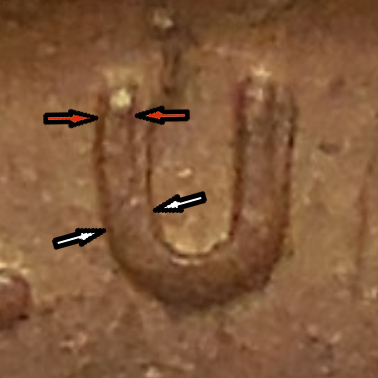 |
|
Pillar of the Community
 United States
5964 Posts |
I appreciate everyone's help here. Coop, please correct me if I'm wrong, I think your picture is showing Machine Doubling due to a worn die. My coin is Machine Doubled due to movement at the strike. Correct? I think the die shifted counter clockwise with a slight northerly tilt at the strike, leaving the east-northeast sides of the northerly devices flat and shelf-like. Wear on the coin has widened the devices and somewhat disguised the abruptness of the flat and shelf-like portions. That's my excuse for missing this one. lol Cwb, your RIBUS picture shows the die shifted in the opposite direction from my coin. It has less wear and shows the flat and shelf-like portions very clearly. Nice pic. The white arrows on your you picture show the original size plus widening due to wear on the coin. That fits right in with my excuse. CoinCents, thank you for your compassion, it is a tough loss for me, I saw that 1944 DD cent the other week and thought lightening could strike twice, but oh well- I'm getting over it. As far as the elongated dots go, they are an indicator of many DDR cents, but there's no reason a cent can't be a DDR without them. You're right about selling it, there is a market for strong Strike Doubled coins. I always label them correctly and usually make specific mention that it's not a Doubled Die. Coop, could you zoom in on that picture of liberty some? I can make out the atoms, but am having a little trouble discerning the electrons from the protons.  |
|
Pillar of the Community
United States
3463 Posts |
Mechanical Doubling is a blanket name given to many types of doubling that can happen during the strike. If there is a loose die, die movement will cause it, die bounce, ejection doubling, slide doubling and push doubling are all referred to as Mechanical Doubling. Sometimes it will affect most of the details, while other times, only some of the devices are doubled. I have a Kennedy half dollar with slide doubling that looks like the whole surface has been pushed over, pretty crazy looking under magnification.
|
|
Pillar of the Community
United States
5964 Posts |
 Cwb, and I appreciate your time. Unless I'm mistaken, worthless doubling caused by wear on the die is also considered MD. |
|
Pillar of the Community
United States
3463 Posts |
Die wear isn't considered MD, and, as I am learning, MD isn't necessarily worthless. They sell on ebay, even clearly identified as MD coins. New generation of collectors.  |
|
Bedrock of the Community
United States
62064 Posts |
The arrows are pointing to the MD on the images. The fields are showing the heavy die flow. The image is not mine, but made from several images to give the 3-D effect. But it helps show the differences between die flow (in the fields) and MD (on the devices with arrows). Ray Parkhurst is the one who made these. I use them to show differences on devices. On these two images you can see the die flow and the MD (with arrows) closer up.
|
|
Pillar of the Community
United States
5964 Posts |
Cwb, now you have truly helped me. I was under the mistaken notion that Die Deterioration Doubling, Abrasion Doubling, and various forms of wear on a die that creates worthless doubling, were all included under the heading of MD. I see them posted on here all the time, and everybody says MD. I did some checking, you're absolutely right, Die wear is not a form of MD. Thank you. Coop, as long as I'm on a learning streak, maybe you could help me out me out too. I see the MD in your pic and understand it came about by excess die movement. I always thought that die flow was from a deteriorating die. How does the die flow figure in with the MD? I see it goes in a different direction than on the fields. It just helps to identify MD? Edited by CoinMasters
04/12/2017 6:14 pm
|
|
Bedrock of the Community
United States
62064 Posts |
I often refer to die wear on the multi-hubbed dies coins. On the Single squeeze die coins I refer to them as a Die Deterioration issue. Why the difference to me? On the die wear examples the device is altered/enlarged as the die is wearing out. 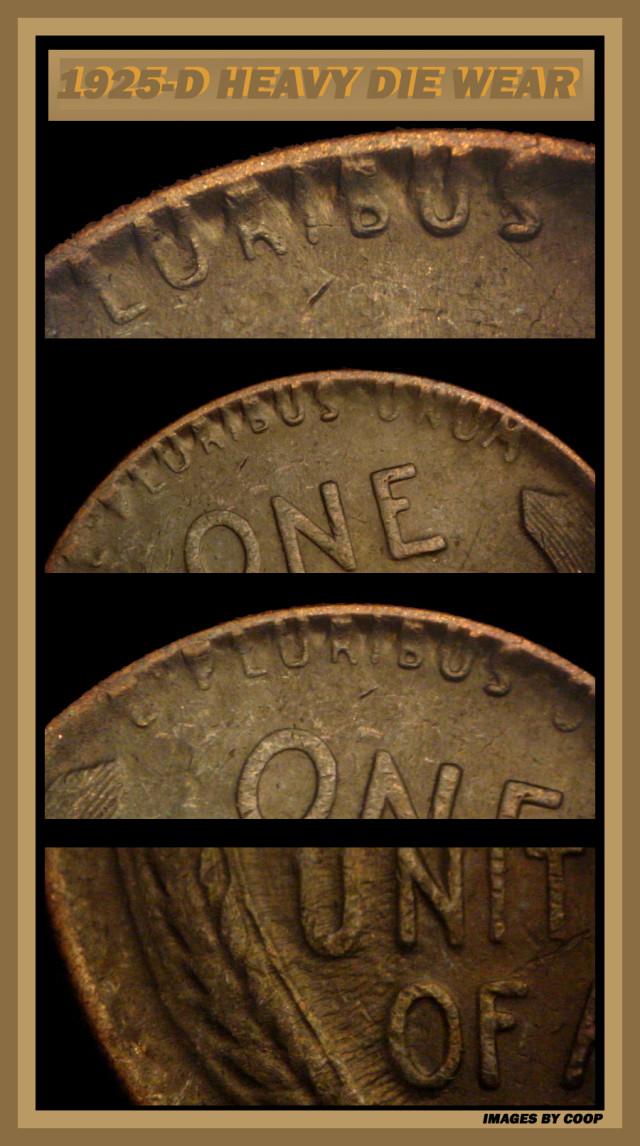 On the Die Deterioration examples, the area next to the devices on the field is show the deterioration. 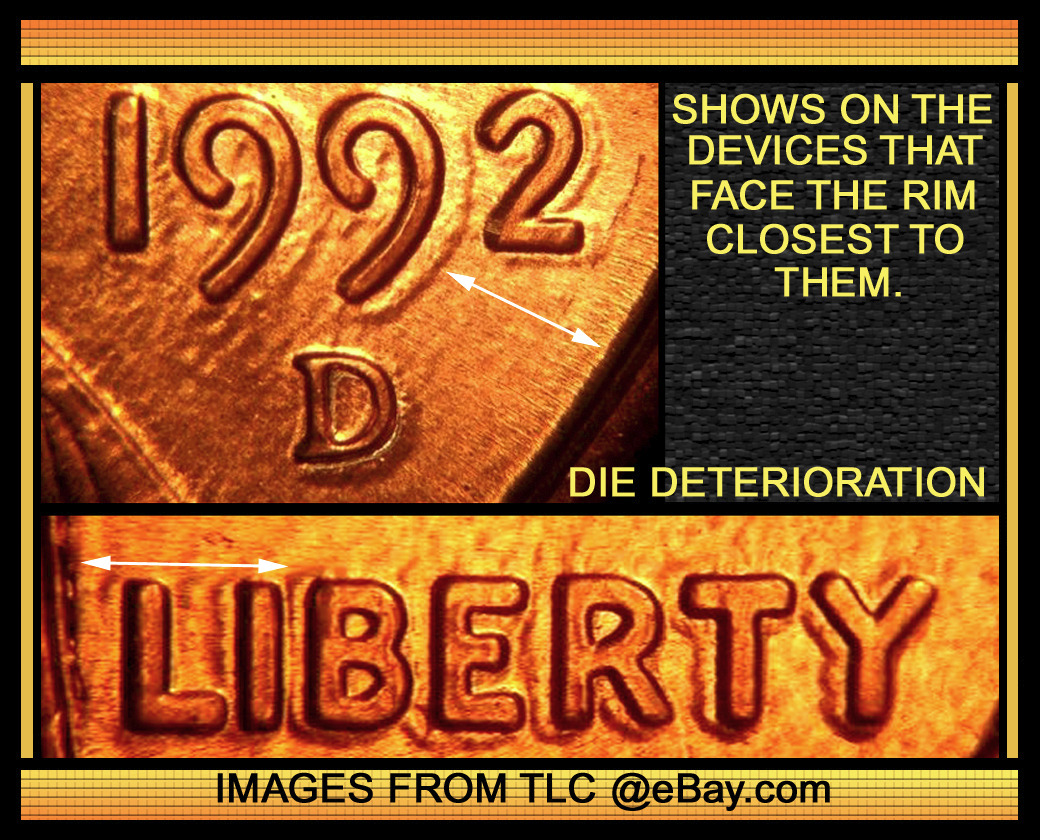 This is why I use the different terms. Each is die wear, but they appear different on the two different methods of the dies as they wear. Probably no one else recognizes this, but it is just my own opinion. |
|
Pillar of the Community
United States
5964 Posts |
Well I recognize it now Coop, thanks. Any idea why the wear appears different on the two methods? I think maybe on the multi-hub the field is more compacted and less susceptible to flow. The wear has to go somewhere and concentrates on the devices themselves.
Not to change the subject, but when I was checking what Cwb said, I noticed a lot of people think that MD does sometimes involve a second strike. I guess sometimes it does and sometimes it doesn't. I have learned three major lessons on this thread.
Thanks to all that participated.
|
|
Bedrock of the Community
United States
62064 Posts |
MD is movement after the first strike.
The multi-hubbed dies have a taller profile on the devices. The single squeeze dies have a lower profile. So I feel that differences in devices height is the reason. Also the deices are stronger/thinner on the multi-hubbed dies.
|
|
Pillar of the Community
United States
3656 Posts |
I to am happy that this thread got into such detail regarding MD and Die Deterioration. Thanks for asking all those questions CM and thanks claude and coop for explaining it in such way that I can understand it. I never really thought of why looked different between the 2 minting processes. |
|
Pillar of the Community
United States
5964 Posts |
Your welcome CC. I never really thought about it either. It's good we continue to learn. I've been on here long enough to know most of what has been said here and should have looked closer at my coin before posting it. I'm glad I did post it though, because I now know some things I didn't. The biggest thing for me personally, is that Die Wear is not MD. On reflection, I think most people probably pick that up in a month or so. It's referred to a lot on here as MD, and 98% of what I learn is from here. Well, I know it now. The next biggest thing I've learned is the difference between Die Wear and Die Deterioration Doubling and why they are different. I collaterally learned the difference of Die Abrasion Doubling as well. Vertical striation lines can help in identifying Machine Doubling as evidenced in Coop's Atomic Pic. I have also learned that MD is thought to sometimes bounce off of the coin completely thus creating a "second strike". This is not always the case however, and cannot be confirmed on a coin by coin basis. In either case, it is considered to occur during the strike. I base this conclusion on comments like " Mechanical Doubling is a blanket name given to many types of doubling that can happen during the strike." as contained in this thread. Another comment from Mr. Mike Diamond supports the idea it doesn't always lift completely off the coin, can be found in the following link. http://goccf.com/t/278297Mr. Diamond is the man the experts ask when they're in doubt. That's a good reason for my position on the matter, a better reason is what he said is very logical. While I do concede the die sometimes separates during the bounce, it is not always the case. Since it can't always be determined, yet one strike is a known, Strike Doubling is considered to occur during the strike and appropriately classified as a mint error. If it was considered to be after the strike, it would be classified as damage. I strongly dislike having to come back to this, but I feel impressionable Newbies should be able to hear both sides. |
|
Pillar of the Community
United States
3656 Posts |
Good summation. I thought with Strike Doubling that there is a definite rotation with it whether it be n,s,e w. plus the devices would show the full width/height of the device. |
|
Pillar of the Community
United States
5964 Posts |
Yes always a rotation, but the flattened portion not as high The width varies with the rotation.
|
|
Page 2 of 2
|
Replies: 24 / Views: 2,986 |
Page 2 of 2
|







 First Page


 Posted 04/11/2017 11:25 pm





