| Author |
 Replies: 21 / Views: 2,615 Replies: 21 / Views: 2,615 |
Page 2 of 2
|
|
|
|
New Member
 United States
43 Posts |
Spence Thank you as well, have a good day! Albert That's awesome that you collect and catalog counterfeits/forgeries. The seller for this coin had it listed as if it were genuine, had "silver crown sized coin" in the title. I was 90% certain it was some kind of forgery, but sometimes silver and the way people takes photos can mess with the coloring, so I wouldn't have been upset if it turned out to be genuine. I have two genuine Louis XV Ecu's, and those things have some authority when held in hand. On another note, I found another forum discussing brass Ecu's and there was a photo of a 1776 Brass Ecu of Louis XV (Yes, he was dead by then, idk why his portrait is on this coin) sold listing. That is so far, the only similar thing I've found. 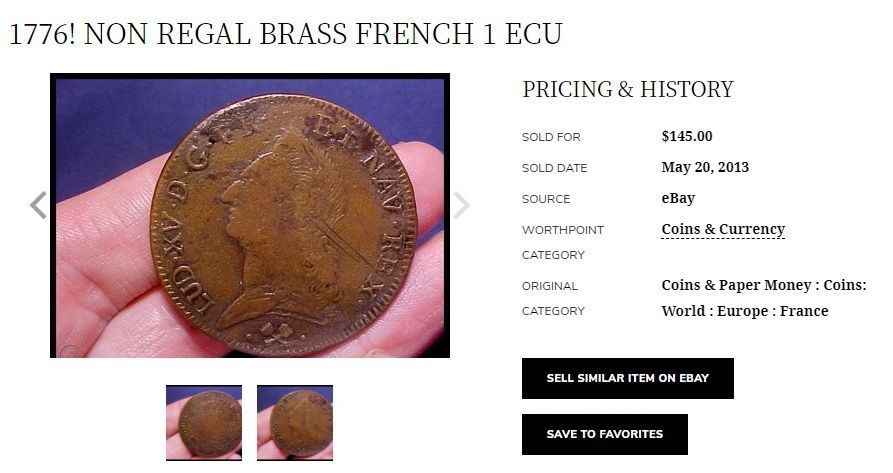
|
|
Pillar of the Community
United States
1917 Posts |
After this topic came up, I did go to three favored online coin sellers looking for a non-genuine 1726 ECU to see if I could buy a coin in order to add comparison data to my book pages. Like I mentioned, the 1726 ECU that should have been fake turned out to be genuine. I normally buy one fake and one genuine to have A-B comparison data for the book. It just worked out that the two 1726 ECUs I have are both genuine. So I lack a fake for the book.
|
|
Pillar of the Community
United States
1776 Posts |
I discuss and illustrate these in my World Counterfeit chapter in Forgotten Coins. Refer to ebay for the CD or Amazon for the softbound book. On some counterfeits we see cancellation (defacement) marks, alloy check marks such as seen on the reverse. The earlier 18thC ECUs are more scarce than the later types in the 18thC. Forget the 19thC too common and worthless to collect IMO. Some still show a traces of mercuric silvering particularly within the protective motif devices. Interestingly the French used brass hosts to silver whereas the British use copper. Silvering brass was more common with French Plate than copper so this carried over to the counterfeit of their coinage using brass hosts. John Lorenzo, Numismatist, United States |
|
New Member
United States
43 Posts |
Wow, very knowledgeable as ever! I had many theories as to what was up with the marks on the reverse. Awesome to know I have an early piece, I wonder what the earliest example of a brass Ecu dates from? If these were intended to be silver plated, as far as I know silver plating has been around since the 18th century. Interestingly enough, I can't find any traces of past silver plating on this coin.
|
|
Pillar of the Community
United States
1917 Posts |
With proper lighting and a good microscope, you might find traces of silvering. In this picture the remaining silvering is easy to see as indicated between the letters. 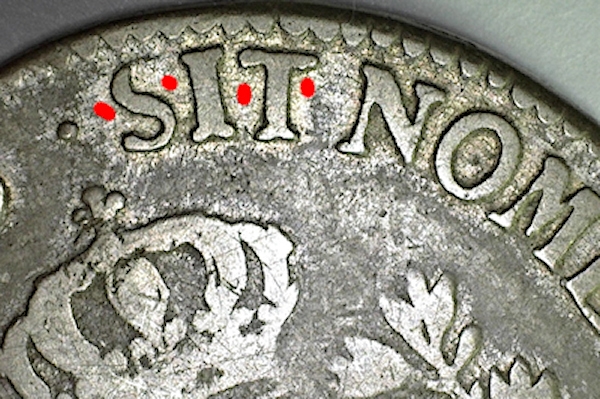 |
|
New Member
United States
43 Posts |
I did take a jewelers loop with 5X magnification and a light to the coin and still cannot locate anywhere with signs of silvering. There is a halo around the characters, but it just looks like the brass patina. Might I ask if that's your coin? It's a nice example and has clearer dentils intact than mine.
|
|
Pillar of the Community
United States
1917 Posts |
Yes this is my 1783 Q coin that is not genuine. Little point to illustrate the pair of 1726 coins since both are genuine. The image is taken from one of the book pages to illustrate how the silvering gets trapped between the devices before it is too worn away. There are available USB computer microscopes with a polarizer and software to aid in Counterfeit Detection. Color temperature of the source lighting is important. Perhaps not widespread, but that is my hobby so I have a variety of tools on hand for photography, tests & measurements. Edited by Albert
02/12/2022 7:17 pm
|
|
Pillar of the Community
United States
1776 Posts |
Excellent illustration of trapped mercuric silvering within the devices. It also takes some time with World CCCs to properly distinguish between Sheffield Silver plating and mercuric silver wash as on this example. As Gurney discusses in this CCC8R book and as seen in ancient/medieval metallurgical studies Sheffield plating is really a 19thC counterfeiting process and mercuric silvering was done from ancient times to the 18thC - in general. HOWEVER - We do see foil silver plating and earlier crude forms of silver plating say from the 1600's particularly in early British silver pieces from Charles I onward as illustrated in my book on World CCCs - FORGOTTEN COINS. Sheffield Plating or the so-called Birmingham counterfeit 8Rs in Gurney is actually a THREE LAYER counterfeit with a thin eutectic CENTRAL layer. Although we never had of course any written records to this activity since its counterfeiting and therefore no records anywhere this is why we incorrectly call them Birmingham counterfeits but undoubtedly from a sophisticated manufacturing CCC house. If not in Birmingham then where? So therefore the undocumented tag <BG>. John Lorenzo, Numismatist, United States
|
|
New Member
United States
43 Posts |
Simply brilliant, when I think silvering or plating my mind immediately goes to the Sheffield process that is more recent. Looking at my coin, I can't find any traces of silvering, so I hypothesize it might have been one of the crude methods you mentioned. Or it was never silvered in the first place, but that does not make much sense to me.
Albert Does your coin have any edge lettering intact? Mine is completely bald on the edge.
|
|
Pillar of the Community
United States
1776 Posts |
Actually silvering is present on your pieces its those darkened areas in/around the motifs. Mercuric silvering as in your piece sometimes is worn away but normally a high end benchtop model can pickup Hg levels down to 0.1%. Mercuric silvering depending on the circumstances can darken as it has on your piece. Its difficult to detect Hg even with a $20K Oxford hand held XRF analyzer. Mercury becomes inert in these situations on the surface based on the mercuric compounds it forms- also no problem handling these without cotton gloves. JPL.
|
|
New Member
United States
43 Posts |
Oh I thought that was just the brass. I was comparing it too exactly to Albert's example I reckon, his still looks silver under a microscope and is a nice example.
|
|
Pillar of the Community
United States
1917 Posts |
The 1783Q that is shown has no edge lettering. You can see the remnants of silvering in certain places. 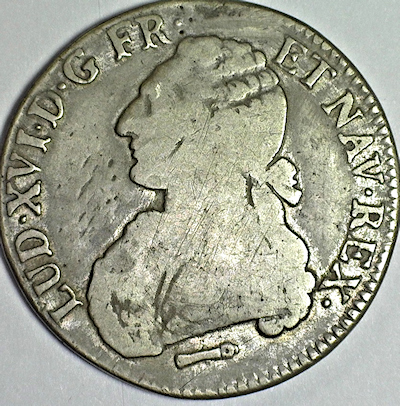 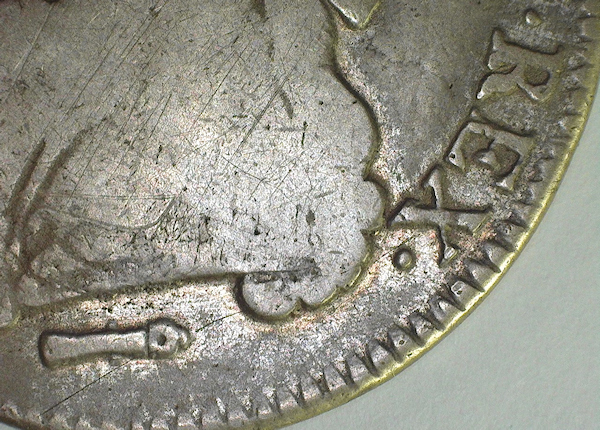 Edited by Albert
02/13/2022 7:42 pm
|
|
New Member
United States
43 Posts |
Awesome coin, thanks for the photos!
|
|
Pillar of the Community
United States
1776 Posts |
L. Beck on her paper on - Counterfeit coinage of the Holy Roman Empire in the 16th Century: silvering process and archaeo-metallurgical replications discusses the mercuric silvering layer being actually THREE distinct layers. An inner copper core/the MIDDLE mercuric silver layer and the outer copper core. Sometimes with copper reacting with sulfides or chlorides can produce this darken effect I discussed with this coin - not ALL mercuric silvering is silver looking as in the other example. See her discussion where the majority of the coins silvered with mercury were struck in Palatinate whereas those with pure silver come from the city of St. Gallenin Switzerland. The mercuric silvering process in general is universal in its technique.
The examination of the coins has shown two main types of silver plating which can be distinguished by the presence or absence of mercury. In case of mercury detection, microanalysis on cross-section clearly shows the
presence of silver and mercury in the same layer (Fig.
1a). This plating layer is between two copper-rich phases, the inner layer is the corroded copper core of the coin and the external layer is composed of copper corrosion products. The presence of silver and mercury in the same layer is non-destructively confirmed by RBS(Fig. 1b). The typical thickness of this plating layer is between 5 and 10 µm.
When mercury is absent, the silvered layer is very thin(1 - 2 µm) and generally less preserved (Fig. 2).
Mercury silvering
The silver and mercury contents of the amalgam silvered
coins were measured on the surface of the coins, and on the cross sections for two coin fragments (numbers
15-15 and 16-5). The results are presented in Table 1.Except for the coin from the city of Strasbourg, the mercury content of the plating is between 25 and 51 %. For
each coin, the result is a mean of at least 7 surface analyses and the dispersion of the data is due to the
heterogeneity of the alloy. On the cross-section of the fragments, we have observed that the plating has less
mercury on the surface than in the middle of the layer
(Fig. 3) (coin number 15-15: 28 % Hg at the surface -between 45 % and 55 % in the center and coin number16-5 (41 % Hg at the surface - between 50 % and 60 % in the center). This difference is probably due to the preferential evaporation of mercury at the surface of the
coin. All the coins, with exception of the Strasbourg coin and number 21-36, have a core in copper with some
impurities in lead, tin, antimony and arsenic.
|
|
Pillar of the Community
United States
1776 Posts |
BTW - next time you submit an early Honduras Provisional coin to NGC and it comes back as VF yet has full silvering which is actually a mercuric silvered copper host (JPL XRF -verified) you then have to ask yourself this question with NGC and its grading capability on early Central American Provisional capabilities - "How can a coin with a mercuric silver layer on average measuring 5-10 microns in thickness at the surface have full silvering and NOT be AU or even 50% silvered and be given XF. Shhhhh .... I am still building my Central American collection ... I do not mind buying AU or UNC coins at VF prices. LOL Also the Honduras real pieces have high lead so with all the lead/copper occlusions (i.e., lead has a very low solubility in copper) seen on the surface it can come back as environmental damage and VF!!
I love it .... since I am buying these JEWELS already slabbed. HA! HA! HA!
Edited by colonialjohn
02/21/2022 1:39 pm
|
|
Page 2 of 2
|
Replies: 21 / Views: 2,615 |
Page 2 of 2
|





 First Page

 Posted 02/11/2022 7:54 pm


