| Author |
 Replies: 19 / Views: 1,738 Replies: 19 / Views: 1,738 |
Page 2 of 2
|
|
|
|
Moderator
 United States
197600 Posts |
Quote:Note to Moderator: I'm not putting this in Varieties and Errors because it might be PMD. If it is some kind of mint error feel free to move. Thanks! I moved this to the V/E sub-forum. Even when things are not errors, the discussion serves to educate people. Examples on non-errors and why they not errors are just aw important as verified errors.  |
|
Pillar of the Community
 United States
790 Posts |
Quote:
I moved this to the V/E sub-forum. Even when things are not errors, the discussion serves to educate people. Examples on non-errors and why they not errors are just aw important as verified errors. Cool! Thanks! |
|
Pillar of the Community
United States
790 Posts |
|
|
Pillar of the Community
United States
790 Posts |
By the way, I did try a 20 minute acetone bath, and a gentle swipe with a Q-tip to see if anything came off—nope.
|
|
Pillar of the Community
United States
790 Posts |
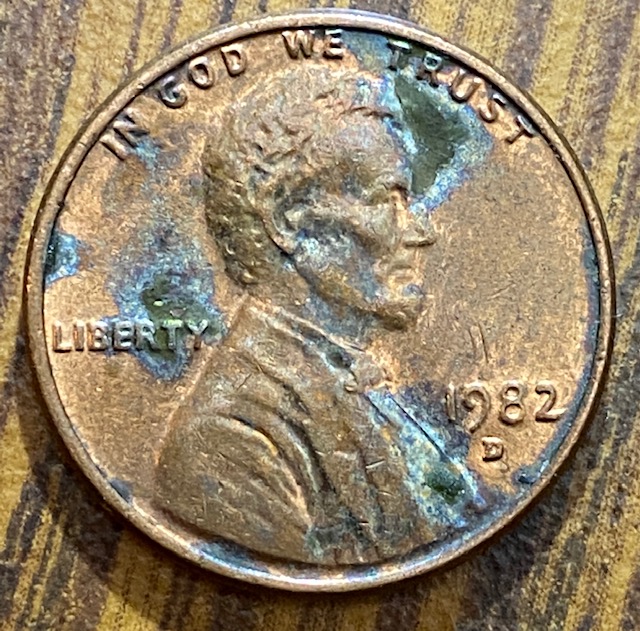
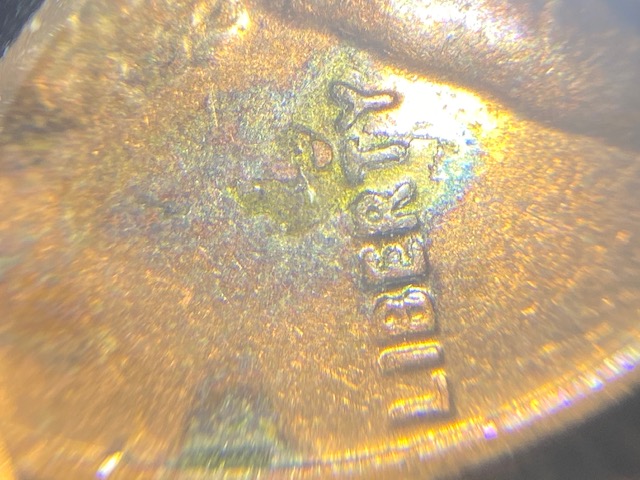
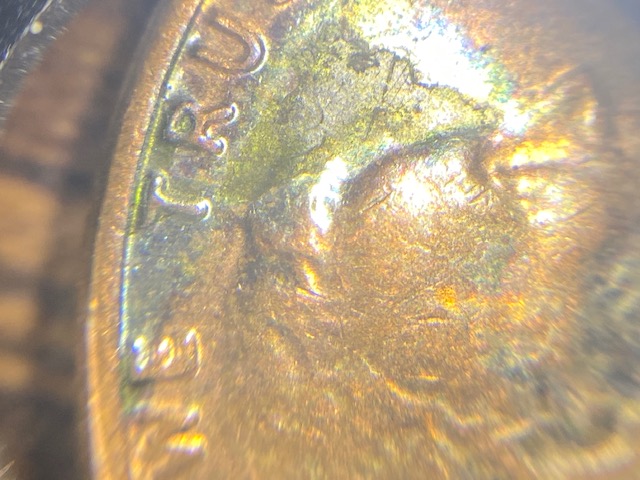
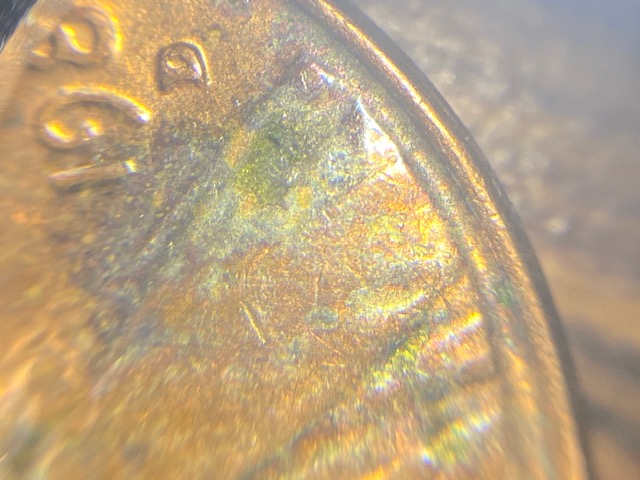
What's weird is that in this photo it almost looks like some kinda green gunk has attached to the surface of the coin—like it's raised—but under the microscope, it looks just the opposite, like the surface got scraped off and whatever is under it has some kind of rot.
Edited by twslisa
11/21/2022 7:56 pm
|
|
Pillar of the Community
Canada
6244 Posts |
What you has it is Zink oxide which past the Cu plating and with the Cu form what is say CuZn oxide which is green. Nothing can clean this. Are methods to slow down the process but will not clean. This chemical oxide reaction it is destructive for the coin.
|
|
Moderator
Australia
17024 Posts |
The 1982 doesn't have zinc rot, because it's not zinc; that coin's solid bronze according to the reported weight. However, it does have corrosion spots. Basically, the coin got placed somewhere in the open, some noxious goo splatted onto it, and it stayed there untouched for years.
Don't say "infinitely" when you mean "very"; otherwise, you'll have no word left when you want to talk about something really infinite. - C. S. Lewis
|
|
Pillar of the Community
Canada
6244 Posts |
@SAP: the zinc plated cents start in 1982. Before was not bronze from 1946 end of August when was change from Bronze to Brass. Sorry, if you need the docs, PM me and pleasure to send to a big resource person,
For 1946 I find with what I have and XRF 1 in 12 been Brass in 250 coins
Edited by silviosi
11/22/2022 12:05 am
|
|
Pillar of the Community
United States
790 Posts |
Silviosi, based on the weight on the 1982D (3.1 grams) it should be mostly copper, shouldn't it? The 1984D has what looks like the same thing (to a lesser extent), and weighs 2.5 grams.
Even without the yuck, neither of these coins would be particularly valuable unless there was some sort of variation, so I wasn't really trying to save them, just wondered why two coins of different dates and compositions had the same "disease," and wondered if it could be identified. The acetone bath was just to see if any of it came off.
Anyway, even if the '82 is mostly copper, it still has SOME zinc, so could still be zinc rot, right?
|
|
Pillar of the Community
Canada
6244 Posts |
The answer it is YES. The '84 we ignore for the moment. We will discuss the 1982. If it is 3.1 gr , yes same oxides could be developed in the environments. It is show that in dry and very humid changed was develop. I have no idea where you are located, but in some parts where for example: Winter is dry and summer humid or vice versa, the oxide will develop. The only way to stop in those environments is mineral oil treatment and then vacuum. Do it is worth to do this for your coins? You decide.
Once the Cu Zn start is really hard and very costly to stop.
This it is my answer.
PS. In your first post you do not say it is 3.1 gr which it is an 1982 brass coin and not bronze.
|
|
Pillar of the Community
United States
790 Posts |
Quote:
In your first post you do not say it is 3.1 gr which it is an 1982 brass coin and not bronze. Yes, sorry. I didn't give that info until later in the thread. Thanks for the info! |
|
Bedrock of the Community
United States
62064 Posts |
Large date copper are common to find. Looking that bad, reminds me of my younger years. I didn't always look this bad. (Coins experience that also)
|
|
Pillar of the Community
United States
790 Posts |
LOL. Unfortunately I've seen better days myself. Thankfully I don't have zinc rot!
|
|
Pillar of the Community
United States
790 Posts |
It just occurred to me that we set aside the 1984D because it has different composition. Would I be correct in assuming it's still zinc rot for that one as well?
Also, is zinc rot "contagious?"
|
|
Pillar of the Community
United States
7174 Posts |
|
|
Page 2 of 2
|
Replies: 19 / Views: 1,738 |
Page 2 of 2
|





 First Page


 Posted 11/21/2022 6:20 pm