| Author |
 Replies: 17 / Views: 2,921 Replies: 17 / Views: 2,921 |
Page 2 of 2
|
|
|
|
Pillar of the Community
United States
3098 Posts |
I think those count as bag and contact marks than actual scratches.
|
|
Pillar of the Community
United States
2189 Posts |
Looks like two different types of scratches,Contact marks from other coins and straight line's which I don't have a clue of there cause.I'm sure somebody will jump in & help
|
|
Valued Member
 United States
371 Posts |
Errors after 2002 or so that come out of the U.S. Mint are rare. They catch errors better than before, so I am not sure how they could have missed a blank planchet!
|
|
Pillar of the Community
United States
4541 Posts |
well blank planchets are not rare so to speak. Off struck or center coins are rare b.c the mint sends the coins to wrapping companies instead of sending the banks bags. I think thats why you will see a blank planchet faster than you will and off struck coin
|
|
Valued Member
United States
371 Posts |
That is true. But all errors for more current dates are becoming even more rare than before. Obviously clipped or double struck planchets can be caught easier than a blank planchet.
|
|
Bedrock of the Community
United States
12437 Posts |
The straight lines are from the treatment of the original metal stock, they are usually obscured by a strike but the can sometimes be seen post-strike. Errors from the Mint have become rarer due to the riddlers currently in use, they separate out odd-sized coins and scrap. Blank planchets continue to be considered quite common since they are essentially the proper size of a Lincoln cent(not getting sorted out by riddlers) and they are dateless so a 2009 planchet is the same as a 1999 planchet. The only blank planchet that I can think of that has been certified to a specific year is the first year of the Sacagawea since that was a completely new material. Of course, any planchet would had to have been certified in 2000 because once 2001 rolls around, you cannot tell the difference between 2000 and 2001  |
|
Valued Member
United States
371 Posts |
There are some errors, even from the 19th century, there are some errors that could have been caught easily, like the infamous "Broken CC."
Edited by SilverTurtle
08/12/2009 08:04 am
|
|
Pillar of the Community
United States
5700 Posts |
Silver turtle, Welcome to the family!!
Just a thought, from what I can see, the gouges, or deep scratches on this "planchet" IMO, would show the zinc underneath the copper plating, being the plating is I believe 3-thousands of an inch thick.
Any chance of some closer pictures of those deep scratches,sides included Thanks Mike..
|
|
Valued Member
United States
371 Posts |
Thank you Morgans Dad.
I could probaly get some pictures with a scanner and/or my camera soon.
|
|
Bedrock of the Community
United States
62064 Posts |
Rolling marks. 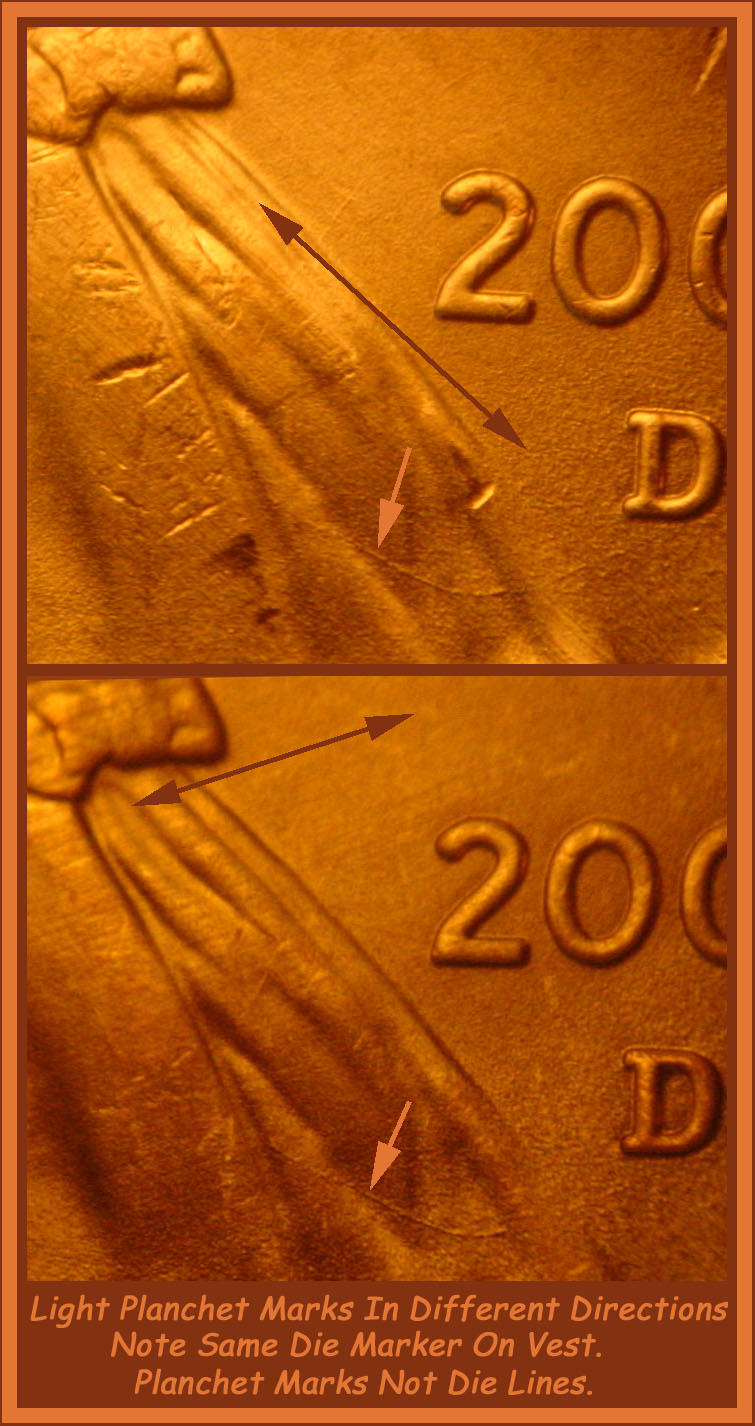 |
|
Valued Member
United States
371 Posts |
I got the planchet appraised this summer at a PCGS Approved Dealer. The planchet was appraised at $5.
|
|
Pillar of the Community
United States
5700 Posts |
Coop, I see the "die marker" on the vest, in the relief area, and also in the field area. Would you please explain to me why this is not a die scratch or small break, being it appears on the relief area and the field.
I would think this is a classic example of a die polishing mark or a small scratch, or a small die break/crack......
|
|
Valued Member
United States
371 Posts |
I'll get more pics of the blank planchet soon: I'll get both sides and a side view.
|
|
Bedrock of the Community
United States
17884 Posts |
The straight lines are caused by the rolling out of the zinc ingots into the strip from which the blanks are punched. They are a result of the stretching of the metal and the surface condition of the rollers. New rollers create smoother surface strip. As the rollers wear the lines become more prominent.
|
|
Bedrock of the Community
United States
62064 Posts |
The die scratch is just a marker to show that both coins came from the same die. The rolling lines are in different directions thus indicating that they are on the planchet and not the die.
|
|
Page 2 of 2
|
Replies: 17 / Views: 2,921 |
Page 2 of 2
|




 First Page


 Posted 08/11/2009 6:33 pm





