| Author |
 Replies: 22 / Views: 4,352 Replies: 22 / Views: 4,352 |
Page 2 of 2
|
|
|
|
Pillar of the Community
United States
7629 Posts |
While there are a couple of examples where the accepted terms do not fit perfectly, I think the same would be the case in any scientific field. Yes, coin collecting to this level is a scientific (forensic) breakdown of what happened at the mint to create what we collect. It's not just result oriented, you have to know how they were made to completely understand them.
While I can see where Danester is coming from with his terminology, I also completely agree with Scooby in the sense that we can't just call it what we want because that's how we want to do things. There are dictionaries and glossaries for a reason - so we share the same language and can be understood.
So Danester classifies ANY design change as a type, then qualifies how much the design changed with an adjective. I guess I can see that, but it has holes all in it. What about mintmark size changes? Are those types too? They aren't die varieties because they are not anomolous and are not collected by individual die. So with this, we would STILL have to have varieties and "minor types"...confusing.
What about the accidental use of proof design hubs on business strike working dies? Those are not intended "minor types", they are mistakes. They were not supposed to be. I personally think they fall under errors more than anything else because using two unintended designs together is a mule - a type of error.
Yeah - a consortium of experts to come together and hammer this out would be the best thing, but I can tell you that likely will not happen, for a number of reasons that I will not get into here. Best we just use the terms as established a while back because they really do take the minting process into account, and they do have their reasons for being what they are, and those reasons have not changed.
What has changed is the vast number of collectors today who want instant gratification in having something they don't understand and don't want to understand...they just care about money and the value of said items. Education is not important to them - valuable coins they can sell are the only important thing. I am not AT ALL pointing this at Danester - quite the contrary, he is a very experienced collector. But I can say the less-education/more-money angle of collecting has definitely lent itself to the lack of general understanding in our minting process and why these terms are what they are.
|
|
Valued Member
 United States
213 Posts |
On CopperCoins.com we just had a similar disscussion on numismatic terms. There was a 2004-D Lincoln Cent that we possibly thought had a Die Dent, but turned out to be a trapped gas bubble under the copper plating - see a similar thread here on CoinCommunity. https://goccf.com/t/85920I used the term "Die Variety" to discribe the coin if it had indeed been a Die Dent. Chuck then responded that a Die Dent was not a Die Variety under current accepted terms. Below is my response. ----------------------------------------------------------- Chuck, that's an interesting observation. If this coin had a Die Dent... then it is specific to an individual die - just as a Die Variety. But if you exclude it from the definition of a Die Variety then it must be in with Cuds, Clashes, and Abraded Dies under Errors (see at bottom). But Die Dents, Chips, or Gouges are not mentioned in the definition (maybe as etc.). And then we have the new book -- The Abraded Die Varieties ( Buffalo nickels) by Ron Pope. Where Abraded Dies are called Die Varieties not Errors, and not considered as Errors by Buffalo nickel collectors, but Die Varieties. Perhaps Cuds, Clashes, Abrasions, and Die Dents (Chips and Gouges) should be classified as a Sub Die Variety - i.e. Production Die Variety. Because, they are all specific to an individual die, where an Error is not. Sorry, I can't help myself - it goes back to my days as a Soil and Foundation Engineer, where we had to define and use terms to classify "dirt". Error - Subdivided into three classes - Planchet, Die, and Strike. Planchet errors are errors that occurred with the planchets before they entered the coining process. Laminations, although very common, fall under this group. Die errors are problems that occur with the die while it is striking coins. Cuds fall into this group, as do major clashes, overpolishing, etc. They are generally repeated ONLY after they occur. Coins struck BEFORE the die error are normal. Striking errors comprise the vast majority of errors, and happen as the result of the strike. The planchet and die could have been completely normal, but because of a problem at the moment the coin was struck you end up with an error. Double struck, saddle struck, broadstruck, etc. The Danester |
|
Pillar of the Community
United States
601 Posts |
Hey Danester- would you PM me? I wanted to ask you a question having nothing to do with threads, you don't have an email link.
Thank you Sir, -CW.
|
|
Pillar of the Community
United States
3507 Posts |
Hi, Those of us who have been in the Error/Die Variety field for awhile understand the use of the word VARIETY. It is also the word used in the " RedBook" for things like Small date and Large date varieties. There is not much point in creating a new word for a definition that has been understood for at least 40 years. As Coppercoins said, you have the right to call it what you want but there is no point in trying to change a well established term just to make it new. Besides, it makes it more confusing...Type, SUB-Type, Minor-Type.... You think it's confusing now, try using TYPE in three different forms in three different definitions. Thanks, Bill |
|
Pillar of the Community
United States
3507 Posts |
One more point is that some authors who do not understand the terminology will categorize things like abraded dies outside of the accepted usage as a term is used by die variety and error specialists. They too are trying to make a mark on numismatics by doing something different.
To call an abraded die a die variety is not correct. It's as simple as that.
A lot of the terminology problems go way back to a guy named Frank Spadone. He wrote a book filled with coins that exhibited minor die chips, for example that he loved to call die varieties.
A lot of people are still hanging on to old, useless , improper terminology because of that book.
Bill
|
|
Valued Member
United States
213 Posts |
OK, I turned on my e-mail address in my profile - I didn't realize it was off. I want to give some final words on my modifications of accepted Numismatic terms. But, first I want to point out that when I communicate with others, I do try to use the accepted terms -- and that's generally outside of the Buffalo nickel collecting community, because of our many Abraded Die Varieties. In any scientific study, and Numismatics is, alike things are grouped. In our study, the first group is Type (Type, Sub-Type, and Minor-Type) -- these are design changes made by the Mint that are either planned or inadvertent (large mintmark or WAM etc.). And, the key word here is ‘'Design". Then following in accepted order we have the Die Variety Group (Die Variety, Production Die Variety). The definition is very simple - any flaw or accident made to a specific die (including Cuds, Clashes, Abrasions, and Die Dents, Chips, Gouges). And, the key concept here is ‘'Specific to a Die". I have no problem dropping "Production Die Variety" and classifying all as Die Varieties. Then we have our third and final group, the Error Group that we all know is subdivided into three classes - Planchet, Die, and Strike. But, more important is the logical grouping definition of "what they are not" -- Errors are not design changes and they are not specific to a die (now that I moved Cuds, Clashes, Abrasions, and Die Dents, etc., to Die Varieties), in fact they are only specific to the coin itself. In other words they are what is left over from the first two Groups; Type and Die Variety. Finally, if we draw a line called "Specific to a Die", then the Die Variety Group would be on one side, and Type and Error Groups would be on the other side. Die Variety ----------------(Specific to a Die) Type Error This is why I choose to change "Variety" to "Minor Type" under the accepted grouping. This change keeps the word "Variety" from dancing from either side of the "Specific to a Die" Line with two different meanings -- either it is specific to a die or it is not. The word "Variety" used only with "Die Variety" I think is the logical choice. I am sure many of you don't agree with me because it goes against what is accepted. But, from a logical grouping point of view it is very difficult to disagree. In fact, I am confident if we were to give someone schooled in logic all the required information and asked to group, the result would be the same as I suggest. FoundInRolls pointed out that the " RedBook" uses "Variety" for things like Small date and Large date. Yes, that is because variety is used everywhere and anyway without thought. It's like our Buffalo nickel which should correctly be called the Five-Cent Indian Head, but most everyone calls it a " Buffalo nickel", as do I because it is accepted. The Red Book uses a duel name "Indian Head or Buffalo (1913-1938)" And, then we have a Bison on the reverse, not a Buffalo. Yes, "Variety" will always be used dually for a design change and something that is specific to a die. But, for us technically in the know, like the Buffalo nickel we should know the logacally correct definitions and terms over the accepted ones. The Danester |
|
Valued Member
United States
213 Posts |
This is how my two modifications would changed the current accepted Numismatic groupings and definitions. What is now nice -- you only have to ask two question to sort a coin into its proper main Group. Is it a Design change (planned or inadvertent)?Yes, put it in the Type Group. No, ask next question. Is it specific to a certain die?Yes, put it in Die Variety Group No, put it in the Error Group =================================================================== Type - major design element changes: Liberty nickel, Buffalo nickel, Jefferson nickel, Seated Liberty half dollar, Capped Bust Dime, Washington quarter. Sub-Type - design element changes: With arrows, without arrows, with stars, without stars, mound reverse, plains reverse, wheat reverse, memorial reverse. (metal changes also fit into this category, i.e. - silver vs. clad) Minor-Type - minor and inadvertent changes in design not generally intended to be noticed: large date, small date, large mintmark, small mintmark, large letters, small letters, large stars, small stars, Wide AM, Close AM. ===================================================================== Die Variety - flaws in die manufacture (usually involve doubling): repunched mintmark, over mintmark, inverted mintmark, doubled die, overdate, repunched date. Production-Die Variety -- accidents that take place in the die/press setup, or coinage production: Cuds, clashes, abrasions, die dents, die gouges, and die chips, etc. ===================================================================== Error - Subdivided into two classes -- Planchet and Strike. Planchet errors are errors that occurred with the planchets before they entered the coining process. Laminations, although very common, fall under this group. Striking errors comprise the vast majority of errors, and happen as the result of the strike. The planchet and die could have been completely normal, but because of a problem at the moment the coin was struck you end up with an error. Double struck, saddle struck, broadstruck, etc. So...examples... 1. A Cud is a production-die variety. It's a break in the die that occurred after the die was hung on the press for use, and is specific to a certain die. 2. An unplated planchet is a planchet eror. It was not plated when it entered the process. 3. A doubled die is a die variety. The die had doubling when it was created and ALL coins struck by it show the same doubling. 4. An 1858 large letters F.E. cent is a minor-type -- Mint design change. There is a small letters variety as well. 5. A Close AM 1992 cent is actually a minor-type - inadvertent Mint design change. It's a mule - an unintended design coupled with another design. 6. A 1937D three-legged Buffalo nickel is a die variety. Overpolishing occurred on the die after it started striking coins. 7. The 1942/1 Mercury dimes are actually doubled die varieties. In order to have an over date, the date would have to have been punched into the die separately from the hubbing process. This is not the case. In fact, ALL 20th century coins with two different dates (unintended) are doubled dies - class 3, design hub doubling, to be exact. 8. A quarter struck on a dime planchet is a striking error. The planchet was normal - just the wrong one. 9. A quarter struck on stock intended for a dime (thinner) is a planchet error. The planchet was flawed before it was struck. |
|
Pillar of the Community
United States
2752 Posts |
Thanks, Chuck. When I entered the hobby in 1997, the terms "variety" and "die variety" were being used interchangeably. Folks who collect doubled dies and RPM's are commonly referred to as "variety collectors". Apparently the original distinction between these two terms was lost quite some time ago, at least among the vast majority of collectors and "experts". They are just too similar-sounding. As an example, James Wiles' website is called "Variety Vista", not "Die Variety Vista". Nevertheless, whenever I can I will henceforth endeavor to use the term "die variety" in its original sense.
Error coin writer and researcher.
|
|
Pillar of the Community
United States
7629 Posts |
Don't have much time to dive into this full-force right now - I have a family wanting me to spend time with them... A die dent, while very minor and acceptable and not really any sort of error, variety, or die variety, would most easily be calssified as a die error since it is something that happens to the die after it is hung for use. A die variety is known to exist on the die during the creation of the die, thus has to be on the die when it is first hung on the press to make coins. Die errors include clash marks, overpolishing that removes devices, Cuds, and other irreversible things that "occur" to the die...which is THE difference between die errors and die varieties. Die errors happen to otherwise normal dies. Die varieties are not normal when they are made. Don't paint it with too broad a brush - just because it is narrowed down to a die does NOT make it a die variety. |
|
Valued Member
United States
213 Posts |
I had said let someone who is schooled in logic group these numismatic terms and definitions, but the following is even better. I want to past along an observation from a zoologists friend who read my post. After some thought she said " in the accepted Numismatic grouping, having Cuds, Clashes, Abrasions, Die cracks, Die Dents, Die Gouges, and Die Chips grouped in with Errors, is a Zoology equivalent to grouping Whales in with Fish. Fish are vertebrates that live in water and breathe with gills. Whereas Whales are marine mammals that live in the ocean and breathe air. One breathes water and lays eggs, and the other breaths air and gives birth to live young". In the case of Cud, Clashes......etc., these are all specific to a certain Die, whereas Errors are only specific to the coin itself. The Danester |
|
Valued Member
United States
213 Posts |
I mentioned Ron Pope's new Abraded Die Variety book, and that most Buffalo nickel Collectors consider these as Die Varieties. 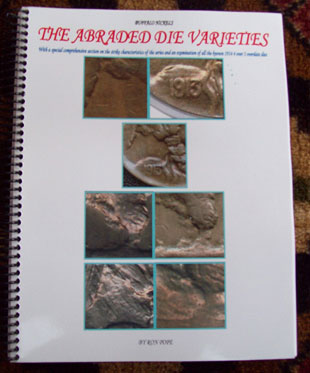 Now, consider VAM'ers, they also treat Cuds, Die Cracks, Die Dent, Die Chip etc., as Die Varieties and give them VAM #'s. The one below is 1880-P VAM-1C discovered by George Powell, July 2002. And, maybe better discribe as a Die Dent in this case. 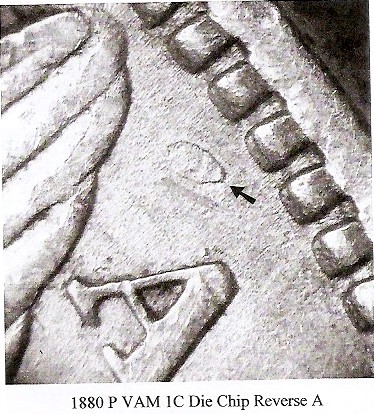 Anything that identifies a specific die (DDO, RPM, Abraded Die, Die Crack, Die Chip, Die Dent etc.) is like DNA or a finger-print and qualifies as a Die Variety (or Production-Die Variety) - it's repeatable every time the Die strikes a planchet. The Danester |
|
Pillar of the Community
United States
7629 Posts |
I'm not sure how to help further. You seem to fail to understand that die varieties are mistakes made during the die manufacture process. Die errors are something that develops on the die after it is placed into use making coins. Die varieties are there before any coins are struck. Die errors occur during the striking process. The difference is night and day.
It makes perfect sense to me that a non-collector would not understand the difference, just as any collector could not understand the difference without first understanding the coin making process employed by the mint. That understanding of the minting process should actually be the prerequisite before arguing points that honestly have no real validity.
The primary reason WHY they are so different is that it boils down to something that happens with tools in a machining process without further inspection (die errors) and something that happens during the process to create the tools, which are very closely inspected before they are used (die varieties). EVERY die is inspected under a loupe or microscope before they are placed into service. They are not looked at again until there is a problem. Obviously one could have easily been prevented, and the other is actually expected to happen.
Before attempting to classify a coin as a die variety or a die error, one simple question clears the whole thing up - is there a chance that the die that minted the coin was indeed a normal die at one time and struck coins that were unidentifiable as anything other than completely normal? If the answer is yes, then you have a die error (if what you have is even significant enough to classify as an error at all). If no, then it's a die variety.
|
|
Valued Member
United States
213 Posts |
Chuck, all that you say is correct, and it's not that I don't understand the accepted definitions. My contention hear is grouping like things, and a couple new terms that if really thought-out "back when", might have been as I suggest. If we were to sort a master group {Set} of balls that were painted or not painted, and made of iron or rubber. And, then define the property of bouncing as a key feature, where all rubber balls go into a single group {Sub-set} regardless if they are painted or not. Then we would have two other groups {Sub-sets} - 1.) Painted iron balls, and what's left over 2.) Non-painted iron balls. In the case of or current accepted numismatic groupings and terms, we have "bouncing balls" mixed up with iron balls. I'm defining the key feature in the group sort as anything that is specific to a certain Die - that's the "bounce" here. After all, that is why we all use our Loupe to look at coins to see the Die "DNA" and "Fingerprints". That's the real rush - it is for me anyway. The rubber balls are then our Die Varieties and Production-Die Varieties. To continue the analogy, the painted iron balls are the Types (Type, Sub-Type, and Minor-Type), and what's left over, the non-painted iron balls are the Errors (Planchet and Strike). I am not disagreeing with what you are saying, I've studied the die making process... you are quoting the current numismatic scripture, and it's all correct. I am saying the concept of "Specific to a Die" (flaws and accidents) is the key feature - the Die Variety or Production-Die Variety. And, maybe scientifically we can do it better - our groupings and terms. Also, when I took a tour of the Denver Mint many years ago in the late 1970's, I saw a foreman walk over to a coin hopper and check the on-going production with his Loupe. Dang! That's probably why they pulled the 1916/1916 DDO Buffalo nickel Dies so quickly. I don't think I can add anymore on the subject. I'll let others give their opinion. I hope this at least encourages everyone to put on their numismatic thinking caps. If you agree with me, I'm pretty sure we will be like those whose said birds were dinosaurs early on.  The Danester Edited by Danester
04/19/2011 4:35 pm
|
|
Bedrock of the Community
United States
62064 Posts |
Your putting too much thought into cataloging common stuff that no one would buy. You time might be better spent on searching for the stuff that others will buy.
|
|
Valued Member
United States
213 Posts |
Coop, well your post was a real "buzz-kill". No replys in the last 11-Days - you really know how to kill a thread. lol  Here is something I think we all can agree on is wrong. I found this quote on the pcgs web site - http://www.pcgs.com/articles/articl...d=313&type=1" Bruce Amspacher - September 10, 1999" " Mint errors. The term encompasses a wide range, and is frequently misused to describe coins that aren't really errors at all, but varieties that were intentionally made. For instance, the 1942/1 Mercury dime is a die variety, but not a mint error as there is no error involved: it was deliberately created. The 1955/55 Doubled Die Lincoln Cent, in contrast, was minted by accident and fully qualifies as a true mint error. There are some coins that stretch the boundaries of mint errordom (to coin a word)......." This writer used another definition to separate errors from die varieties. He says die varieties are intentional, while errors are accidents. He then goes on to give examples with questionable statements of what is intentional and what is an accident. The Danester |
|
Page 2 of 2
|
Replies: 22 / Views: 4,352 |
Page 2 of 2
|
To participate in the forum you must log in or register.
Disclaimer: While a tremendous amount of effort goes into ensuring the accuracy of the information contained in this site, Coin Community assumes no liability for errors. Copyright 2005 - 2026 Coin Community Family- all rights reserved worldwide. Use of any images or content on this website without prior written permission of Coin Community or the original lender is strictly prohibited.
Contact Us | Advertise Here | Privacy Policy / Terms of Use
|
| Coin Community Forum |
© 2005 - 2026 Coin Community Forums |
| It took 0.61 seconds to rattle this change. |
 |
|





 First Page


 Posted 04/15/2011 4:07 pm


