| Author |
 Replies: 10 / Views: 8,348 Replies: 10 / Views: 8,348 |
|
|
Formerly nancyc
Australia
5385 Posts |
Would anyone be able to tell me for certain if this is a real coin or a counterfeit. I thought I had it tagged as China Empire y#127 until I realized the weight was wrong. I don't remember why or where I got it, maybe off ebay. I lost what little info I had on deciphering a date for Chinese coins, so I don't even know what year it's supposed to be. The Obv looks OK to me, but the rev (dragon) appears as though it may be cast. The edge is reeded. China Hu-Peh Province 7 Mace and 2 Candareens (Weight 18.48g; Diam. 39mm) All assistance appreciated.  life is a mystery to be lived not a problem to be solved
|
|
|
|
Pillar of the Community
United States
4883 Posts |
My attitude towards the genre of older Chinese silver coinage is that they're presumptively fakes until demonstrated otherwise. At the weight you've determined, there's no doubt that this particular specimen's a phony, almost certainly a modern numismatic forgery.
Colligo ergo sum
|
|
Pillar of the Community
United States
1915 Posts |
Better look again- obverse sure looks wrong to me.
Edited by Albert
07/03/2017 01:36 am
|
|
Moderator
 United States
34538 Posts |
Missing parts to the english letters in the inscription means fake to me.
"If you climb a good tree, you get a push."
-----Ghanaian proverb
"The danger we all now face is distinguishing between what is authentic and what is performed."
-----King Adz
|
|
Pillar of the Community
United States
1915 Posts |
Missing parts of English letters are normal on many authentic coins.
This piece is one of the numerous incoherent coins having two incompatible sides.
Apart from wrong weight and not silver, it has numerous flaws but among the most obvious is Chekiang in Chinese but Hupeh in English.
|
|
Formerly nancyc
 Australia
5385 Posts |
Thanks all. I was fairly sure it was a fake, but just needed convincing.
life is a mystery to be lived not a problem to be solved
|
|
Pillar of the Community
United States
1915 Posts |
You are welcome. There dozens upon dozens of fakes coming out of China these days.
This is just one of many. Real silver coins having mismatched sides were described in Kann as "mint sports".
Mint workers back in the day took it upon themselves to make unauthorized coins using dies that don't belong together. Your coin is just an imitation of such an item and is not silver. I buy coins like yours for about a dollar. They get photographed, measured and tested then end up being documented in the binder pages. I have a few hundred so it was easy to see the wrong province name in Chinese. I didn't mention that fact in my first reply. I thought somebody else would do that. But may others are busy with vacations and family cook-outs.
|
|
Formerly nancyc
Australia
5385 Posts |
Thanks Albert, and thanks to everyone who took the time to reply, all info is much appreciated.
life is a mystery to be lived not a problem to be solved
|
|
Pillar of the Community
Belgium
2895 Posts |
That is what I regret: there is so much discussion about these fakes, again and again and again. It should be on the national news channels that there are no real coins for sale anymore (or very very little). (sorry to sound so negative, just had a bad day  ) |
|
Pillar of the Community
United States
1915 Posts |
Here's another version having two different province names on the same coin. This, by the way, is an example of a poor quality job. Many other coins are made quite well and would be hard to spot as fake just using the pictures. Kann does list a Hupeh / Kwangtung combination, but not this particular imitation. My feeling is that Kann did not elaborate very much on what he considered to be nonsense. But now, what we have today, are imitations of some of those coins as well as other nonsense fabrications. 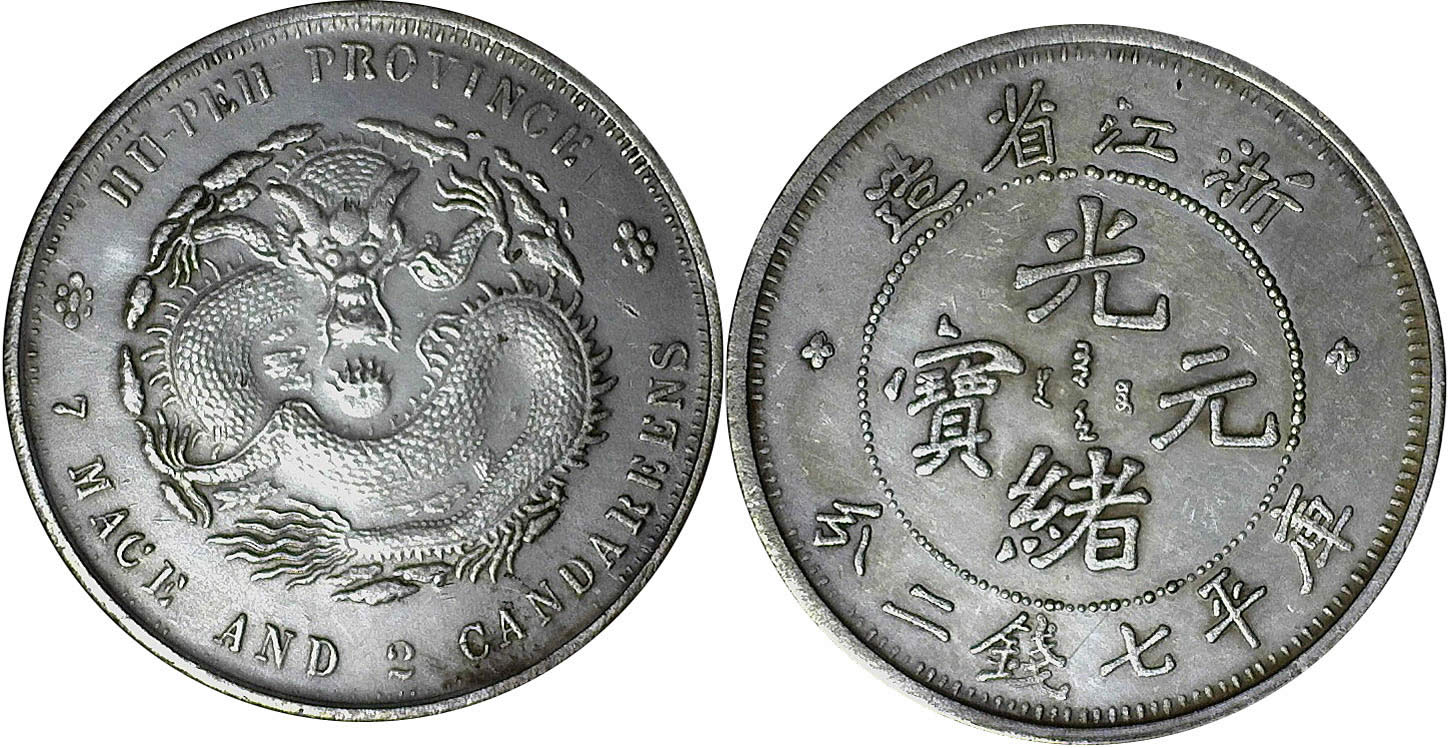 |
|
Pillar of the Community
Belgium
2895 Posts |
|
| |
Replies: 10 / Views: 8,348 |
|







 Posted 07/03/2017 01:35 am





