| Author |
 Replies: 14 / Views: 1,594 Replies: 14 / Views: 1,594 |
|
|
Pillar of the Community
United States
570 Posts |
|
|
|
|
Pillar of the Community
United States
7629 Posts |
Often times you have to take into account what's going on around the area in question. Note that there are two other areas with split plating just like what's inside the 4 of the date. All three areas are to the right of something else, which is also generally indicative of split plating. That's the zinc core you're looking at through those splits. They are rather common and command no premium value.
|
|
Pillar of the Community
 United States
570 Posts |
Thanks for the info! I figured it wasn't anything, just thought I should get a second opinion.
|
|
Bedrock of the Community
United States
10045 Posts |
Coppercoins knows. In terms of repunched dates, I think the last year that was possible was 1908 IHCs. From 1909 onward, the date was on the hub.
|
|
Rest in Peace
United States
7075 Posts |
I think coppercoins is really a materials science engineering prof.  I learn something every day here and often from you coppercoins! |
|
Pillar of the Community
United States
526 Posts |
The last year that the date was punched into the working dies was in 1908. After that year, the date was engraved into the master die, which in turn made the master hub, which then made the new master die for that year. For the next year's master die, the last year's master hub had the last two or three digits in the date abraded from the hub, which in turn made a new master die. Then the two or three digits that were missing on the master die were engraved into that die, which then made a master hub, which made the new master die for that year.
|
|
Pillar of the Community
United States
7629 Posts |
BJ Neff and DVCollector have it correct. There is actually no such thing as a repunched date (or an overdate) in Lincoln cents because of the change in the minting process. Same thing applies to the Buffalo nickels, Mercury dimes, Standing Liberty quarters, Walking Liberty half dollars, Peace dollars, and any series that started after them. ANY case of one date on another date in those series is a doubled die. Class 3, to be exact - design hub doubling. Two different designs used to hub a single die. |
|
Bedrock of the Community
United States
10045 Posts |
That's interesting to be reminded of the exact die-making process involving the date on US coins!  US die-making processes diverged from many other countries in 1909, where those mints continued to sink dates into individual dies...into the 1940s, some even more recently. |
|
Pillar of the Community
United States
570 Posts |
Thanks for the info! I am a dark side collector, but this one caught my eye. Glad to know the process involved. I learn something new everyday on here.
|
|
Bedrock of the Community
United States
17884 Posts |
Are you sure that is a plating split? I see no silver color like you do with the split by the mintmark. Also if it was a split it would seem to come from the diagonal of the 4 since it parallels it (And splits tend to be on the radially outward side.) I was thinking it looked like a die gouge. Also the lighting highlights seem to indicate that the feature is raised on the coin. (lighting highlights are the same as that of the diagonal of the 4, lit on the upper left and shadowed on the lower right.)
Edited by Conder101
10/31/2011 5:08 pm
|
|
Bedrock of the Community
United States
62064 Posts |
It is split plating. When a line reaches the zinc underneath, it raises.
|
|
Valued Member
United States
304 Posts |
You learn something new everyday.
|
|
Bedrock of the Community
United States
17884 Posts |
Quote:
It is split plating. When a line reaches the zinc underneath, it raises What? Sorry but that makes no sense to me. Are you saying the the plating comes loose and curls up? I've never seen that unless zinc rot has set in. |
|
Bedrock of the Community
United States
62064 Posts |
I thought I included this image, but I guess I forgot? 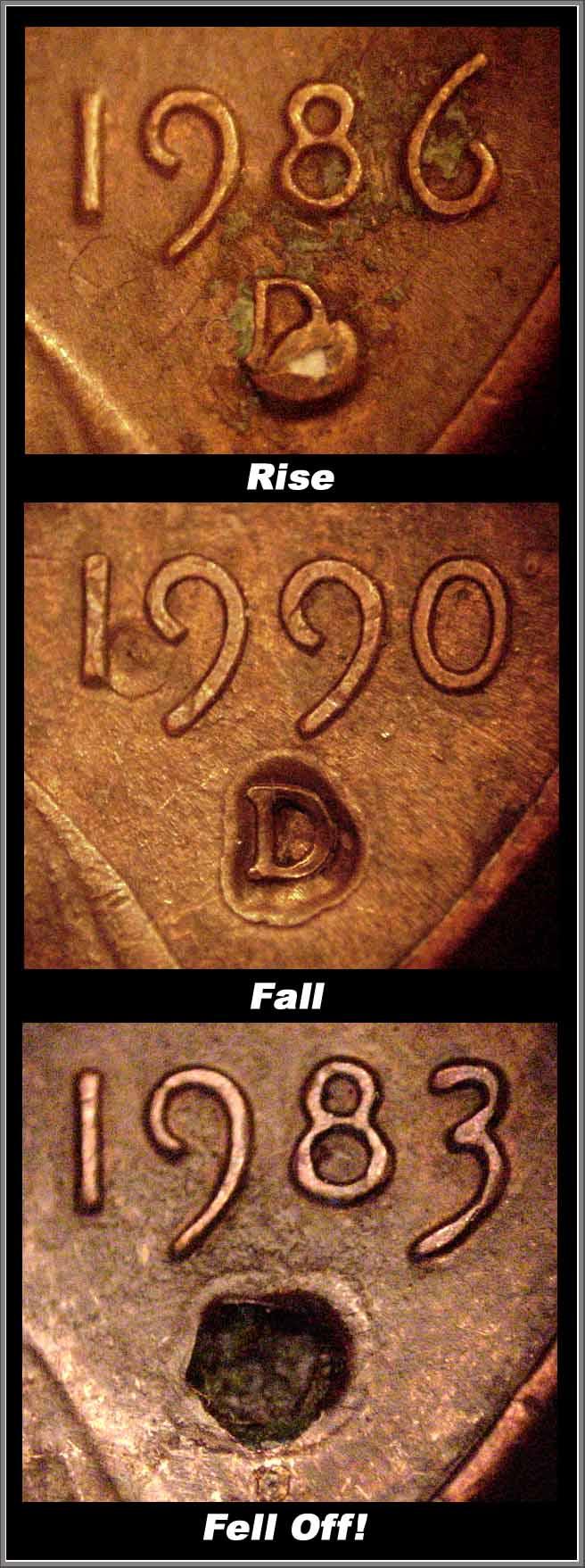 |
|
Bedrock of the Community
United States
17884 Posts |
OK so you are talking about zinc rot. but I see no evidence of rot on the 94 D in the OP.
|
| |
Replies: 14 / Views: 1,594 |
|







 Posted 10/28/2011 8:10 pm





