| Author |
 Replies: 14 / Views: 4,624 Replies: 14 / Views: 4,624 |
|
|
New Member
United States
16 Posts |
 The photo that you are viewing is of coins that were manufactured, inspected and distributed by the US Mint. These coins are real and two of these coins with errors were packaged together. The mints sets also included a Certificate of Authenticity from the US Mint that states: The United States Mint certifies that these proof versions of current United States circulating coinage were produced and packaged at the United States Mint, San Francisco, California. Each coin bears the mintmark "S" designation of that facility. United States proof coins are produced from carefully selected planchets, that have been burnished to a high luster. The polished blanks, which are carefully handled to minimize scratches and abrasions, are struck on specially adapted coining presses. Each coin is struck at least twice to bring forth the most minute detail with remarkable clarity. The surfaces of the coinage dies for striking proof coins are meticulously processed to create a frosted appearance of the image on the die. the background surface is polished and buffed to a mirror like finish. the dies are also buffed during the striking process. The finished coin with its frosted cameo image on a mirror-like field is carefully inspected--with gloved hands to protect its surface--before being assembled into sets. The proof coins are then placed into transparent presentation cases. Proof coins, referred to as "Master Coins" in the early days of the mint, were originally produced to "prove correctness" of the dies" and etc....... 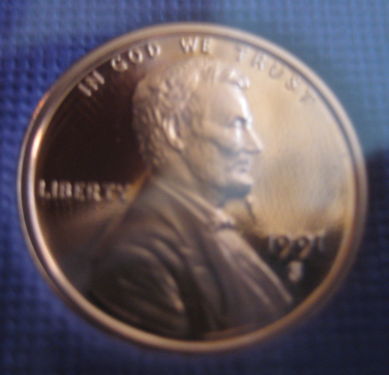 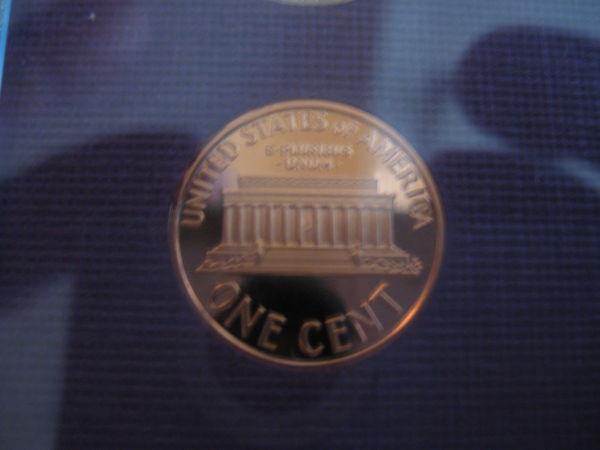 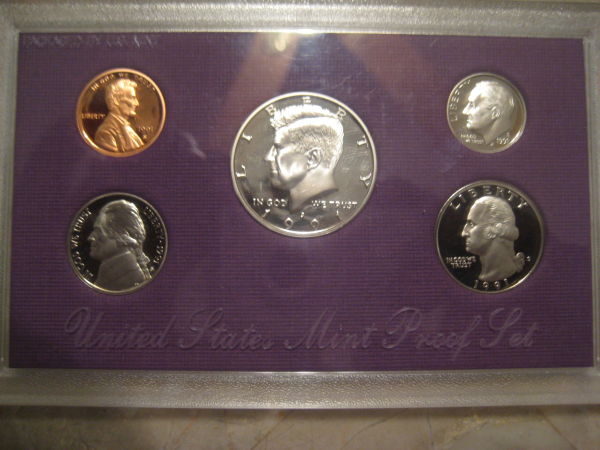 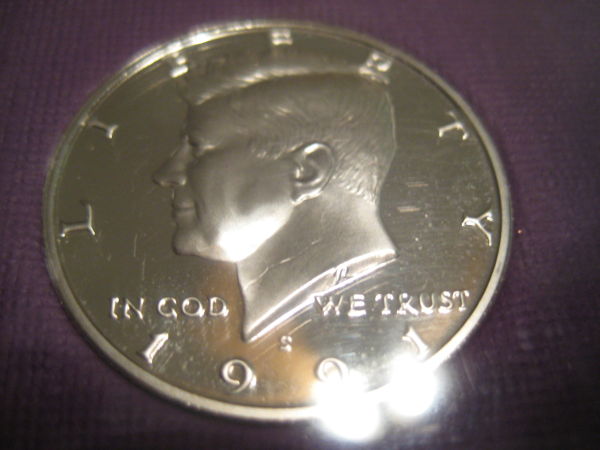 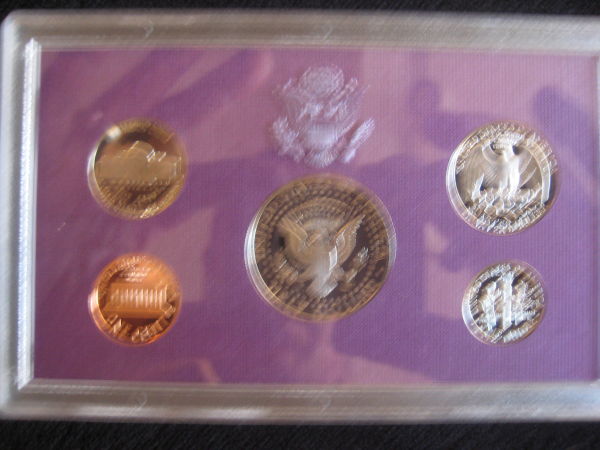
|
|
|
|
Pillar of the Community
United States
4897 Posts |
Umm..not trying to be dense but what "errors" am I supposed to be seeing? |
|
New Member
 United States
16 Posts |
Look closely at Lincoln's beard and at Kennedy's neck. These coins are not suppose to have deviations. They are Ultra Cameo Proof coins.
|
|
Pillar of the Community
United States
1205 Posts |
so would this classify as a planchet bubble?
|
|
Pillar of the Community
United States
4212 Posts |
Is that a struck-thru or die chip on the 1c? Die crack on Kennedy? Fortunate goofs, for sure!
Edited by fioti
12/03/2011 5:47 pm
|
|
Rest in Peace
United States
1943 Posts |
I see a bubble on the Lincoln Cent. Not an error. Just a poor quality planchet. There is no Deviation on Kennedy's neck. That is part of the design. You will see this on other proof Kennedys. |
|
New Member
United States
16 Posts |
I actually think that the Lincoln Error looks pretty cool. It is an error because the coin was not intended to be completed with the extended beard. the Kennedy half has a die break across 3/4 of his neck. I have look at other Kennedy half dollar coins and the line on this coin is not the same as the others this is a die break. I only put these coins on here because I thought that they would be appreciated by other collectors. |
|
New Member
United States
16 Posts |
fioti I think it is a die chip on the Lincoln Cent. The only other coin that I found so far with a similar error is the 1804 Spiked Chin Half Cent. If you look at a picture of the 1804 Spiked Cent Half Cent you will see that it is listed as an error (variety). It is an image of liberty on the obverse with a spike (die chip) chin that is on a different angle than this coin. This coin is possibly the only one of its type and this is the first publication of this error, the 1991 s US Mint Error Proof Set, the 1991 s Lincoln Extended (Spiked) Beard or the 1991 s Kennedy half dollar Die Break discoveries. |
|
Pillar of the Community
United States
4897 Posts |
Still think it is a gas bubble (I am no expert). Would be interested to see what Mike Diamond, BJ Neff or Coppercoins think...maybe pm them a link?
|
|
Pillar of the Community
United States
7629 Posts |
ccobb357 - Unfortunately we cannot define for ourselves what an error is...and your Lincoln Cent is not an error. It's what some of the others here have said it is - a planchet defect. It has to do with the fact that the zinc planchet was dirty when the copper plated it, and the zinc corroded underneath the copper. You can compare it to the spiked chin Half Cent if you like, but you are comparing apples to oranges. The spiked chin Half Cent is die damage (a very heavy die gouge) that repeated for all of the coins struck after the gouge came onto the die. It was a die that should have been summarily retired and was not. It continued to strike coins with a silly looking (yet huge) spike coming out of LIBERTY's chin. The main difference between your coin and the spiked chin - your coin was a planchet defect that shows on one coin here and there, hit and miss. The spiked chin was a die defect that was minted into all the coins that followed the defect, because coins are a mirror image of their parent die. When people buy proof cents they want a NICE proof cent - not one with obvious defects in the planchet. When people collect Half Cents, they collect by date, then get into the overdates and obvious traditional errors. The spiked chin happens to be one of those errors. I photographed one of those Half Cents this past month in fact. Here it is...  |
|
Pillar of the Community
United States
3640 Posts |
The line/crease you see on the half is normal.
Look at others.
|
|
New Member
United States
16 Posts |
As you have mentioned that we people buy proof coins they want one that is a nice proof cent is understood, however, finding such a coin should be considered a rare find considering the special treatment, inspection and etc.. that goes with proof coins compared to business strikes that are handled and inspected to lesser standards?
|
|
Bedrock of the Community
United States
20037 Posts |
Gas bubble, actually pretty common on proof cents, not considered an error. The flaw actually decreases collector value.
Lincoln Cent Lover!VERDI-CARE™ INVENTOR https://verdi.care/
|
|
Pillar of the Community
United States
2651 Posts |
+1-Normal and negatively affects the value
|
|
Pillar of the Community
United States
7629 Posts |
And the lesser quality coins slip through the cracks once in a while and end up in the hands of collectors. This is not an error, it is a simple matter of a planchet flaw that made it through the entire process - that's all. Just because something is uncommon does not make it valuable. It has to have a market first.
|
| |
Replies: 14 / Views: 4,624 |
|







 Posted 12/03/2011 5:06 pm





