| Author |
 Replies: 21 / Views: 7,694 Replies: 21 / Views: 7,694 |
|
Pillar of the Community
United States
1549 Posts |
Another thread brought up the subject so I made an illustration to show the four different poses found on coins of the Falling horsemen type. Three of these examples are Constantius II; FH1 is Constans but the same classifications work for Gallus and Julian.  FH1 - Kneeling: The horseman is face down touching the ground (whether in front of or straddling the horse is not easy to tell on most coins). The easy distinction here is the head of the horse which is stretched forward (chin down) rather than tucked backwards as shown on the other three types. This is by far the rarest of the four types and was only used in the early years on larger AE2 size coins by a few mints. I apologize for the low grade example but this is the rarest and most valuable of these four coins being both FH1 and Constans. (Thessalonika mint) FH2 - Sitting: The horseman is sitting on the ground reaching up toward the soldier with both arms. This is much more common than FH1 and much more rare than FH3 and FH4. Again this type is only found on earlier, larger coins from a few mints. (Lyon mint) FH3 - Reaching: The horseman is still on the horse and is twisted around extending his arm toward the soldier in an attempt to knock away the spear. On some coins it does appear that the spear is aimed more at the horse than at the rider. This is by far the most common of the four poses and was used on coins from the beginning to the end of the Falling Horseman period. (Antioch) FH4 - Clutching: The horseman is still on the horse but is face down clutching his arms around the neck. It differs from FH1 Kneeling in that he is clearly on top of the horse an the horse still has its read legs extended rather than laying flat on the ground. This type was also used throughout the period but not as commonly as FH3. (Antioch) RIC does not number according to details of the clothing or hairstyles of the horsemen but it is clear that there are several distinct variations. However, the FH3 and FH4 examples here clearly show the same tribe of foe with beard, pigtails and no hat. If any of you have FH1 style horsemen you don't want, I would love to upgrade mine. |
|
|
|
Moderator
 United States
23731 Posts |
Thanks for posting, because this series is so common we tend to overlook the many different styles that were struck.
|
|
Pillar of the Community
United States
2044 Posts |
That's a pretty good description and apparently how RIC identifies those FH coins, I take it? Instead of various factors such as what helmets are being worn or not worn by either the spear man and the fallen horse and man?
The Constantius II FH that I have appears to be FH3, although a different RIC ID.
|
|
Pillar of the Community
United States
4253 Posts |
I have to give it to you Doug. That's a great explanation of the FH types and rarity. I'm not sure I have ever seen this or anything like it anywhere else. Now, if I understand you correctly, it is only the poses that make the differences, not the helmet or style of clothing, beard/hair? The example I have attached is a Constantius II with the FH reaching backwards and wearing a Phrygian helmet. I would take it then that this is FH3 according to your description? 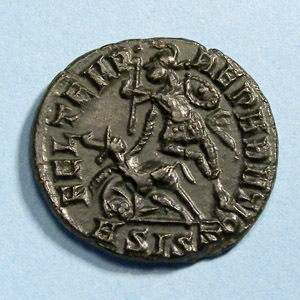 |
|
Pillar of the Community
United States
2703 Posts |
Thank you for a clear and very useful explanation of these types! Now I will go see what I have.
|
|
Pillar of the Community
United States
1315 Posts |
What type would this one be considered? 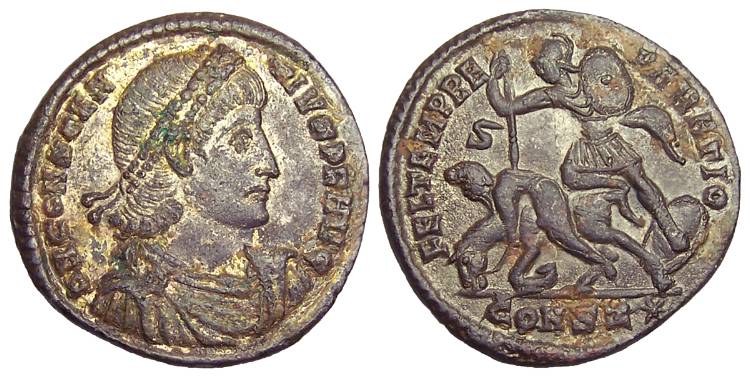 |
|
Pillar of the Community
United States
4253 Posts |
Based on the above images, I would say it is FH4. I can see the differences here as well. The shield for one. BTW, that's pretty darn good detail on the reverse of your coin.
|
|
Moderator
United States
23731 Posts |
I would say FH4 also. Excellent detail.
|
|
Pillar of the Community
 United States
1549 Posts |
Matters like pigtails, beards and helmets do make a difference but not to the point of assigning an RIC number. There are about 2000 variations of Falling Horsemen and room for a lot more detailed study. The recognition that the small figures on these coins were portraits rather than random is relatively recent. I am glad to see the addition but many of my coins are hard to read with certainty because their low grade makes it hard to tell if there is a beard or a chin on that blob. I usually avoid coins with unclear legends but I have bought coins with confused horsemen. JW's beautiful FH3 of Siscia is a case in point. The headgear has a brim and is bent over at the top. I do not know the full and proper definition of a Phrygian helmet. 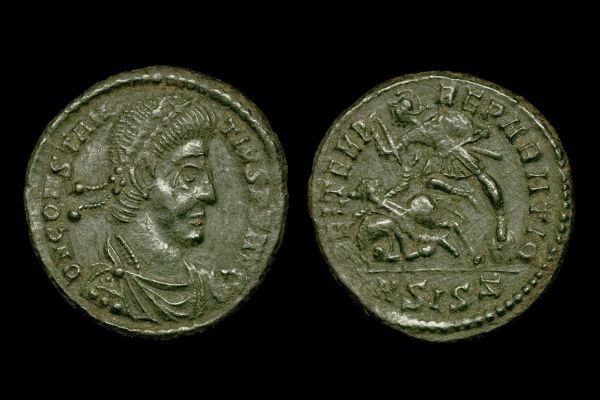 Compare my coin which lacks the brim and the top only edges forward a little. Where do we draw the line between names applied to the two? Now imagine both of these coins worn to the point that it is harder to see the details. I believe this is why RIC chose to shop the variations with the basic types. I'm sure there will be a bigger and better book on these coins someday (perhaps written by Dane?). |
|
Pillar of the Community
United States
1315 Posts |
The coin I posted above is not my coin, but one that looked quite different from most and I had thought about getting from Roma/Vcoins. It's a nice coin but the price is too much for me. I ended up getting this one from ebay. Now I can see it's an FH3, then a friend wanted it so I gave it to him. 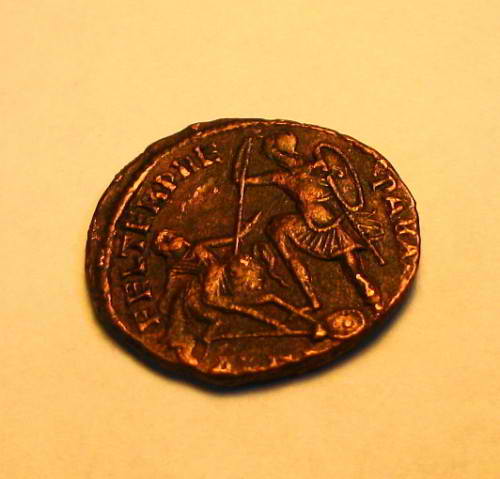 It's still not clear to me what a FH1 looks like, it's hard to tell from dougsmit's picture above. I believe I found a drawing of one on Tesorillo.com under his reverse types AE2, although he doesn't have it categorized as FH1 or showing one coming from Thessalonica. This is a complex type, much more that I thought. Thanks |
|
Pillar of the Community
United States
2044 Posts |
|
|
Pillar of the Community
United States
4253 Posts |
Quote:
Perhaps close to FH4 since the horse's head is tucked backwards. I'd say that it is FH4 |
|
Pillar of the Community
United States
2596 Posts |
Nice post dougsmit with perfect timing. I ordered a few of these coins last month, just finished my order a couple days ago and think I have all styles(generally speaking not ALL the styles but a good example of FH2-4) in the first post except FH1. Cant wait I think they will be here in the middle of jan. All nice examples with good details and size ranging from AE2-3 12 total.
|
|
Pillar of the Community
United States
1549 Posts |
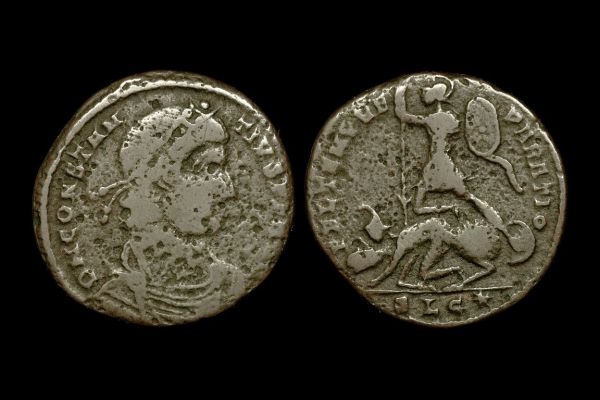 I own a total of two FH1 coins out of well over a hundred FH of other styles. One was shown in the inset. This is the other. They are not common. Again look here at the head of the horse which is stretched forward and NOT tucked under. The nose is at the left rather than right of the ears. The soldier is more on top of the horse than behind it. The horseman is touching the ground; note the hand lower than the head of the horse supporting him rather than holding on to the horse's neck. The horse is quite flat rather than holding its rump high up as common on FH4. I have some doubt about whether the horseman is fully off and in front of the horse but it is not obvious that he is still on the back of the horse. We use the term Falling Horseman but FH1 and FH2 could be called correctly Fallen while the FH3 and FH4 riders are still in the process so Falling is a better term. You see both used interchangeably and incorrectly by non specialists. All FH1 coins are AE2. They were made very early in the series at very few mints. While scarce, I paid no extra for the two I have because both of my coins are very low grade. If you see a nice one, you should give it to me for Christmas.  Edited by dougsmit
12/17/2011 11:15 am
|
|
Pillar of the Community
United States
2596 Posts |
dougsmit I have a question. Can the FH1 have an outstretched arm on the rider?
|
|
Pillar of the Community
United States
2596 Posts |
Which fallen horsman style would this one be? It looks like an FH3 but the horses head isn't as tucked under as the rest.
|
| |
Replies: 21 / Views: 7,694 |










 Posted 12/10/2011 2:29 pm


