| Author |
 Replies: 12 / Views: 3,569 Replies: 12 / Views: 3,569 |
|
|
Pillar of the Community
Czech Republic
803 Posts |
The coin is now in my hands and I'm very pleased with it. I was pretty nervous about Aureo pictures, having received quite a few cleaned pieces that looked problem-free in their auction catalog in the past. Looks like a nice XF40-VF35. Nothing is raising red flags in terms of authenticity. 26.78 grams and properly edged. Overdate 4/3 is weak, but you can see it under magnification (see image below). Researching information about this coin I saw that Calbeto mentions an 1814 HJ without an overdate in his Compendium, but lacks a plate coin for it. I was not able to find a reference to it in any other material. All the information points to 1814 HJ having a 4/3 overdate, which makes me wonder if the HJ die pair only had one obverse die, which was recut from the previous year. Since I've only been playing in this field for a few years, I'm hoping somebody more experienced can chime in on this. Without having more examples of the 1814 year it's hard for me to put together a comprehensive picture of the dies used, but my assumption based on the scarcity of the different assayer combinations makes me think that it was somehing along the lines of the production starting with the recut 1814/3 die and HJ reverse. Shortly afterwards the HJ die was replaced with a JJ (are there any JJ/HJ coins out there?), keeping the same 1814/3 obverse die (going to see if I can find clear examples of this die to confirm it was the same one), then changing the 1814/3 to 1814 die. Taking one more step back, what's with multiple assayers on Mexico City coins from 1812-1814? Both HJ(Henrique B. Azorin + Joaquin Davila Madrid) and JJ(Joaquin Davila Madrid + Jose Garcia Ansaldo) assayer initials can be found on coins of that period. And if you look at the Armored Bust series you see similar things happening with the TH and HJ assayers. Looking at the Ferdinand VII coinage of 1808 to 1821 from Mexico City Mint we have: 1808 --- TH 1809 --- TH 1809 --- HJ/TH 1809 --- HJ 1809/8 --- TH (possible there is 1809/8 HJ/TH?) 1810/09 --- HJ 1810 --- HJ/TH 1810 --- TH 1810 --- HJ (what about 1810/09 HJ/TH?) 1811/0 --- HJ 1811 --- HJ 1811 --- HJ/TH (what about 1811/0 HJ/TH?) 1812 --- HJ 1812 --- JJ/HJ 1812 --- JJ (any overdates this year?) 1813 --- HJ 1813 --- JJ (any overdates and over-assayers?) 1814/3 --- HJ <--- Last time HJ die is used 1814/3 --- JJ 1814 --- JJ (was the HJ die recut? if so, are there JJ/HJ for both 1814/3 and 1814 obverse dies?) 1815/4 --- JJ 1815 --- JJ 1816/5 --- JJ 1816 --- JJ 1817 --- JJ 1818 --- JJ 1819 --- JJ 1820 --- JJ 1821 --- JJ Very interesting series to study. Almost forgot - here's the coin :) 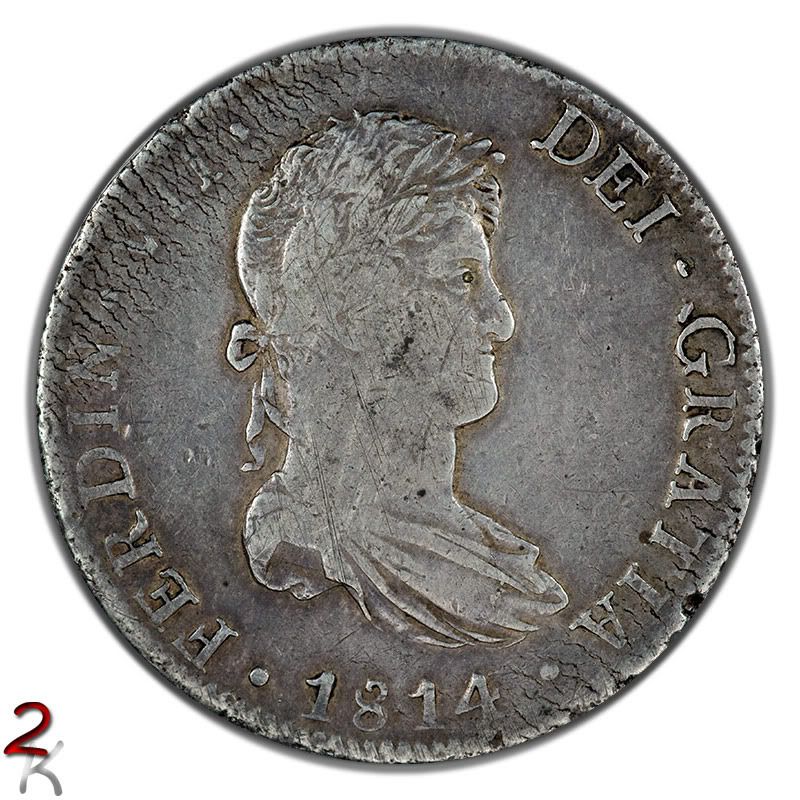 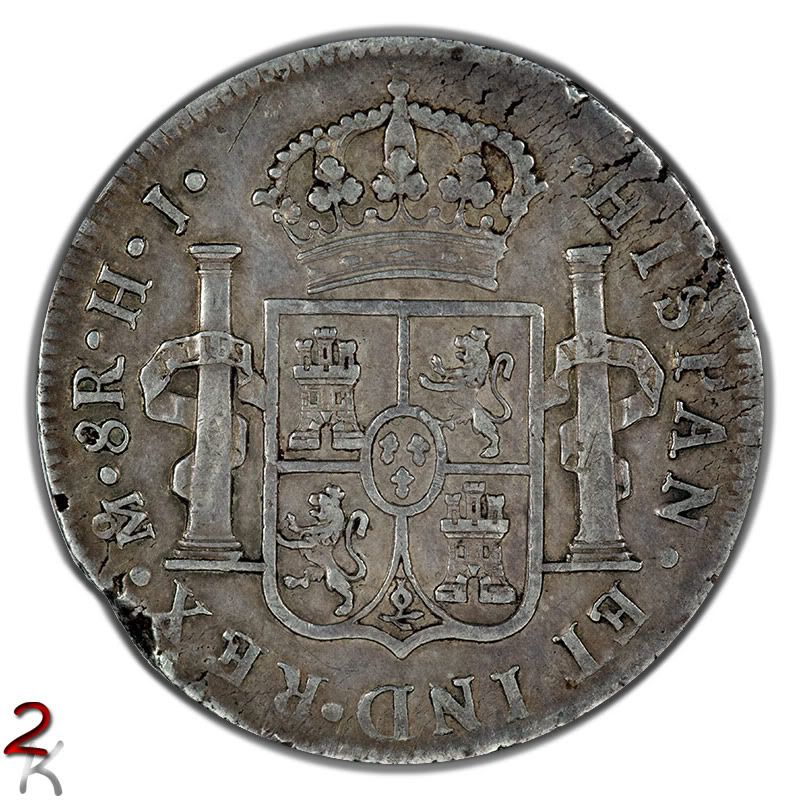 I had to play with lighting and contrast to make the overdate obvious in the photos. 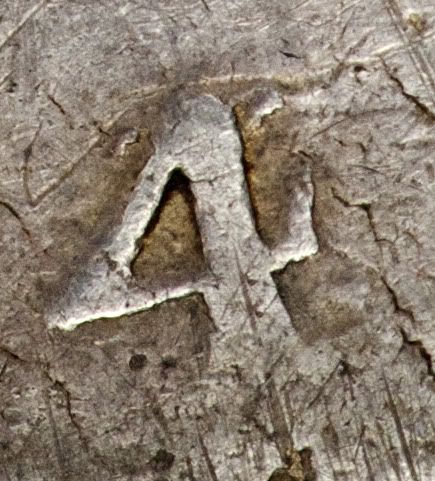 Edited by TwoKopeiki
12/15/2011 10:14 am
|
|
|
|
Pillar of the Community
Mexico
1304 Posts |
Oh my, that is a very nice coin. I really like the expansion cracks from the expansion under the die. Makes you wonder how big that chunk of silver was before being compressed.
|
|
Pillar of the Community
United States
1962 Posts |
Yeah, solid, uncleaned piece in hand... good to see. Planchet flaws don't bother me much, personally... they kind of add character.
I would suspect (as I think you do) that Calbeto is simply not precise there and the only HJ variant produced for that date was "1814/3 HJ". As rare as the 1814-dated assayer HJ seems to be, there couldn't have been more than a lone die pairing, could there? Note that my old 1988 Calico doesn't show the overdate either... OR any other known overdate in that run of years.
The progression of assayers/dies you theorized for 1814 could make sense... However, since the HJ and JJ partnerships were concurrent for several years (as opposed to a simple transition from one team to the other), I do think you would need to compare the die states to verify that logic. Perhaps there could have been some quirky events that caused "1814/3 JJ" to be struck first, THEN "1814/13 HJ" for a brief time? As large cent die progressions prove, weird things happened sometimes. That said, your theory probably is how it went down.
Nice piece, congrats. It wasn't cheap, but true rarity... rarely is.
PS - The authoritative coinfactswiki.com claims that a "1814/3 JJ/HJ" actually is known. That reference apparently comes the older Pillars and Portraits book (by Harris), since Krause is the only other source the page cites, and KM doesn't show that.
PPS - a little Googling shows there was an 1814/3 HJ in a 2006 Ponterio sale, per one of those pay-for-archive data websites (artfact). It seems this might have specifically been August 2006, but not certain... Unfortunately, that wouldn't be archived on the current site since that was prior to Bowers acquiring them.
|
|
Pillar of the Community
United States
1962 Posts |
OK, just doing a quick comparison... Below are pics of the 1814/3-JJ right after yours in the Aureo sale, and another 1814/3-JJ from a 2005 Heritage lot. Those two pieces are clearly the same obv die (same die crack under date and blob in right field). However, that's not the same obv die as your 1814/3-HJ... note the positioning of some legend lettering compared to nearby denticles. 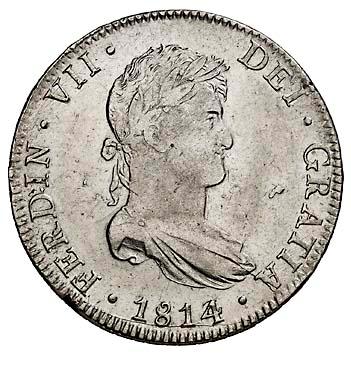 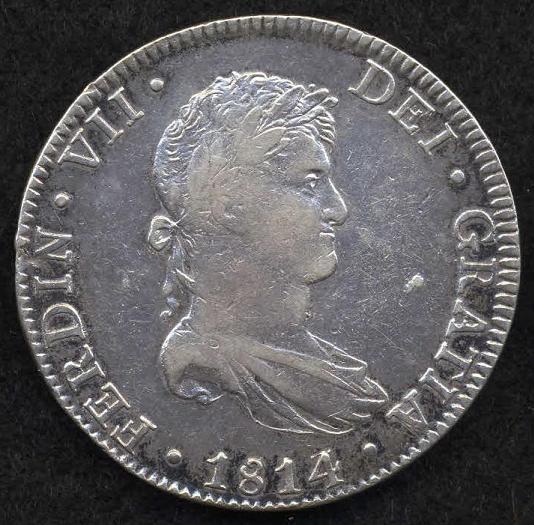 Edited by realeswatcher
12/15/2011 5:33 pm
|
|
Pillar of the Community
United States
1801 Posts |
My 1814/13 HJ could be the same die as TKs, however my 1814/3 JJ is a different die than the two posted 1814/3 HJ 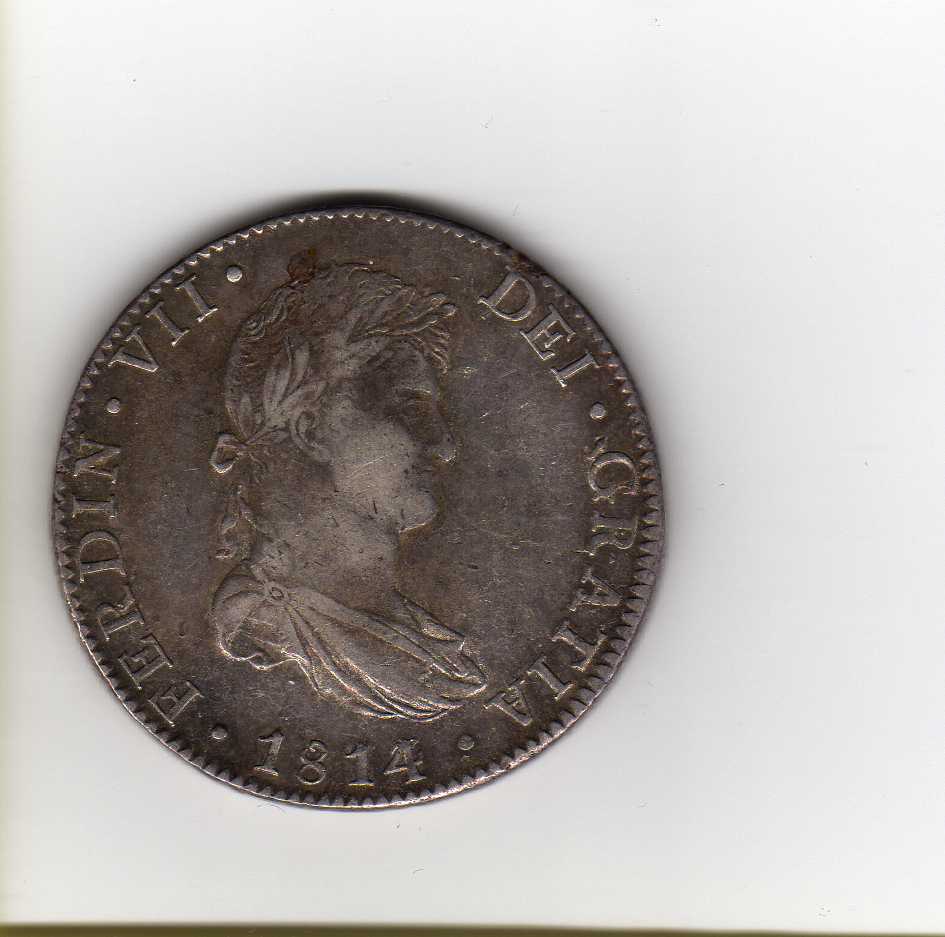 1814/3 JJ 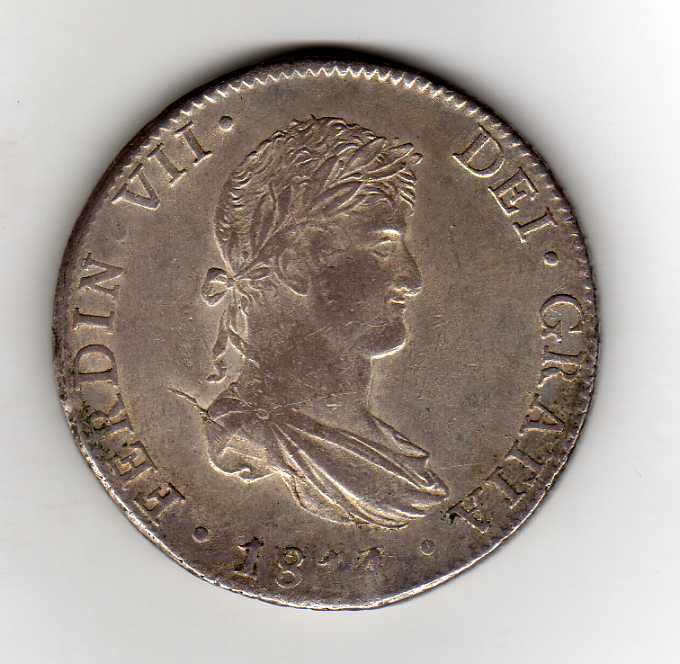 |
|
Pillar of the Community
United States
1962 Posts |
Damnedest thing, this site is... You'll get people on here asking "Help, I don't speak foreign language, what does Republique Francaise" mean?", or like, oddball posters from Outer Mongolia... BUT then when someone posts a great rarity of Spanish Colonial portrait coinage, someone else is right there to say, "Hey, let's compare mine!"
OK, so Kopeiki's and jfransch's specimens of the 1814/3 HJ are indeed from the same die, as you'd expect. Positioning of the legend matches, and they have the same identifying die blob next to "G" in GRATIA.
That obverse die is not the same as either the two matching 1814/3 JJ pieces I posted OR the 1814/3 JJ jfransch has. Further, those 1814/3 JJ are themselves from two different obverse dies...
SO, that makes THREE different 1814/3 obverse dies... are there OTHERS out there?!
Nice pieces, both of you! Those two should get together and have a play date or something...
|
|
Pillar of the Community
Mexico
1304 Posts |
Quote:
Damnedest thing, this site is... You'll get people on here asking "Help, I don't speak foreign language, what does Republique Francaise" mean?", or like, oddball posters from Outer Mongolia... BUT then when someone posts a great rarity of Spanish Colonial portrait coinage, someone else is right there to say, "Hey, let's compare mine!" I literally laughed out loud when I read this! I'm glad no one pulled that on me when I asked about my 1812 Zacatecas 2R! |
|
Pillar of the Community
 Czech Republic
803 Posts |
So, after the Sedwick sale, I followed-up with Kent Ponterio and we've settled on the price for another 1814/3-HJ they were selling as part of a large 8 Reales collection that I was able to preview at NYINC. Once the coin is back from Sedwick, it's going to be on its way to me. Super excited to own two of these rarities. First image is of the coin I snapped with my phone at NYINC, the other two are from the auction description. 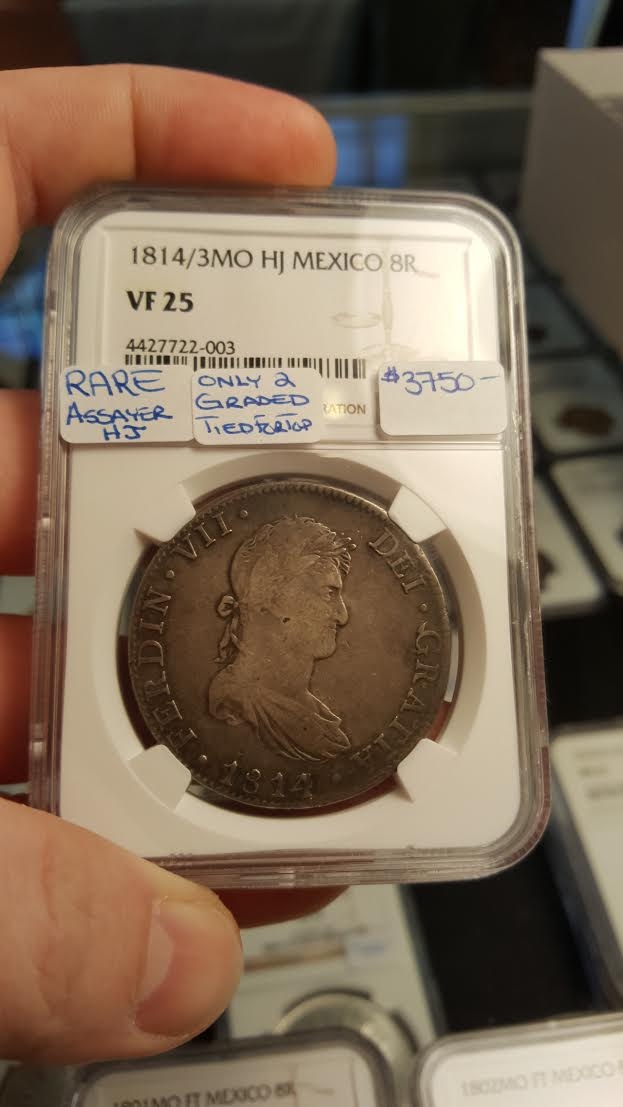 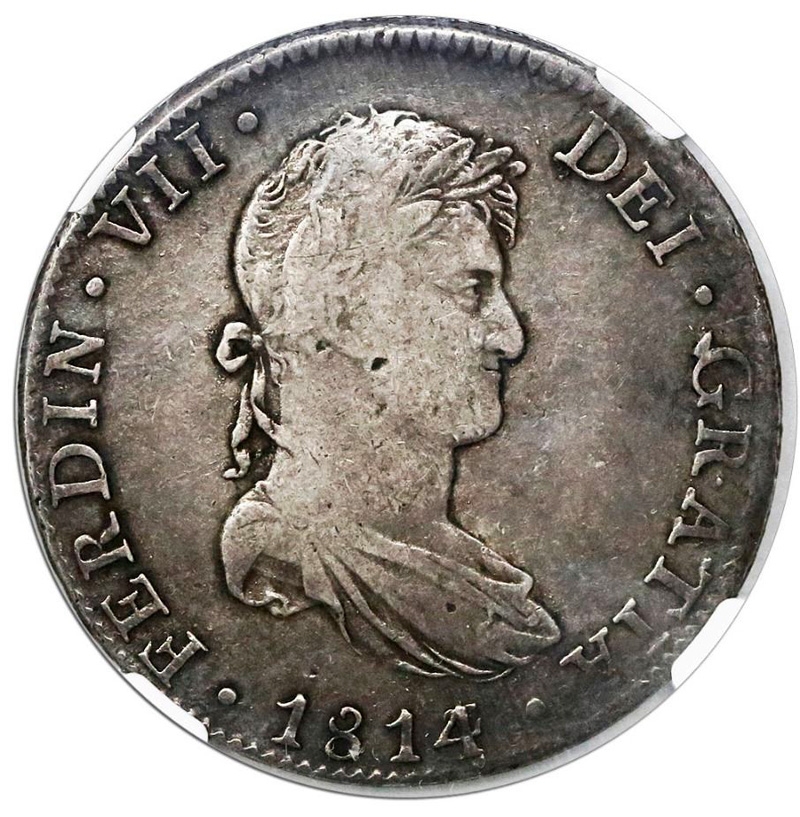 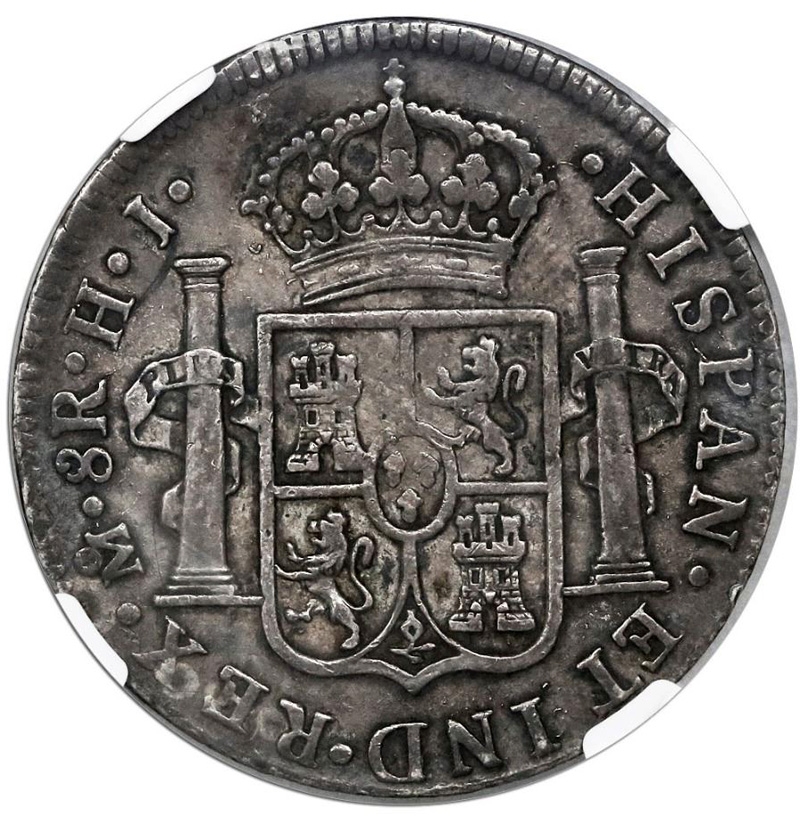 |
|
Pillar of the Community
United States
1962 Posts |
Edited by realeswatcher
05/07/2017 10:23 pm
|
|
Pillar of the Community
United States
1962 Posts |
BTW, reading your PCGS thread... note that your incoming piece does indeed show an early stage of the die crack that blossoms into a break between S and P: The photo of John's piece isn't crisp enough to see anything there (though must be small if present)... but looking at these four as pictured, seems like the crack sprouted from #1 to #2... grew a bit more from #2 to #3... and then you get #4. Given those small steps, I'm guessing the fissure developed rapidly over the course of not that many coins... and then the die was retired. 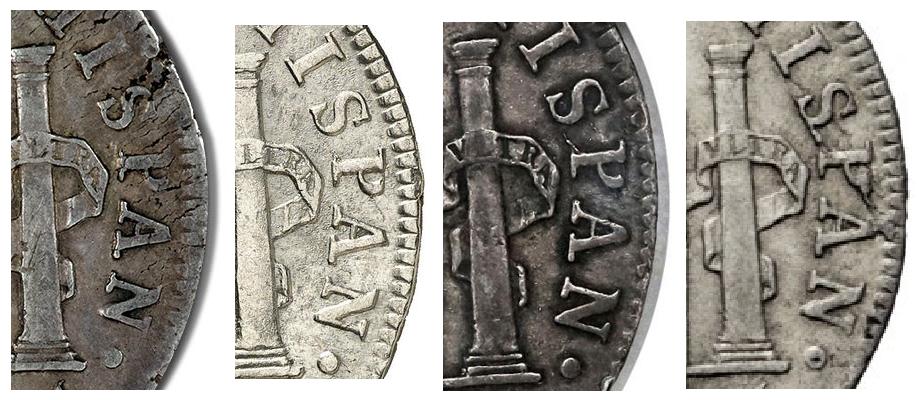 |
|
Pillar of the Community
Czech Republic
803 Posts |
Nice visual comparison, Brian! I pulled John's PCGS certification page photo ( http://www.PCGS.com/cert/28928754 ) and it looks like there is no sign of the crack forming. Since his overdate is more pronounced and the obverse die chip near "G" in "GRATIA" does not touch the letter, I would place his die state right after the Leunda coin. 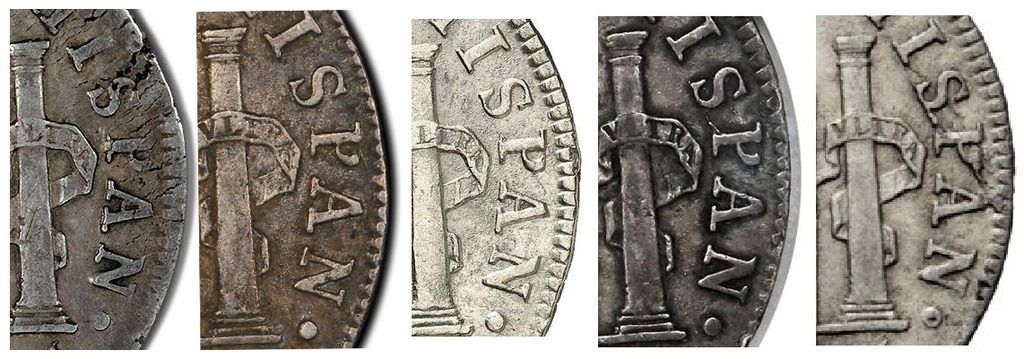  Edited by TwoKopeiki
05/08/2017 07:57 am
|
|
Pillar of the Community
United States
1801 Posts |
Just reviewed this thread to see the updated pictures of Roman's second 14/13 HJ Was looking at my recently upgraded 14/13 JJ (Acquired from Paul Brombal Rare Coins in Santa Barbara, CA, sourced to a European auction he attended) and I think it might be another over-date die, not matching any of the ones we previously discussed. Opinions? 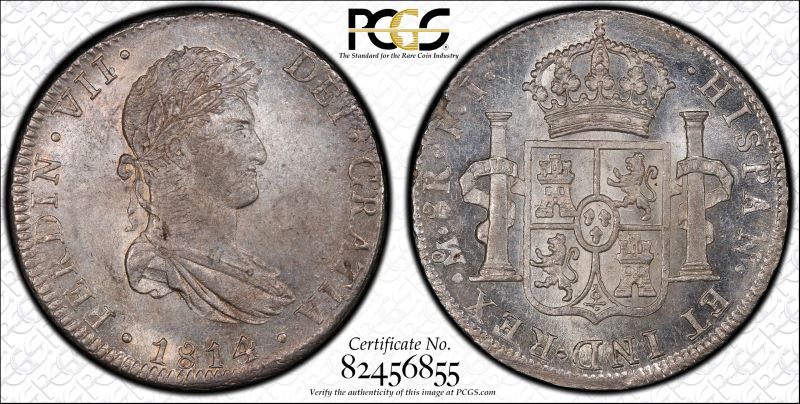 |
|
Pillar of the Community
United States
1962 Posts |
Hmmm... the positioning of the overstruck "4" does seem to be higher compared to your previous piece, doesn't it? What's visible of the denticle positioning vs. the lettering LOOKS ***although see below*** to match up just about exactly on your previous piece and this new one (both notably different than the pieces above with the extra metal blob in the R obv field). That top of the crossbar of the 3 being lower is hard to ignore, though. Your new piece seems to be a definite match to these two - small blob under the bottom of the F in FERDIN matches (clearly seen in the large blowup of your piece on the PCGS site)... and note that one floating tip of hair (the one sticking out forward): https://www.ebay.com/itm/1814-3-MO-...132423374845https://www.worthpoint.com/worthope...ii-402142532Then this piece - while blurry pics, it's clearly a match to your old 14/13 JJ - note the die crack coming out of the shoulder. The denticle position visible under the date definitely doesn't match the die from the new piece: https://www.worthpoint.com/worthope...n-1732311376Thus, it looks pretty conclusive that those were different dies - meaning at least THREE different 1814/13 dies with JJ reverse (plus one more with HJ reverse). Doing some more review of 1814 pieces... there may be other 14/13 dies (nothing confirmed, but some apparently differing diagnostics at first glance). Suffice it to say... there were at least a few 1813 obverses turned into 1814s. Edited by realeswatcher
12/04/2017 8:22 pm
|
| |
Replies: 12 / Views: 3,569 |
|










 Posted 12/15/2011 5:09 pm


