| Author |
 Replies: 6 / Views: 4,437 Replies: 6 / Views: 4,437 |
|
|
New Member
Nicaragua
4 Posts |
Hi everyone! I just recently joined this forum, and this is the first topic I'm making. For some time I've had this odd coin, and only last year I discovered that it could in fact be an Atocha Coin. It hasn't been valued nor appraised by anyone. I would like to know: 1. How likely is it that this could be an authentic atocha coin? 2. If it is an atocha coin, what grade would it be? 3. How much would it be worth? Thanks beforehand 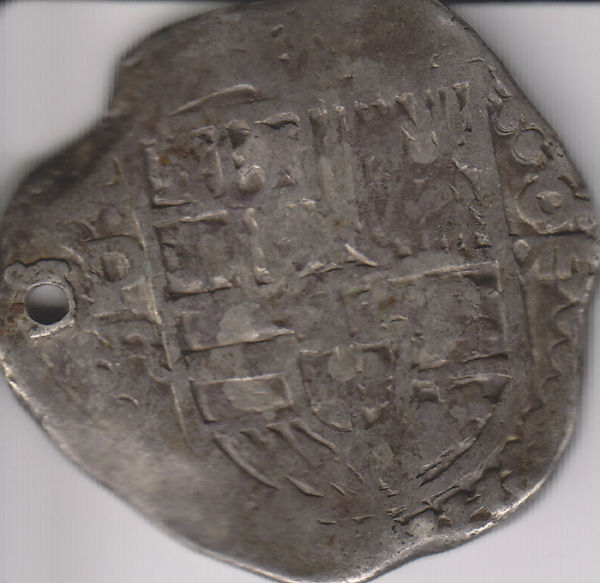 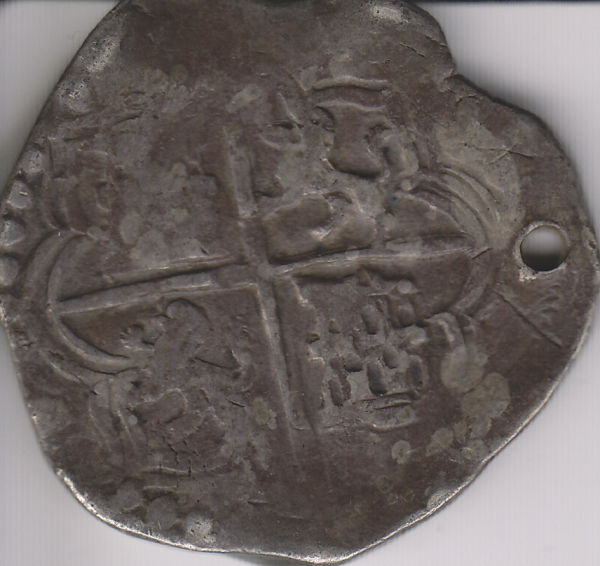 |
|
|
|
Pillar of the Community
Canada
695 Posts |
Your coin has all the appearances of an 8 reales coin from the Spanish Colonial mint at Polosi, Bolivia and could very well have been found in the wreck of the 'Atocha'.
There is nearly full cross with one castle and two lions visible. Full shield with a visible mint mark P and What appears to be the assayer mark below. A coin of this type should weigh about 22.9grams and have a diameter of between 1.4-1.6 inches. The 'Atocha' sank in 1622 so the coin would, obviously be minted before that date. Have seen coins from the 'Atocha' of this denomination and condition selling between US$400-500. If you are able, take it to a reputable dealer for full evaluation.
|
|
Pillar of the Community
France
1591 Posts |
The issue is that Atocha coins worth the premium if they come with the Atocha certificates. Else they are worth the price of a regular cob.
This one being pierced, I don't think it comes from the Atocha (it looks like an ancient hole)
|
|
New Member
 Nicaragua
4 Posts |
Thank you very much aiglet7, you've been very helpful. I have been researching about the "Atocha" coins and I do think that my coin is authentic. I don't know why that hole is there, but that's how I received it.
I currently live in Nicaragua (central américa), and I have no idea where I could get a professional evaluation, least to say an atocha certificate. What could I do? Can that be done here? o by Internet?
|
|
Pillar of the Community
United States
689 Posts |
Call me paranoid, but this does not look right. Lion monkeys, fake pantina, fat devices... caveat emptor.
|
|
Pillar of the Community
United States
1962 Posts |
MJValladares... I think you have a misconception of what is meant by "an Atocha coin". The Atocha (short for Nuestra Senora de la Atocha) was simply a ship that wrecked in 1622, not a type of coin. This style of coinage is called a cob, hand-struck on hand-cut planchets; the Spanish world calls it "macuquina". Now, this was the same style as the coins that went down on the Atocha... however, the pedigree to THAT particular shipwreck makes an "Atocha coin" more valuable. Because the ship was particularly loaded with silver and gold, the long search to find it became famous and as such, the coins that were salvaged from the Atocha wreck sell (now) for roughly a 2-3 times premium over what normal "cob" coins of the period sell for. As mentioned in a prior post, the paperwork confirming that a coin came from the Atocha (primarily a photo-certificate) is quite important to the value.
Your piece is certainly not from the Atocha... It does not look to be a sea-salvaged coin at all... rather, it appears to have come from a reasonably well-protected land-hoard based on the patina. The speckled toning is a bit odd, but I think that's just due to "environmental effects" of how/where it was stored. The detail looks fine for assayer "curved R" (this dates the coin to right around 1602-1613)... lions/castles are normal style for that period, etc. I don't think authenticity is a question. It is quite worn (appears to have circulated for quite a long time, which would be pretty typical for a piece used in Central America), and it's obviously holed... but overall, not a terrible example. Value - assuming that in hand it is authentic, somewhere in the area of $100-150 American.
NOTE: DON'T try to clean it! Leave the patina as is.
Just to confirm the exact attribution of the coin:
-- 8 Reales (see the VIII denomination to the right of the shield)
-- Potosi mint (Bolivia, known as Upper Peru in Colonial times), denoted by the "P" to the left of the shield
-- assayer R, curved (approx. 1602-1613 - mark shown below the "P")
The prescribed weight for these was supposed to be a little over 27 grams as made... This varied slightly because they were hand-cut and sometimes the alloy was not precise... plus, circulation wear, possibly some edge-clipping, and the hole would all combine to reduce this particular piece by somewhere between maybe half a gram to as much as several grams.
|
|
Pillar of the Community
Canada
695 Posts |
|
| |
Replies: 6 / Views: 4,437 |
|










 Posted 01/16/2012 04:39 am


