









 Posted 01/26/2012 10:20 am


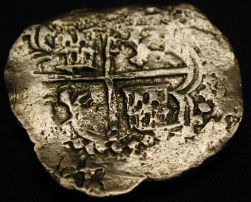
The piece is a cast REPLICA of a Potosi mint (current Bolivia) 8 Reales coin... The assayer mark is not present (due to the imperfect strike of the coin they copied for this replica), but from style elements it's probably an assayer "R" piece dating to right around 1605-1613 (give or take a year on the front end of that). I happen to have a picture of another specimen of this replica. Note that these "cob" coins were hand-struck on hand-cut planchets... no two will ever be exactly alike in terms of the exact impression of detail on the same exact shape of planchet. See below... Given the exact era of the coin, and its general "look" (like it was cast from a well-preserved sea-salvage example), this is almost certainly intended to be an Atocha replica coin.
Note that you should be able to at least strongly suspect that this piece is a cast copy without seeing its "twin". First, the piece shows very little substantial "corrosion", yet it's over 8 grams underweight. In terms of the surfaces, the cross side in particular shows pores typical of casting, plus there's roughness in the protected areas. And yes, with experience you CAN (at least some of the time) tell the difference between sea-porosity and casting porosity... even on a piece that is cast FROM a sea-salvage coin. The pores on a cast tend to be more random/discrete, caused by air bubbling when the cast forms.
There may or may not be some visible remnants of a casting seam along the edge, depending on how well they tried to conceal it.

Note that you should be able to at least strongly suspect that this piece is a cast copy without seeing its "twin". First, the piece shows very little substantial "corrosion", yet it's over 8 grams underweight. In terms of the surfaces, the cross side in particular shows pores typical of casting, plus there's roughness in the protected areas. And yes, with experience you CAN (at least some of the time) tell the difference between sea-porosity and casting porosity... even on a piece that is cast FROM a sea-salvage coin. The pores on a cast tend to be more random/discrete, caused by air bubbling when the cast forms.
There may or may not be some visible remnants of a casting seam along the edge, depending on how well they tried to conceal it.
Edited by realeswatcher
01/26/2012 10:31 am
01/26/2012 10:31 am


