Notes on when
Bermuda - Hog money in 1600s
Biafra - briefly for their coinage in 1968/1970 and later as part of Nigeria. Nigeria was the last country to abandon the setrling system in 1973.
British West Africa - On their coins until 1957/60
El Salvador - No its a Hispanic country so all pesos and reales unless the Brits controlled a piece of it for a few weeks in the 1700 or 1800s
Gambia - as part of British west africa and independently until 1971 when the Dalasi came in, a 1966 coinage included a 6d piece. 6d = 5 Bututs
Ghana - Issued its own sixpences in 1958 and used until 1965 when replaced by Cedis and Pesewas - 6d = 5 Pesewas
Great Britain - Right up to 1971, the first sixpence was issued in the mid 1500s.
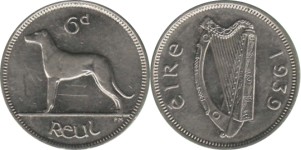
Ireland - Used British coinage until 1922 and then its own sixpence or "reul" from 1928 to 1971.
Irish coins go back to the 10th century, but the bulk of them especially later ones were penny and lower copper tokens until 1928 excepting some bank tokens of the 1810s including a 5d and 10d!
Ireland Republic - See above, the republic was formed in 1949 but had been using Irish reuls since 1928.
Isle Of Man - British coins and I think a local issue in the 1960s.
Malawi - Colonial coins until 1964 when independent Malawi issued a set of sterling coins in 1964 with a 6d. Switched to Kwacha and Tambala in 1971. 5 tambala in 1971
Mozambique - No - unless the Brits used them on the Salisbury - Laurenco Marques line.
New Guinea - Yes from 1880s and own 6ds issued in 1936 and 1943. Australian coins 1946 to 1966 then Aussie 5 cents to 1975 and 5 toea after 1975.
New Zealand - Yes from 1933 own coins and British before. In 1967 became 5 cents
Nigeria - BWI coins from 1800s and 1960 issued 6d coins under Federation of Nigeria until 1972 when it became 5 Kobo.
Rhodesia - Yes used British and South African coins to 1932, then Rhodesian 6d coin up to 1970 when it became 5 cents. Rhodesia is now Zimbabwe.
Rhodesia And Nyasaland See notes above, used Rhodesian coins and a R and N coinage used between 1953 and 1963 when this federation was operating, included both Rhodesias and Nyasaland (Now Zambia, Zimbabwe and Malawi)
Scotland - Had its own coinage until 1707, by the 1500s the scottish pound was worth less than English one, so that a Scottish 6d was an English ½d!
South Africa - Yes 1923 to 1961 when it became 5 cents
Also South African Republic(Transvaal later) 6d (Boer coinage 1892 - 1900). Before 1923 they (Union of South Africa after 1910 and before Natal and Cape Colony to 1902 and OFS and Transvaal (1902 - 1910) used British coinage.
Southern Rhodesia - See notes fro Rhodesia, existed between 1923/53 and 63/1965 when it became Rhodesia.
Trinidad & Tobago - Yes used Carribean and Jamaican coinage until 1951 when it went decimal. 6d = 12 East Carribean cents.
United States before 1790, colonial coinage was sterling, various colonial 6d coins from 1650s onwards, none after about 1790.
Zambia - Used Southern Rhodesian, British, R and N and then its own Sixpences from 1964. In 1968 became the decimal Kwacha and 6d was 5 Ngwee.
Other countries
Australia - Used British coins to 1910 and minted own 6d coins from 1910 to 1963 - in 1966 it became 5 cents. Australian coins used in most Western Pacific Islands as well.
Fiji - Used British, New Zealand and Australian coins to 1934, own 6d coin up to 1969, then 5 Fijian cents. Fijian coins used in Tonga and Samoa too.
Lesotho and Swaziland - Used South African 6d coins until 1961 when they also adopted rand. In 1974 they got their own currencies of Maloti and Emalangeni.
Botswana and Namibia (South West Africa and Bechuanaland) - used sterling coinage until 1961, then Rand and later the Namibian Dollar (1993) and Botswanan Pula (1976)
Ceylon - Used British coins until 1876 when it switched to decimal rupee
Seychelles and Mauritius - as above 1876/77 switched to a decimal rupee - before imperial coins including 6d. General rule of conversion 6d = 25 rupee cents or 1/4 Rupee.
Canada - Used sterling system and British coins until 1858, Prince Edward Island and Victoria Island up to 1870s.
Malta - Used British sterling coinage until 1972.
Independence came in 1964 but own coins of decimal Lira only arrived in 1972 - 6d = 2½cent
Gibraltar - Used British coinage 1702 - 1886 and 1890 to 1971 when they went decimal with Britain. A brief period in the late 1880s saw them using Pesetas.
St. Helena, Tristan Da Cunha, Ascension, Falkland Islands, Channel Islands, IOM and British Antarctic Territories - all used British coinage in both sterling and decimal eras. Channel islands issued some coins, but not any 6d ones.
Niue, Cook Islands, Samoa, Tonga, Fiji, Gilbert and Ellice, British New Hebrides, British Solomon Islands, Pitcairn Islands - all used the Pound sterling and the 6ds in use at various times were either British, NZ, Aust or Fijian.
This should cover most bases, no doubt I will miss some!












 Posted 02/03/2012 6:54 pm