| Author |
 Replies: 10 / Views: 2,327 Replies: 10 / Views: 2,327 |
|
|
Valued Member
United States
80 Posts |
I have heard the opinion that the word COB possibly came from the Spanish words Cabo de barra and that they were cut from the end of a silver bar of the appropriate diameter. Now I have worked with silver quite a bit and find that if I were going to make planchets from a silver bar I would first pour the molten silver out on a flat surface, making the thickness about the thickness of a finished coin. I would then use some type of shears to cut the planchet to the desired weight by clipping the edges, a much easier task.
I would think if extremely difficult to cut the end of a bar off and obtain the thickness wanted, especially as silver is fairly hard. Any opinions out there?
Mike
|
|
|
|
Valued Member
Germany
194 Posts |
You are perfectly right in your assumption, here is an expert article on the subject: http://www.sedwickcoins.com/strap.htmIn Germany, cobs are also called "Schiffsgeld", that is "ship money", allegedly because the Germans thought that the cobs were produced on board of the Spanish galleons during their travels back to Europe. Which means that misconceptions about these coins are most likely as old as the coins themselves... |
|
Valued Member
 United States
80 Posts |
Thanks for the article dosmundos. I have never seen this article before and completely agree with him. Thanks again. Mike
|
|
Pillar of the Community
France
1591 Posts |
Excellent reading, I was wondering since a while (especially those bubbled cobs)
|
|
Valued Member
United States
328 Posts |
A very interesting article. I too have wondered how the heck they cut planchets off the end of a bar.
|
|
Valued Member
Germany
194 Posts |
Is it just my computer that's not showing the picture that comes with the article, or is it a problem of Sedwick's?
|
|
Pillar of the Community
United States
689 Posts |
Cabo de Barro, is the most widely believed origin of cob.
However, Colin Bruce in Krause's Standard Catalog of Mexican Coins, Paper Money, Stocks, Bonds, and Medals (1981) states that cob is derived from the Middle English (or Dutch) word "kub" meaning lump or piece.
|
|
Pillar of the Community
United States
1962 Posts |
http://www.sedwickcoins.com/strap.htmAs Sedwick notes: "We must emphasize that this method only applies to Mexican cobs from the early 1600s to early 1700s. The earlier coins and those from other mints are much more round, which means either there was a different method for making those blanks or the blanks were simply (but laboriously) trimmed down to more circular shapes."... In looking at the typical shapes of Mexican pieces, I think that should more properly be from around the 1670's through the 1730's... The typical semi-roundish "barrel-shape" Mex 8R you see up until about the 1660's, and certainly the rounder pieces from the 1620's back (and of course the Potosi and Lima pieces) could not have been produced with that method.
|
|
Pillar of the Community
Czech Republic
803 Posts |
A while back I remember reading a cob study from one of the shipwrecks that illustrated multiple cobs matched side by side, hypothesizing that instead of cutting ends of a bar, silver was poured in a strip and cut into pieces before striking. I'll see if I can dig up the article.
|
|
Pillar of the Community
United States
1962 Posts |
Kopeiki, that was almost certainly this Sedwick article... The article's photo link seems broken... this was it: Again, looking at that illustration, clearly the earlier style Mex cobs and most of the South American cobs were produced differently. 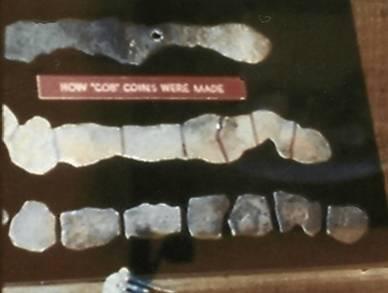 |
|
Pillar of the Community
Czech Republic
803 Posts |
|
| |
Replies: 10 / Views: 2,327 |
|







 Posted 03/02/2012 3:37 pm





