| Author |
 Replies: 19 / Views: 6,458 Replies: 19 / Views: 6,458 |
|
Pillar of the Community
 United States
2703 Posts |
This morning I placed an low bid on this halfpenny and went off to a coin show. I figured I would be easily outbid. Just now checked the website and I won it!   |
|
|
|
Bedrock of the Community
United States
10045 Posts |
That is a beautiful coin!
|
|
Pillar of the Community
Canada
1610 Posts |
 Wow, she's purrrty. Do you mind me asking how much you paid? |
|
Pillar of the Community
United States
2224 Posts |
WOW! That is one sweet coin! I second the ! |
|
Pillar of the Community
 United States
2703 Posts |
70 euros + 10% buyers fee = 77 euros (US$100)
|
|
Pillar of the Community
Canada
1610 Posts |
Woah, that's cheap! Good job  |
|
Moderator
United States
23731 Posts |
|
|
Pillar of the Community
United States
2224 Posts |
This is probably a dumb question, as I know little about British coinage of this era, but does this coin show signs of being struck on an already struck coin? I see a lot of extra lettering under BRITTANIA and some other extra detail, especially on the reverse.
|
|
Bedrock of the Community
Australia
21792 Posts |
The copper of George 11 in this condition is very scarce indeed. I have a few, but none anywhere this grade.
|
|
Pillar of the Community
United States
2703 Posts |
Quote:
This is probably a dumb question, as I know little about British coinage of this era, but does this coin show signs of being struck on an already struck coin? I see a lot of extra lettering under BRITTANIA and some other extra detail, especially on the reverse. On the contrary, that is an EXCELLENT question! On the reverse, the incuse letters running under "BRITAN" are "GEORGIVS" running counterclockwise, and you can see an incuse "II" just under the shield. I vertically flipped the image of the obverse to see how another coin might have caused an obverse brockage. Obverse brockages occur when the previously struck coin is not ejected and gets stuck to the lower die. This planchet looks like it got a weak impression of the obverse design from an initial striking with a coin stuck in the lower die, then the stuck coin was ejected, and the planchet struck again normally. If someone has a different explanation, let us know.  |
|
Pillar of the Community
United States
2224 Posts |
No, I think you nailed it! That makes plenty of sense. Since the coin is in such fantastic condition the brockage is very clear. A thought: might it be severely clashed dies?
|
|
Pillar of the Community
United States
2703 Posts |
I think the lettering would be raised (not incuse) if it were due to a die clash.
No that's not right. A die clash would look similar. It would have to be a very severe die clash to produce such a strong effect.
Edited by t360
03/12/2012 08:28 am
|
|
Bedrock of the Community
Australia
21792 Posts |
t360: Was the 70 Euros what you bid, or was it the hammer price?
|
|
Pillar of the Community
United States
2703 Posts |
There was one other bidder at the opening bid of 60. I bid 70. The hammer price was 70.
|
|
Pillar of the Community
United States
3499 Posts |
Amazing coin! very pretty!
|
|
Pillar of the Community
778 Posts |
Hi - I believe that this is a Die Clash. Sometimes they are quite strong, like the incuse lettering near the bottom of the obverse of this piece from Bolivia - 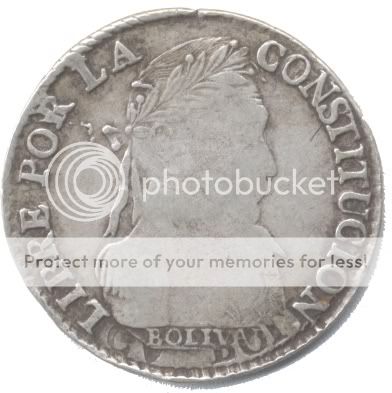 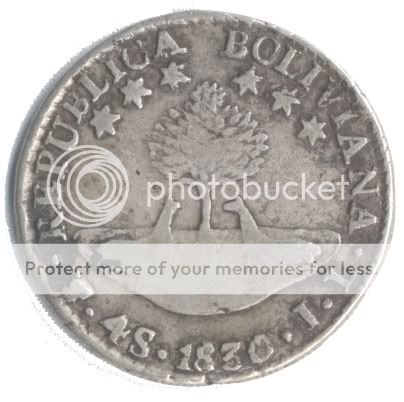 Super-nice halfpenny, by the way! Bill Edited by BillSnyder
03/21/2012 5:03 pm
|
| |
Replies: 19 / Views: 6,458 |










 Posted 03/11/2012 6:57 pm


