| Author |
 Replies: 22 / Views: 22,211 Replies: 22 / Views: 22,211 |
|
New Member
Australia
2 Posts |
Hi all
I am new to forum so if I do something wrong just let me know
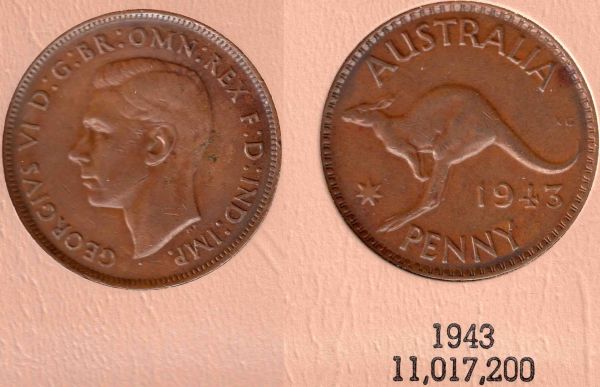
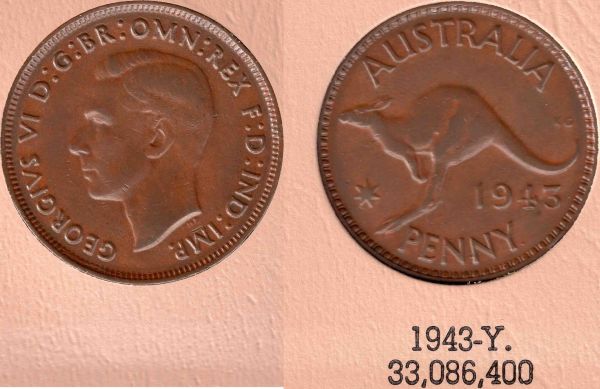
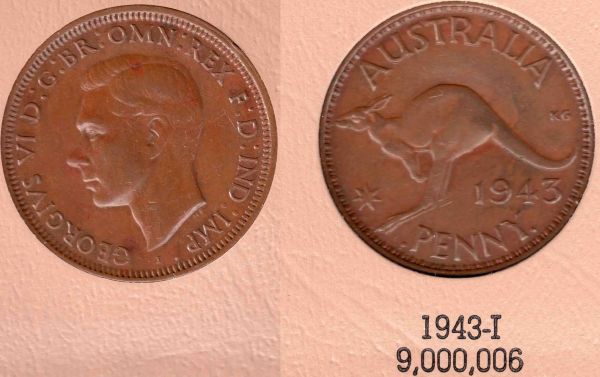
If a 1943 penny is worth anything it was minted in india as it has a I under the head and the penny has a . Before and after
I also have a few other old coins is there a data base anywhere so I can look them up
|
|
|
|
Pillar of the Community
Australia
4411 Posts |
The 1943 could be worth between 50c and a couple hundred depending on its condition. Could you post some pictures?
|
|
Valued Member
Australia
312 Posts |
Welcome, Joy. enword is right, it could be worth little or more depending on condition, need see the picture first.
|
|
Pillar of the Community
Australia
7096 Posts |
 Joy Mob1 Another Aussie is here  . Can you either take a picture of the coin or scan it and post the piks  |
|
Pillar of the Community
Australia
541 Posts |
|
|
New Member
United States
21 Posts |
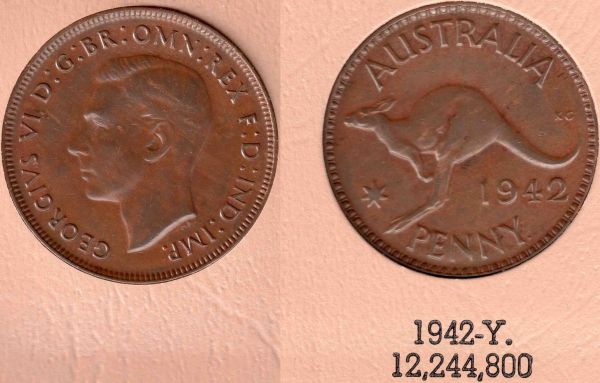
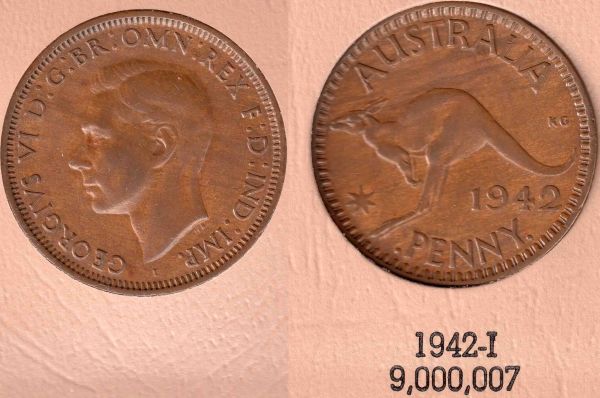
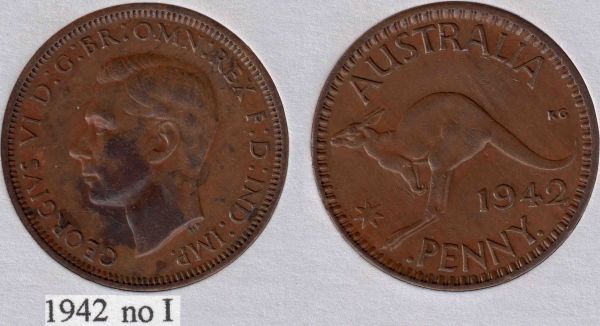
Hello Everyone! I recently found one of the 1942-I Australian Pennies.
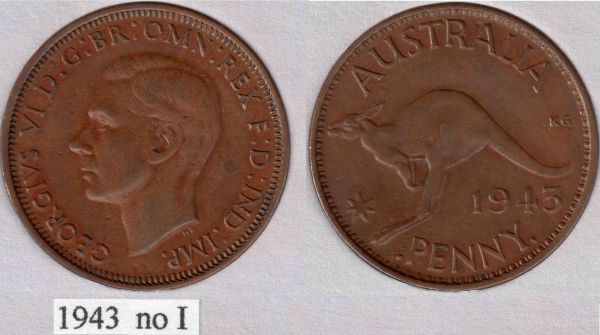
It has the two dots and large denticles on the reverse, however the I is missing on the obverse. has any one every seen or heard about this mint error?
|
|
New Member
United States
21 Posts |
Hi Everyone! I found the pictures of the Mint error 1942-I- Penny. 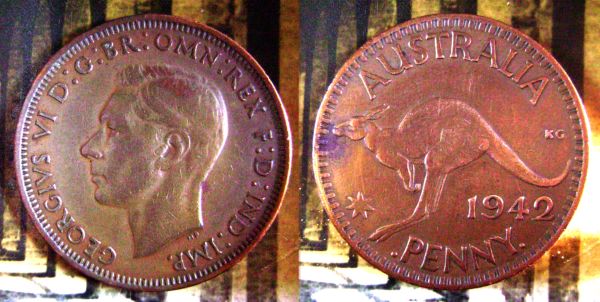 |
|
Pillar of the Community
Australia
1607 Posts |
The 1942 I missing mint mark is a Very Scarce variety/error & value ? not sure.
Edited by appleangel07
04/16/2012 11:18 pm
|
|
Valued Member
Australia
51 Posts |
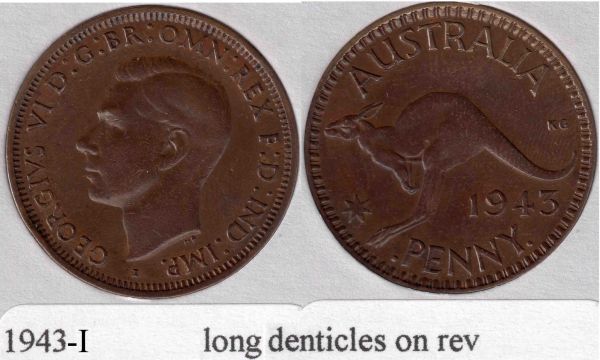
The missing "I" exists for both the Indian minted pennies of 1942 & 1943. Of course none of the Perth minted 1942-Ydot, 1943-Ydot or Melbourne minted 1943 had an "I" mintmark so don't initially get excited if you don't see one. It has to have a dot both before & after PENNY on the reverse & tall denticles & the P of IMP aligning with a gap between rim denticles on the obverse.
BTW in 1943 the Bombay mint used both long & short beaded reverses but all 1942 Indian minted penny reverses had long beads.
In 2010, a 1942 penny with Indian die obverse but no "I" mintmark cost $20.00 & a 1943 penny with Indian die obverse but no "I" mintmark cost $35.
|
|
Pillar of the Community
Australia
869 Posts |
Those prices are valid if the coin hasn't been cleaned.
It looks like it has at some point in its life.
|
|
New Member
United States
21 Posts |
 I recently received this link that explains the missing I mint mark on the 1942 Australian Penny See Also: [url]http://www.triton.vg/[url] A portion of the page [below] However it is well known that some 1942 pennies struck in Bombay do not show the "I" mintmark. It must be remembered that it was wartime and the need for coins was urgent. I personally packed, addressed and wrote out the Customs Declaration for the first pairs of master dies and punches sent to Bombay. They were made at the Melbourne Mint and did not have an "I" on them for the excellent reason that Melbourne did not possess an "I" punch. It seems that, the need being urgent, they were put to use immediately on arrival, and later a new master tool was struck using an "I" in Bombay's possession or which they acquired from elsewhere.~~Bill Mullett 1996 "Notes on Australian Pre-decimal Coinage" (Journal of the Australian Numismatic Society, 1996) |
|
Valued Member
Australia
51 Posts |
Yes & the article goes on to speculate that because the coins produced in India were different to those made in Melbourne & that Melbourne was unlikely to have made unique dies specially for India, "the dies from Melbourne presented the Bombay Mint something of a technical challenge. Perhaps its coining presses could not render the high-relief designs properly so the Bombay Mint elected to prepare new tools more suitable for its equipment." It would most likely have been this newly prepared Indian master obverse die that was missing the "I" mintmark & which produced working dies that initially were also missing the "I" but which was soon incorporated.
As well as longer denticles, the coins made from these dies in India show a much more robust chin on the kangaroo than coins made elsewhere. It is also likely that the Indian prepared reverse die didn't have the final year in the date but only 194 because originally the 1943 coins were missing the "I" as well (although again it was soon included) & their design matched that of the 1942 coins. However, in 1943 this design was apparently not considered suitable (maybe the difference in denticles was noted) and was soon replaced by a revised Bombay reverse that had shorter denticles than the previous design & this was used to strike the bulk of the 1943 pennies.
So the missing "I" certainly seems to be a genuine mint manufactured variety unlike the missing "I" from the 1916 halfpennies in examples I've seen where in certain lights the ghost of an "I" can be seen indicating that in this case, the absence of an "I" was produced by die fill.
|
|
Valued Member
Australia
51 Posts |
Incidentally, according to an article in both my 1970 & 1980 editions of Renniks Australian Coin & Banknote Guide by Dion H. Skinner, at the time of the changeover to decimal coinage in Australia, the Bombay mint rather cheekily but superbly re-struck these 1942 & 1943 halfpennies & pennies in proof condition from the old dies that unfortunately were probably rusted because they were abrasively cleaned. However, on learning of this, the Australian government soon put a stop to this enterprising activity & the dies were returned to the RAM. Very few sets of these 4 coins were sold & in 1980 the price for a set was reported as $1,000 (in 1970 it was $400) so who knows what they would fetch today.
|
|
Pillar of the Community
Australia
4411 Posts |
I remember reading about that  cheeky buggers!  P.s. S. Debt your information is great! Thanks for sharing Edited by enworb
04/17/2012 7:13 pm
|
|
Pillar of the Community
Australia
852 Posts |
A pair (penny and halfpenny) of restrikes goes for around 40 thousand, I didn't know that they sold them as sets of 4 coins and havn't seen them come up that way at auction. IIRC they didn't just restrike the Australian coins but also coins from other parts of the Empire.
Filled "I" coins also exist for the 1916 and 1942 pennies (not to be confused with genuine missing "I" 1942 pennies). An early issue of Australian Coin Review had a good photo of an UNC 1943 "no I" but I don't know if it was due to die fill (probably) or mint staff forgetting the I punch.
The denticle variety of 1943 is about 1 in 30 coins as is the 1942 "no I" (I've searched through huge numbers of coins)but have never seen a 1943 "no I" (excepting the ACR photo).
|
|
Valued Member
Australia
51 Posts |
|
| |
Replies: 22 / Views: 22,211 |







 Posted 03/25/2012 01:40 am