| Author |
 Replies: 12 / Views: 2,396 Replies: 12 / Views: 2,396 |
|
|
Pillar of the Community
Australia
869 Posts |
|
|
|
|
Pillar of the Community
Australia
515 Posts |
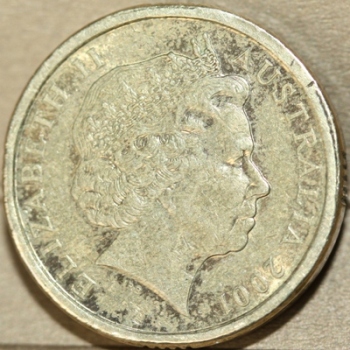
hmmm......circulated proofs can look like that.........
|
|
Pillar of the Community
 Australia
869 Posts |
There you go. I'll store that one in my brain for future reference. If only it was a 1991.  |
|
Bedrock of the Community
Australia
21789 Posts |
You have dazzled me with stats, tatts, cats & rats! I like the guy's X-ray eyes. Do laser beams come from them?
BTW,
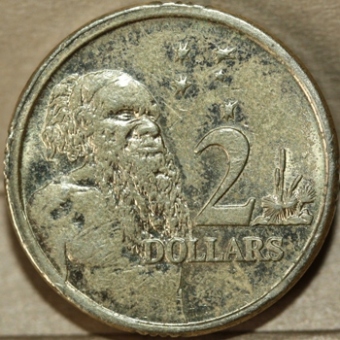
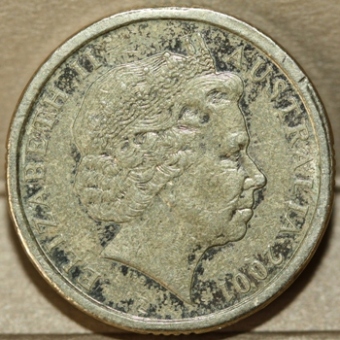
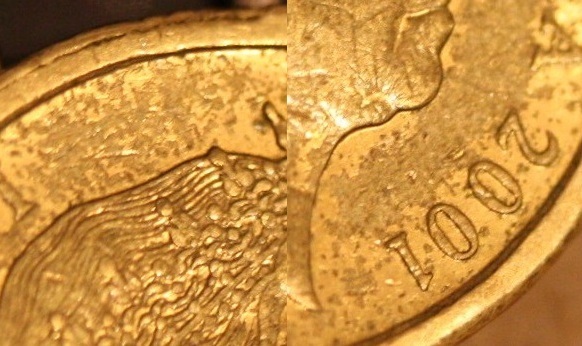
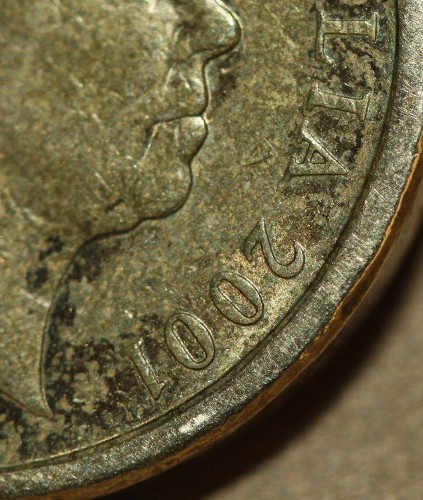
Your coin is struck slightly off centre, and is halfway to being declared as 'roadkill'. I am reasonably sure that the Mint uses nickel plated dies. I do have a coin that has been struck from rusted dies, and the texture on the coin is different to what has been pictured here.
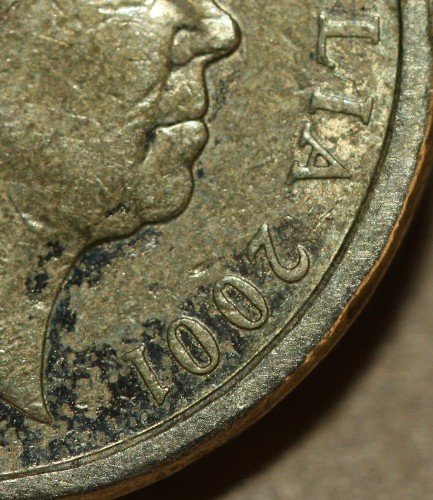
The black staining which is post Mint, maybe organic OR inorganic. Try cleaning it with acetone. If the black remains, it is probably copper chloride, oxide or sulphide, all three of which are inorganic.
Edited by sel_69l
04/23/2012 11:49 am
|
|
Pillar of the Community
Australia
2830 Posts |
I'd guess that the black is mould, and that this coin has had a tough life, lost in a dark nook somewhere ... until someone moved the furniture.
And, the road-damage theory is good too.
But my first reaction, as I looked at the pics, was to wonder if this might be one of the counterfeits that we've heard about ... ?
|
|
Formerly nancyc
Australia
5385 Posts |
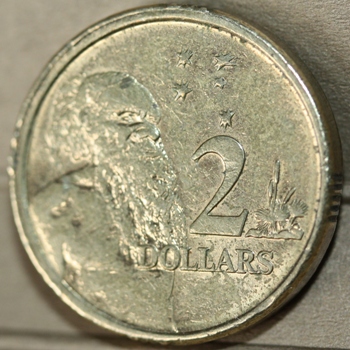
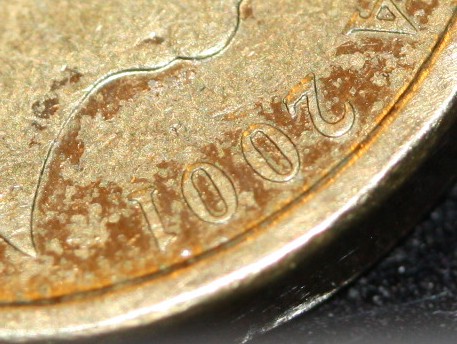
I also think that it's a Proof that made it into circulation. I'm certain the 'black' isn't mould, it's just that gm has taken several different pics from several angles.  life is a mystery to be lived not a problem to be solved
|
|
Pillar of the Community
Australia
1295 Posts |
Definitely a circulated proof.
|
|
Pillar of the Community
Australia
1005 Posts |
I was thinking that the "dark areas have mint lustre" part might mean that there is a coating that has protected the lustre, but has itself discoloured.
That could fit with either the "bored schoolkid" or the "proof in the wild" (as proofs are coated).
Since knowledgeable members are saying "proof in the wild" I would go with that.
I guess the main point of my post is to add a theory on why a proof might end up looking like that (the coating getting affected by circulation)
|
|
Bedrock of the Community
Australia
21789 Posts |
I don't think this coin is a severely impaired proof. If that was indeed the case, there would be some evidence of a polished field in between the letters. I can't see any evidence of this.
|
|
Pillar of the Community
Australia
4411 Posts |
I saw a circulated 20c proof on this sight a while ago. Cant find it again but it looked very similar. I agree with others that is is a proof coin, or once was. Moral of the story - dont put your proofs into circulation |
|
Pillar of the Community
Australia
1295 Posts |
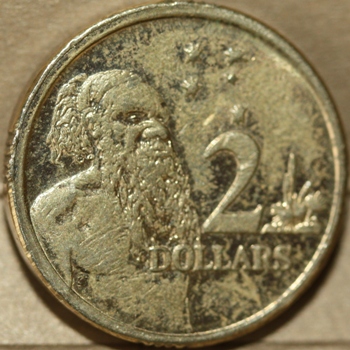
The dark areas ARE the mirrored fields. Mirrored fields typically show up black on photographs because they reflect all the light perfectly away from the camera lens rather than scattering it like the surface of a coin normally does. I've found several proof $1 coins in the wild and received a $2 proof in change on an QANTAS flight of all things. They all look like this coin. Here's one that looks almost the same, it's not a proof but you can see how the protected highly reflective areas appear black while the scuffed up parts do not.:  |
|
Pillar of the Community
Australia
1005 Posts |
markn,
Thanks for clarifying.
GM are the dark parts on the Queen (throat and hair) also shiny, or is that dirt?
|
|
Pillar of the Community
Australia
869 Posts |
Very interesting. Well I'll know what they are in the future. Thanks guys/girls. Appreciate it.
|
| |
Replies: 12 / Views: 2,396 |
|








 Posted 04/23/2012 04:57 am





