| Author |
 Replies: 31 / Views: 4,284 Replies: 31 / Views: 4,284 |
|
|
|
Pillar of the Community
United States
4132 Posts |
The key is the economics of extracting whatever you're trying to mine. Take a look at this picture:  This is a 19th century photograph from deep inside the Quincy mine in Hancock, MI. During operation it was the deepest underground mine in the world, its main shaft driving 1.75 miles into the earth along the 55 degree slope of the lode. The bottom of the mine was close to 100 degrees F because of its depth. See that blobby, car-sized object upon which our mustachioed miner reclines? It's a mass of pure copper. Michigan's copper country is one of just a few places where native copper like this was commercially mined. Rich deposits of truck sized boulders of pure copper sound pretty enticing, but it was quickly discovered that they were not all that economical to mine. 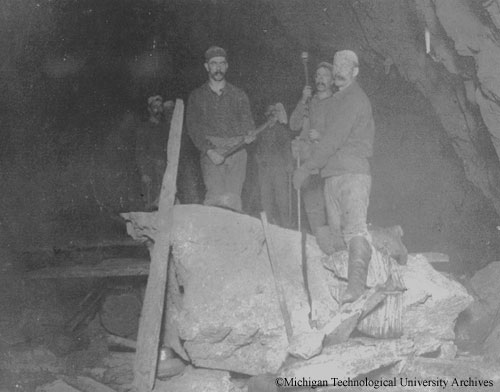 Here are some miners cutting up the last bit of what was once a 300 ton mass of copper. It's not possible to lift such masses to the surface, so they had to be broken up. Solid masses of copper couldn't be blasted, even if they could have been drilled. They had to be cut into pieces. Two miners would swing hammers while a third guided a chisel across the surface of the gummy metal, slowly cutting it a little deeper with each pass. Pretty soon the mines there switched over to amygdaloid and conglomerate deposits. These were less rich, but had primarily smallish pieces of copper embedded in the rock. The ore could be easily broken up and brought to the surface, and had the copper removed mechanically. Eventually underground mining of native copper became economically impossible. They were competing with open-pit mines out west that mined poorer ore containing tiny flecks of copper or copper compounds. But they were mining it at the surface with steam shovels instead of a mile under the earth with chisels and hammers. There are still boulders of copper weighing hundreds of tons under the basalt of Michigan's Keweenaw peninsula. But until the deposits of "easy" copper dry up, and the value of the metal multiples to several times its current price, they will remain there. And re-opening these mines is a piece of cake compared to going to space. |
|
Pillar of the Community
United States
3670 Posts |
Very fascinating story and great history an info on the copper mining history and those copper boulder pics are amazing, very cool....
But your last paragraph points toward your thoughts on it not being ECONOMICALLY FEASIBLE. But again I feel this is irrelevant compared to what may come of the discoveries that again we can't understand until someone begins to go through the motions....
Is it gonna be cheap early on, no? Will mankind as smart as they are find ways of bringing it home way cheaper in time? Little doubt in my mind that they will indeed do so....
Do people who are interested in FUNDING this project have more money then they or any family member could blow in 10 lifetimes in all likelihood, so who cares let them cover the early bills of this frontier. It is all in the name of science an discovery in the end....
When Cameron just dove to the bottom of the seas it probably cost way more then what it produced as has many of his Titanic explorations, again irrelevant in the eyes of science an future generations....
Edited by Silverhawk74
04/30/2012 2:49 pm
|
|
Pillar of the Community
United States
4132 Posts |
We've been going to and from space for a good long while now, and it's still really expensive. the barrier is the energy costs of lifting stuff into space (around $11,000 per pound), and mining equipment is heavy.
Marketing this as space exploration, or research is one thing (and I'm a big booster of space exploration and research.) But I'm not sold on it as a practical means of gathering resources for use on Earth unless you've got some material on asteroids that's worth $100,000 per ounce.
It might be useful for getting resources for use in some space-borne industry (again, because lifting things off the Earth is so expensive), but going for the mining first is putting the cart before the horse. You have to have a plausible space industry that would use the resources. No sense in building a general store out in the wilderness hoping that an industry and a town shows up.
It might make more sense to start investing in projects to develop a space elevator or similar to bring down the costs of putting things into space (Google apparently is already putting money into this).
Edited by CaptainFwiffo
04/30/2012 3:05 pm
|
|
Pillar of the Community
United States
3670 Posts |
You are right CW with some great valid points as always, I just like to dream, lol....
So many variables an different types of thought an opinions at play. Who knows what the future may bring. Perhaps the company the provides the resources needed for such exploration, will put up the fuels to get the job done in exchange for their name being plastered all over the title of the company and large amounts of the pm's a minerals (whatever) they find in their mining efforts being given back to them in return. The first ever space exploration an the company which backs it. Totally hypothetical of course, but perhaps something similar could or will take place....
New undiscovered cheaper sources of energy in the future perhaps, making it more feasible an so on....
|
|
Rest in Peace
 United States
9104 Posts |
Quote:
Won't mining millions of pounds of platinum from an asteroid dillute the market on Earth?
Plentiful doesn't mean cheap. Others are mining the huge quantities of PM in the oceans. |
|
Pillar of the Community
United States
4008 Posts |
Quote:
Others are mining the huge quantities of PM in the oceans. Indeed they are, Fredd, but they are fighting dilution with tons of seawater needing to be processed for each ounce of PM that is recovered. One technique that might be promising is a large flow-through tube packed with ion exchange resins that specifically attract gold, silver, etc. If they can do this and then effect the release of these metals on demand, such as by supplying a small electric current of just the right voltage, this could become profitable. They would also need to harness wave or wind action to provide the sea water pumping because they would be doing a HUGE amount of that. It might also be possible to tow such a recovery device behind a ship and use the recovered metals profits to off-set the cost of the ship's fuel and the cost of the resin. Although specialty ion-exchange resins can be quite expensive, this kind of extraction could be quite gentle as a process, which would allow the resin to be used many times before it needed to be re-manufactured or replaced. Seems as if there could be a lot of potentially profitable possibilities in this. |
|
Pillar of the Community
United States
808 Posts |
Quote:
One technique that might be promising is a large flow-through tube packed with ion exchange resins that specifically attract gold, silver, etc. If they can do this and then effect the release of these metals on demand, such as by supplying a small electric current of just the right voltage, this could become profitable. Seems like a well developed concept you've got there, Ed. Do you know of any university research or corporate R&D actively working on perfecting this process? If not, I recommend you chat with your lawyer about filing a patent on this idea of yours.  |
|
Valued Member
Canada
262 Posts |
Quote:
You never know when some quantum leap in technology can change things, like aluminum going from more expensive than gold to super cheap. To this day, that boggles my mind. |
|
Pillar of the Community
United States
1454 Posts |
There might be a future in rare earth element mining in space. They're supposedly not as rare on our lunar neighbor as they are here on earth. I'm not sure why they couldn't be found on asteroids, as well. IDK if they are in the necessary $100K an ounce ballpark but REEs are in so many of the products people use today and they aren't called rare earth elements without just cause. China currently has the largest reserves, I think, although I read Afghanistan, of all places, has major untapped REE resources that might pull the whole country out of the opium racket in the future. http://ceramics.org/ceramictechtoda...th-elements/ |
|
Rest in Peace
United States
9104 Posts |
Cost calculations are based on getting a payload to the moon/asteroid, picking up mining and returning it to erf.
Once you are on the moon with a mining operation, the one-way trip from moon to erf orbit will be a LOT less expensive, due to lower gravity, especially from a hemorrhoid asteroid to erf.
|
|
Pillar of the Community
United States
1554 Posts |
*** Edited by Staff for Family Friendliness ***
|
|
Pillar of the Community
United States
4008 Posts |
Quote:
Seems like a well developed concept you've got there, Ed. Do you know of any university research or corporate R&D actively working on perfecting this process? If not, I recommend you chat with your lawyer about filing a patent on this idea of yours. Thanks for the thumbs-up, CW, but that was just something off the top of my pointed head. lol I'm sure that a real process that is commercially viable would require several years of intensive R&D. It has some possibilities, though. |
|
New Member
United States
40 Posts |
Quote:
Cost calculations are based on getting a payload to the moon/asteroid, picking up mining and returning it to erf. If it's to the moon, why pick it back up right away? You're going to need an outpost on the moon, a mining town if you will (picture the wild west mining town's), granted a little bit more modern than those, but with all the same ammeneties. Saloon, Jail, Brothels, etc. Can you imagine what that town would look like? Simply amazing! Granted if you're packing to an asteroid you'll need to pack up and get out sooner, because it will dry up fast and at say 30 meters it wouldn't take long to dig all teh way through, but the moon, is vast. Ultimately while they would be mining for platinum, gold and the usual initially, the key would be finding that next PM, which could be worth the upwards of $100,000/oz. Until they found too much of it of course  OK, I'll pull my head out for awhile and stick with the reality. They aren't looking hard enough at the feasibility of the endeavor. Just the reward. It's like finding silver in rolls of coins, which is awesome, but if you had to drive 400 miles to get that silver, it's not quite as awesome! (Still awesome though)! |
|
Rest in Peace
United States
9104 Posts |
Quote:
Seems like a well developed concept you've got there, Ed. Do you know of any university research or corporate R&D actively working on perfecting this process? Gewgil, for one. http://www.google.com/jobs/lunar_job.html |
|
Pillar of the Community
United States
4008 Posts |
Quote:
This unique opportunity is available only to highly-qualified individuals who are willing to relocate for an extended period of time, are in top physical condition and are capable of surviving with limited access to such modern conveniences as soy low-fat lattes, The Sopranos and a steady supply of oxygen. Hmmm... they don't seem to mention any openings for fat, bald, 62 year old chemists who are almost completely out of shape... lol... guess that this gig is just for the kids! Too bad. They could probably use an older and wiser head for those annoying "yes we can but should we" type questions.  |
| |
Replies: 31 / Views: 4,284 |








 First Page


 Posted 04/30/2012 2:42 pm


