| Author |
 Replies: 14 / Views: 3,232 Replies: 14 / Views: 3,232 |
|
|
Pillar of the Community
Canada
933 Posts |
I was wondering, I used baking soda and vinegar to clean a few coins back when I just started collecting. It works pretty good, but how bad does it "damage" the coins? Would they still be considered "cleaned"
|
|
|
|
Bedrock of the Community
United States
12437 Posts |
baking soda= abrasive
vinegar= acid
both will leave distinct signs of cleaning
|
|
Pillar of the Community
Australia
4411 Posts |
|
|
Pillar of the Community
 Canada
933 Posts |
darn it! some of the coins I just soaked in that solution for a few minutes, but I guess that too would leave obvious signs of cleaning
|
|
Rest in Peace
United States
9104 Posts |
 , RoyalSilver! I don't think a quick soak will hurt. Long term, definitely. And no scrubbing! |
|
Bedrock of the Community
United States
20031 Posts |
If you like your coins, NEVER use this combination on them.
|
|
Bedrock of the Community
Australia
21789 Posts |
What if you have a coin that has been buried, and is impossible to identify without cleaning?
|
|
Pillar of the Community
United States
4333 Posts |
Quote:
What if you have a coin that has been buried, and is impossible to identify without cleaning? I dig hundreds of old coins every year. Some of the silver comes out nasty. One Morgan dollar came up brown as it had been slightly scorched in a fire at one time. I carefully clean some of these, if common date, using baking soda. Some need electrolysis. All of my dug oldies go into a seperate folder/binder, and if not for some type of cleaning they would be unrecognizable. When I listen to LED ZEPPELIN...so do my neighbors...
Roll hunting since '77
Dirt fishing since '72
|
|
Bedrock of the Community
United States
20753 Posts |
Quote:
What if you have a coin that has been buried, and is impossible to identify without cleaning? The main thing is to always try the easiest, safest, least dangerous to coins first. By that I mean to always try warm distilled water first. Next would be just Acetone dipping. Of course many have STUFF on them that will still be there. In many instances the STUFF may now be part of the metal of the coin and removing it, removes part of the coin. This could in some instances be worse than the STUFF on the coin. Sort of like ripping off the material on a Egyptian Mummy do to it being dirty. Or sanding down a 5 hundred year old table if it is dirty. If it is so bad that it takes things like acids, electrolitic methods, baking soda, vinegar, lemon juice, etc., the final cleaning may make it look better but may also ruin it for value. |
|
Pillar of the Community
United States
2269 Posts |
 The least acidic and abrasive method is always the best to use first. Distilled water is a good first step. Cleaning modern coins if usually frowned upon, as for ancients, cleaning is generally accepted. |
|
Bedrock of the Community
United States
20031 Posts |
Quote:
What if you have a coin that has been buried, and is impossible to identify without cleaning? I don't believe the OP was talking about dug coins. Obviously, there are exceptions with horribly corroded coins. Either you have a chunk of unrecognizible junk or you have something you can see. Lincoln Cent Lover!VERDI-CARE™ INVENTOR https://verdi.care/
|
|
Pillar of the Community
United States
4333 Posts |
And everything in-between. Many dug coins are in excellent shape yet are very badly stained. Distilled water soaks will not fix and the coins are terrible to display.
When I listen to LED ZEPPELIN...so do my neighbors...
Roll hunting since '77
Dirt fishing since '72
|
|
New Member
United States
6 Posts |
I've used baking soda to brighten up 'over dipped' silver and they look great even under magnification. A few minutes doesn't hurt I don't think. In fact, they look great if done correctly.
|
|
Bedrock of the Community
United States
17884 Posts |
Quote:
If it is so bad that it takes things like acids, electrolitic methods, baking soda, vinegar, lemon juice, etc., the final cleaning may make it look better but may also ruin it for value. If it is so bad that you have to resort to those methods, it has no value already and you have nothing to lose, and maybe something to gain. After all which has more value a harshly cleaned, pitted, corroded 1914 D Lincoln, or a corroded unidentifiable lump of metal? |
|
Pillar of the Community
United States
1314 Posts |
Always and never are words I choose to avoid on this topic. Your choices very much depend on your objectives and what makes you happy. I have three primary collections. One of them is a type collection of world coins. So far I've got over 2000 and most cost less than $.25. I'm learning a lot and enjoying myself. Some coins beg for attention in the area of cleaning/restoration. Here is one of them. France, 10 Centimes, 1916 Madrid mint. It came with plenty of green crud. The process... 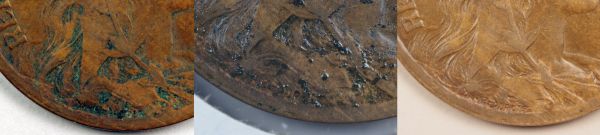 The result... 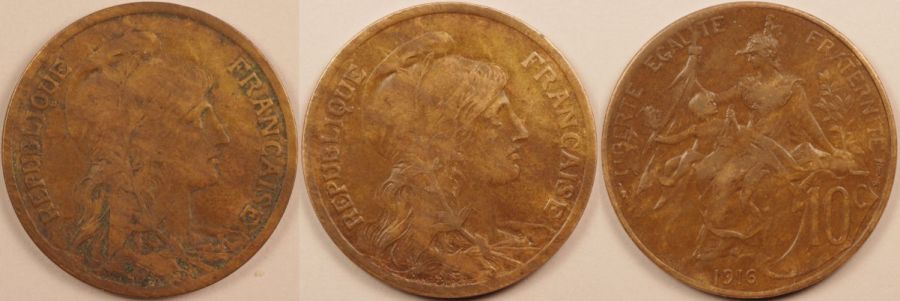 It cost me $.23, and I am happy with the results Edited by Chute72
02/22/2017 7:22 pm
|
| |
Replies: 14 / Views: 3,232 |
|







 Posted 04/28/2012 11:14 pm





