| Author |
 Replies: 21 / Views: 6,407 Replies: 21 / Views: 6,407 |
|
New Member
Taiwan
5 Posts |
Hi guys, Recently I bought a 5 francs an12 silver coin. But its diameter is 38mm rather than 37mm. Besides, it weighs 25 grams, though not UNC. Is this a fake? 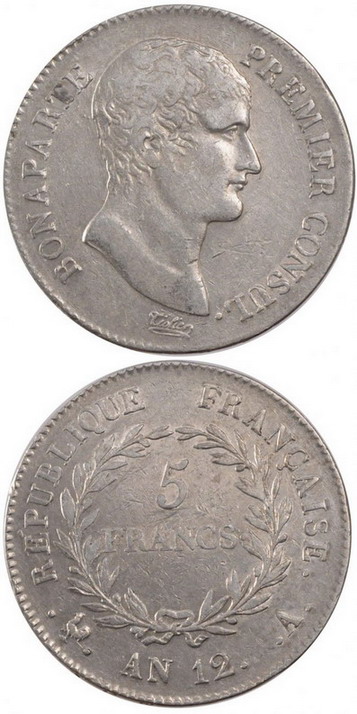 *** Moved by Staff to a more appropriate forum. *** *** Moved by Staff to a more appropriate forum. *** |
|
|
|
Pillar of the Community
United States
2120 Posts |
Nothing jumps out at me to make me think its a fake.
Can we get a picture of the edge of the coin?
How precise are your calipers?
Paris is a fairly common mint. I don't see a fake being made of this particular coin. If someone was, they would do it for Poitiers Mint (G).
IMO, its a very nice example of a VF35 L'An 12 5 Franc. If you paid anywhere between $100-$135 USD, or less, I would be happy with this purchase.
|
|
Bedrock of the Community
Australia
21792 Posts |
Namachieli:  , with congruency! |
|
Pillar of the Community
France
1591 Posts |
Looks very nice to me at first glance, there is nothing unattended there giving me warnings.
The edge would help indeed.
|
|
Pillar of the Community
614 Posts |
Nothing too suspicous but the fact that the reverse has a weak strike may be a mini-red flag.
|
|
Bedrock of the Community
United States
37029 Posts |
The coin looks real. As for the weakly struck area on the reverse, many of these coins came that way. The obverse and reverse lettering close to the edge are very bold, so I'd grade this one an EF-40, but I think it might have been cleaned at some point.
|
|
Pillar of the Community
Australia
2830 Posts |
of course, we are only looking at two photographs ...
and I'm no expert, but I am a collector of Napoleon's coins, trying my best to learn, and I live in dread of landing a counterfeit, but I can't see anything scary in this coin.
|
|
Valued Member
United States
230 Posts |
Another vote for real... I don't see anything suspicious at all.
|
|
New Member
 Taiwan
5 Posts |
The coin is beautiful to me, indeed. But the question is mainly about its size. I have about 10 Napoleon coins, each with 37mm diameter. But this one is 38mm, obviously larger than others. So I'm very confused. Of course I hope it to be genuine, but I never heard that there is 38mm francs.
|
|
Pillar of the Community
United States
2120 Posts |
I guess a Good question where did you buy it?
And still wondering, how precise are your calipers.
|
|
New Member
Taiwan
5 Posts |
I don't know how precise my calipers is, but I'm sure that each other Napoleon I have is 37mm, and only this one 38 mm. And, while I pile them up, this one is obviously bigger than others. I bought it on an internet shop, which guarantee its authenticity.
|
|
Pillar of the Community
Hong Kong
1270 Posts |
I have the same one but much poor grade. Same year, same mint, 37mm exactly.
|
|
Pillar of the Community
United States
2120 Posts |
Perhaps this would a good coin to have authenticated by a TPG. |
|
Pillar of the Community
Luxembourg
588 Posts |
At the beginning of the 19th century the manufacture of the flans has not yet been as precise as some 50 years later.
You can also find many coins with adjustment marks which is a sign that the flan has initially been too heavy.
The diameter can also vary a lot. My largest 1/4 franc for instance is 2mm bigger than the smallest in my collection.
|
|
Pillar of the Community
United States
5362 Posts |
I own only 2 real and 8 counterfeit Napoleon 5 Francs - but to my eye the coin looks fine. I see no surface details that scream fake. I normally do not use diameter as a criteria before the use of the collared press. Do you know when the collared press was introduced for 5 Francs?
That said - France was noted for a VERY progressive mint facility (Paris anyway) and standardization dates to before the time of Napoleon. Many of Matthew Boulton's innovations used in the UK first at Soho in the 1790's came either directly or indirectly from France.
So I think the key question is the type of press used in AN 12. Let me know what you find about how the edge was added.
|
|
Pillar of the Community
Luxembourg
588 Posts |
I believe collared press could be translated as virole in French?
If so, it has been introduced in 1807 with some experimentation in 1797.
|
| |
Replies: 21 / Views: 6,407 |







 Posted 06/19/2012 1:09 pm





