| Author |
 Replies: 30 / Views: 8,159 Replies: 30 / Views: 8,159 |
|
|
|
Pillar of the Community
Hong Kong
1270 Posts |
When I read the Riddell book again, I recognize that No.44 is genuine. What Riddell said the counterfeit Spainish American Dollar referred to No.45, not No.44 on the same page. I am sorry that I made a big mistake. This amendment is made before reading swamperbob's most current post.
|
|
Pillar of the Community
 United States
2120 Posts |
Quote:
They are forgeries that have stood the test of 200 years and have PASSED. That is Impressive to say the least. Bob, Please... Tell us when your (you and your colleague's) book will be available. I am throwing money at my screen, but nothing is happening! Great post once again Bob. Thank you so much for your time! |
|
Pillar of the Community
Hong Kong
1270 Posts |
Thank you swamperbob, your last post was so knowledgeable and I got a lesson from it.
Having read your posts, I just imagine at the olden days, it seemed there were no too much difference between the counterfeiters and those officials working in the government mints. They both worked for their own mints and produced the same products - silver dollars.
The government officials produced coins that circulating in the monetary market as unity (1) while those coins produced from the counterfeiters still can be circulating in the market but with a less value, that is, <1 (on average). Once those counterfeiters were willing to employ a more skillful engraver and input more good silver, their "money" could cheat more people, more widely circulated and the final average would approach 1 more closely. This might be the initiative of the counterfeiters and because of this, the counterfeits were struck more and more likely to be "real".
Why this unlawful activity could be so prosperous?
I believe there were no corresponding law to stop this unlawful activities for the time being and of couse, the counterfeiters had to pay their cost before getting a profit return from producing such fake coins. They were actually boosting the economy by increasing the money supply of the country. From this point of view, the counterfeiters were not so cheating as a whole.
All in all, using an expensive metal like silver as the legal tender will attract those counterfeiters to take these desperate measures. I suppose the risk of counterfeiting might not be too high also.
Bob, can you tell us when this massive conterfeiting activity stopped in US? At 1857 when the Spanish Mexican and Mexican dollars were no longer been the legal tender of US at all?
I have over 10 Cap and Rays and over 20 Portrait Dollars , I will set up my own system to investigate the S.G. of these coins, as S.G. is one of the most assertive data to determine it is contemporary counterfeit or not. Of course, I believe Bob's book will also be very useful for us to understand the field of contemporary counterfeiting - another half of numismatics.
|
|
Pillar of the Community
France
1591 Posts |
We are two on the 1821 Zs then (I was looking for a nice "fake")
I'll leave it to you, it's better being studied than sitting in my collection :D
(unless you are not on it after all - tell me - I don't want any of us to increase the price ...)
Edited by MathieuMa
07/29/2012 1:53 pm
|
|
Pillar of the Community
France
1591 Posts |
Well, you just costed me 70 bucks, I was not sure you were on it ... :/ :D
I'll mail it to you if you want to check it out.
|
|
Pillar of the Community
United States
5362 Posts |
MathieuMa I was on the Sheffield 1821 with the cut in the plate but got outbid at $226. The winner has a feedback score of 434 - wonder if he thinks it is real? But the price was still decent for such a nice one - small break only. Here is the link. http://cgi.ebay.com/ws/eBayISAPI.dl...190704991873Just curious - what does NOT SCREAM FAKE about this 1821 - look at the big cut that exposes a dark off metal core? You don't even need to look at the dies to see that huge cut. It is NOT an intact plate but still worth $250 in my estimation. I would have gone higher but I already have quite a number of Sheffields - they are my favorite forgeries. What coin did I cost you $70 for? The only other counterfeit I was bidding on was http://cgi.ebay.com/ws/eBayISAPI.dl...160848471312But in that case, my bid was too low by snipe time. I think I may know the under-bidder # 3626 but I am #3310. Are you # 1303? wonghinghi The questions you ask about how such counterfeiting operations went undetected for about 100 years is a key question addressed in our book. Also we cover the fact that a counterfeit made using 100% of the correct amount of silver can still make a profit for the forgers. But I don't want to cover specifics at this point because it would be very hard to explain briefly. The best thing I can say is to wait and go over all the facts and form your own judgement about the truth of the operation.
|
|
Pillar of the Community
France
1591 Posts |
swamperbob : that bidder was myself, I did set a quite high snipe, but didn't expected it to go that high ... (my snipe was at 234USD) I was unsure you were on it ... :/ :D I said 70USD as we were two on it - one bidder only would have got the starting price :) I actually wanted to get a nice contemporary counterfeit for study - and that one seemed to be a nice target - with inner core visible but still with superb details. Do you want to check it out ? (if so I ask Stuart to ship it to you, and you ship it back once you are done) Regarding the second coin, I cannot see it, I get the red message saying it's not available in my country ... not sure why. The winner is : greatestateroadshow13 (feedback already given for it) wonghinghi : One of the reasons has been detailed in previous posts by Swamperbob - it was due to higher value of spanish reales as Trade dollars, compared to english silver for example (they had an excellent reputation as safe coins). Check out the forum archives, there is a lot of interesting posts there. |
|
Pillar of the Community
United States
5362 Posts |
MathieuMa Well I am sorry I cost you the money - it was not my intent. Next time - just be clear that you are very interested in a coin that you are bidding and I will not bid. I was not aware we were on the same coin. I do not bid against friends and associates. If we both really want the same coin than I would just compare snipes with you and if you were higher I would cancel so as to not run up your price.
|
|
Pillar of the Community
France
1591 Posts |
No worries, I was unsure it was that one you were on it - I saw your post an hour before the auction end...
Anyway, that's how auctions work.
Do you want to check it out first ? Or shall I ship it directly to France ?
|
|
Pillar of the Community
United States
5362 Posts |
No that's OK. If it a Sheffield it holds no surprises for me. Hope it is what you wanted.
|
|
Pillar of the Community
France
1591 Posts |
Yes, I was looking for a Sheffield - although for a bit less :)
I wanted to check the engraving, the edge, the way it was made, compare it and so on. You are getting me hooked to contemporary fake coins ;)
Edited by MathieuMa
07/31/2012 06:03 am
|
|
Pillar of the Community
United States
5362 Posts |
Most of the Sheffield Plate issues (thick plates) were manufactured in the area of Birmingham England before 1830-or 1840. They were used in the colonial areas by merchants. Very successful forgeries until they were worn through. That is why a fully intact Sheffield with NO breaks is so hard to find. Every time I spot one I will bid over $400. In fact the last one I got on ebay I had $600 on but I got it for $180 which was a very low price. The reason it was such a good one was that the dies were not really a perfect match for Regal and our book already had a well worn example using the identical dies - showing a lot of copper core. But being intact, I just had to outbid the guys that wanted a nice EF AU. |
|
Pillar of the Community
Hong Kong
1270 Posts |
swamperbob - Quote:
The 1820 Zs AG is a very interesting coin. Based on what I see it could be a high grade nearly intact Sheffield Plate.
Sheffield Plate coins were a three layer sandwich of metal - two layers of 900 fine silver over something else - copper or debased silver or a nickel alloy. I have set up a system to measure the S.G. of a silver coin. I use the 1797 2D as a standard of 100% copper while using a .999 silver bullion as the 100% silver. The hardware setup are as shown in other pictures. My data as follows: S.G. 8.88 found for pure copper S.G. 10.45 found for pure silver (raw data not shown here) A chart for above two points is plot to find the unknown silver contents of subsequent coins. Take my 1820 Zs Portrait Dollar as an example: Weight of the hanging frame + coin in air = 28.80 grams Weight of coin in air = 26.85 grams Weight of the hanging frame + coin in water = 26.17 grams. The difference in weight out/in water = 2.63 grams Suppose the floating effect of the metal wire (iron)winding the coin = 0.01 grams (an arbitrary assumption) S.G. calculation: 26.85/2.62 = 10.25 From my standard chart, I read 88% (silver content) for the value of 10.25. This means my 1820 Zs Portrait dollar is not a Sheffield piece as described by swamperbob. Is my coin a real one, another type of contemporary counterfeit or it is a modern forgery? Who can give me the further ideas? 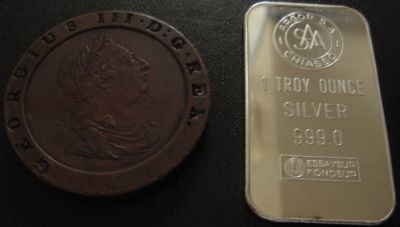 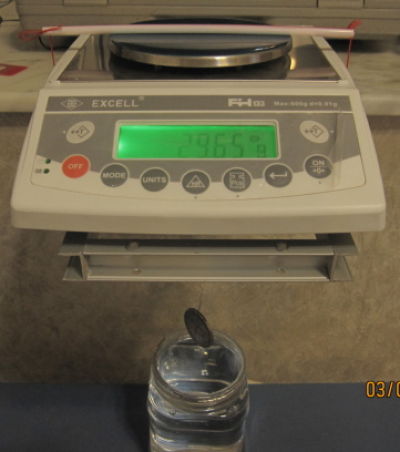 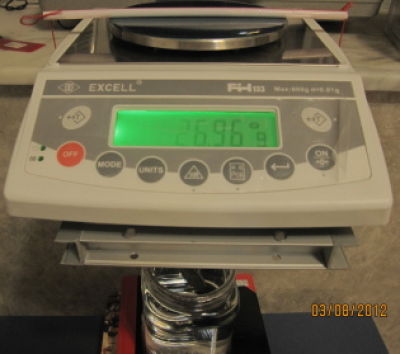 Acknowledgement : swamperbob provided me the theory and some practical details for this experiment.
|
|
Pillar of the Community
Hong Kong
1270 Posts |
The pictures just show you the setup of my system and the value shown in the electron scale is not for this 1820 Zs Portrait dollar but for another coin.
|
|
Pillar of the Community
United States
5362 Posts |
Those appear to be good numbers. I presume the 8.88 was the result for testing the George III penny or twopenny coin and the 10.45 was for the silver 999 fine bar.
The theoretical numbers for each is well within tolerance for this set up. So I think you have a full weight silver coin. But is it Real or a bullion forgery (unauthorized restrike)?
The edge was the cause of my suspicion about Sheffield but the SG rules that OUT. It is also NOT a Class 1 forgery simply because it is silver.
In considering real - I would say I have never seen that particular edge "error" before. It could possibly be a metal fin left over after the blanking step which was broken off by edging. But other than that I can not at this time think of a mechanism that would normally cause that appearance.
As far as Counterfeit Class 2 "silver restrike - not authorized" I see a couple MINOR style traits BUT NOT ENOUGHT to label the coin as a restrike. So barring some other evidence like XRF testing - I would leave it uncertain.
|
| |
Replies: 30 / Views: 8,159 |








 First Page


 Posted 07/29/2012 01:58 am


