| Author |
 Replies: 30 / Views: 8,157 Replies: 30 / Views: 8,157 |
|
Pillar of the Community
United States
2120 Posts |
So my dealer recently bought this coin, but doesn't know a lot about Mexico. He deferred to me and I'm a bit stumped. He let me bring it home to do some research on it. First off; Weight: 26.5g (Krause - 27.07g) Diameter: 39.25mm ~ 40mm Comp: 90.8% Ag, 9.2% Cu (0~1% variance, measured by spectrometer) (Krause - .0903 Ag) KM: 111.5 *** Hi-Res Version ***  Now I've read this thread where SwamperBob provided some insight. Quote:
During the war there were shortcuts taken. That is known for certain. Planchets were irregular and debased coins were made and issued officially. So most of the "normal tests" provide only clues to authenticity. The real problem is in inconsistency seen in quality. During 1819 there were radically different versions issued by the Zacatecas mint for example. In 1820 and 1821 most mints start to produce more "normal" looking coins so the usual tests are far more useful. Ok, That could explain the slightly off composition readings. That and my scale is a cheapo. .5g for wear and crappy scale? Sure. Quote:
The planchets appear to be cast and the coin is struck in fine silver. Mine doesn't have that "cast like" appearance you typically see. Quote:
The first edge photo of the 1821 captures perfectly the WAVE seen in the edge detail on certain counterfeit 8R coins made in the 1880's. Ok, Edge on mine looks good to me. Quote:
Look at the F in the King's name - the central cross bar is recut - likely because the transfer was weak. Look at the E's especially the one in Ferdin - you can clearly see a flat gouge was used to deepen some of the letter. But on the obverse die (shield side) the gouge was NOT used. Ok, I think it looks good. Not 100% sure. Quote:
The primary diagnostic for me is the MISSING mouth. Even high grade strikes of this coin have NO mouth. I know of no other real 8R where the King has no mouth. Uh-oh, pretty flat mouth on this guy. So I've tried to find other photos of known authentic and known counterfeit to compare features, and I can't find one that has the same alignment of letters/pillars and letters/portrait, yet the placement/alignment of the date seems (to me) consistent across multiple counterfeits and authentic examples. Also, Krause mentions "Note: Mint mark: Zs. Several bust types exist for the 1821 issues." Sigh... of course. So I'm kinda on the fence here. My first instinct was that it's a counterfeit, most likely contemporary, and often times my instinct is correct. However it feels like it could be authentic. My dealer most likely only wants around melt for it, so most likely I will buy it regardless. But I would like to know with some degree of certainty before we complete the transaction. Thanks for the perspective / insight.  Hopefully SwamperBob happens by. I need to get a copy of the books in his library.  Edited by Namachieli
07/24/2012 10:21 pm
|
|
|
|
Pillar of the Community
United States
5362 Posts |
Namachieli The coin you posted is an exact die match for a coin which I have assigned to Class 2 - Late Circulating Bullion Restrike (Counterfeit). While we have not elected to give GNL numbers to the Class 2 coins, it is my inventory number 1821-036.
The key diagnostic in this case is seen on the edge detail - notice the rectangles are not SQUARE on the edge. Each rectangle seems slightly turned and in addition there is a border line parallel to the edge segments.
This is at the end of the War so I would expect a better edge in 1821.
This classification is tentative until it is verified with XRF. The examples I own are more worn and I hope to get a test of the substrate. It is really the trace contaminants that prove when a silver coin was made. I expect it should be within 1 or 2 percent in silver content but the very small traces determine if it was really produced in Mexico.
I expect that there are so many Class 2 coins on the market that they will be treated as if they were real and will be priced accordingly.
|
|
Pillar of the Community
 United States
2120 Posts |
Thanks for the post Bob.. Cant wait for the book to come out so I can buy a copy!
|
|
Pillar of the Community
United States
2120 Posts |
And I see what you mean on the Edge, The are all oblique, instead of squared off.
|
|
Pillar of the Community
Hong Kong
1270 Posts |
If compared with Namachieli's piece, can I say my Zacatecas 1820 Portrait Dollar is original? I hope all of you can have a comment on this piece. Specification of the coin: 26.87grams, 40mm, bought from ebay about 2-4 years ago at price US$125.00. Please focus on the three lilies at the middle of the emblem, it is seldom to see such a 'bird-like' lilies. Were they the product of war time emergency? Please also see the edge figure 1, is it the overlap by the coining of the edge die(s)? Edge figures 3 and 4, who can explain the crack of the edge from the coin body? 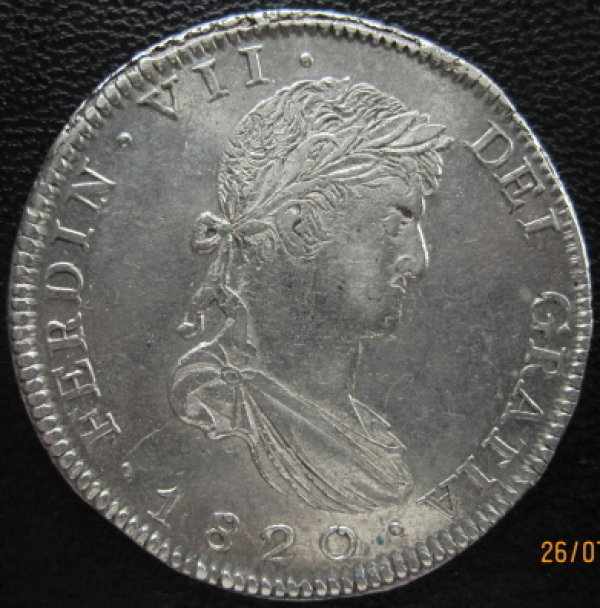 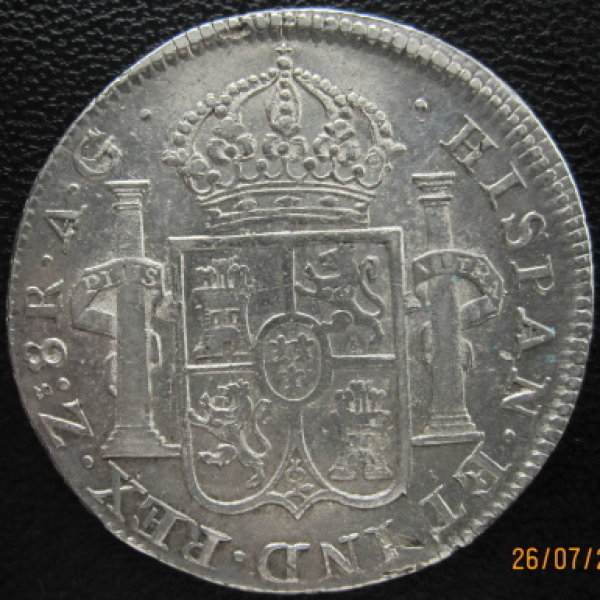 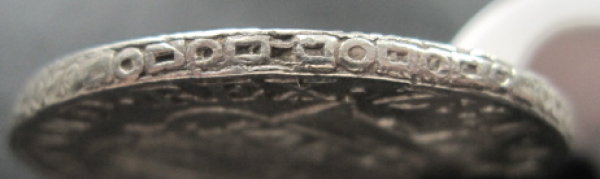 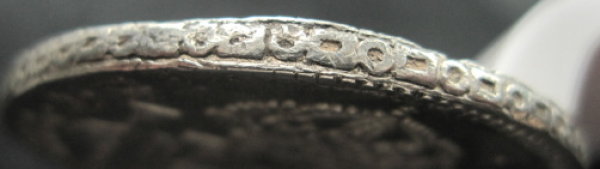 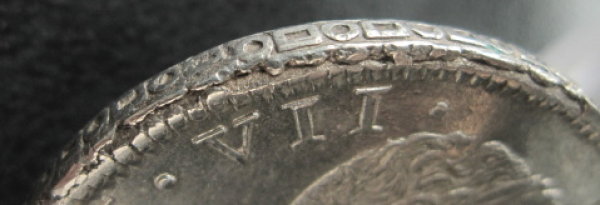 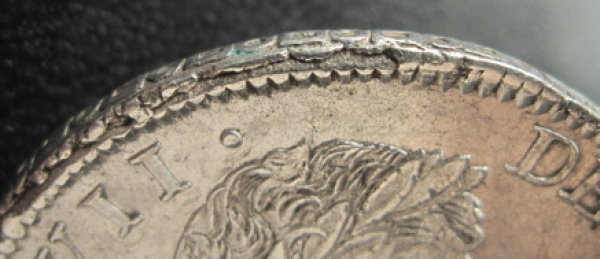 |
|
Pillar of the Community
Hong Kong
1270 Posts |
swamperbob - Quote:
a coin which I have assigned to Class 2 - Late Circulating Bullion Restrike (Counterfeit). I am new to this forum so would you please to elaborate what is meant by Class 2 coins? Or can you direct me to your explanation to this term in previous posts? Thank you so much! Henry |
|
Pillar of the Community
United States
2120 Posts |
I believe this is local to his book he and a few colleagues are writing.
Also, IMO, the edges on your coin are cause for alarm. IIRC the metal should not have protruded out like that.
Though I'll leave that up to SwamperBob.
|
|
Pillar of the Community
United States
5362 Posts |
The 1820 Zs AG is a very interesting coin. Based on what I see it could be a high grade nearly intact Sheffield Plate.
Sheffield Plate coins were a three layer sandwich of metal - two layers of 900 fine silver over something else - copper or debased silver or a nickel alloy. But the problem in completing the coin is how do you cover the off metal edge. One method was to roll a silver wire or thin strip of silver ONTO the edge of the planchet under pressure to make a mechanical weld. This was usually done in the same step that applied the edge design.
I think the weld may have been in part unsuccessful.
If you notice on the side opposite the spot where a bit of metal seems to be missing is a place where I think I see evidence of a rolled in overlap on the dentils. If the silver ribbon slipped to one side during the rolling process - that is the result I would expect to see.
The price is GREAT if it is an Intact Sheffield. There are only a half dozen examples known to exist.
|
|
Pillar of the Community
Hong Kong
1270 Posts |
I think it is rather difficult to prove swamperbob's guess is right or wrong, that is, it is a contemporary counterfeit or a genuine coin. I can't deny that the lustre of this coin is different from those Spanish colonial 8R with 90% silver content. This coin is believed to have a lower silver content. So it seems difficult to get a conclusive result even if the S.G. is performed as the silver content of this type of coins may be varied. But the coin was struck very decent so I believe it was produced from the official mint rather than by the machine of a counterfeiter, especially at the war time period. Mexico Zacatecas 8R was always crudely struck. There is another one selling in ebay, also quite crude at the edge of the coin. See the link: http://www.ebay.com/itm/19070499187....m1438.l2649Can anyone show a real one for comparison? Quote:
The price is GREAT if it is an Intact Sheffield. There are only a half dozen examples known to exist. swamperbob, if it is a Sheffield plate, then when did this coin minted? I will be thankful if you can tell me more about what is 'Sheffield plate'. Do you also mean this contemporary counterfeit is an expensive one, even more expensive than the real counterpart?  |
|
Pillar of the Community
France
1591 Posts |
Here are the ones I have - both genuine (but not same date / essayer). 8 reales - 1817 Zacatecas AG : 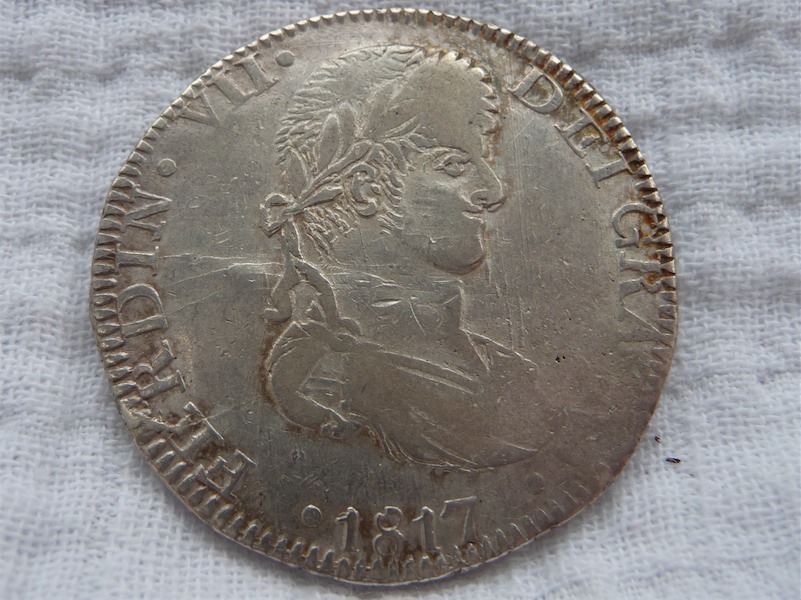 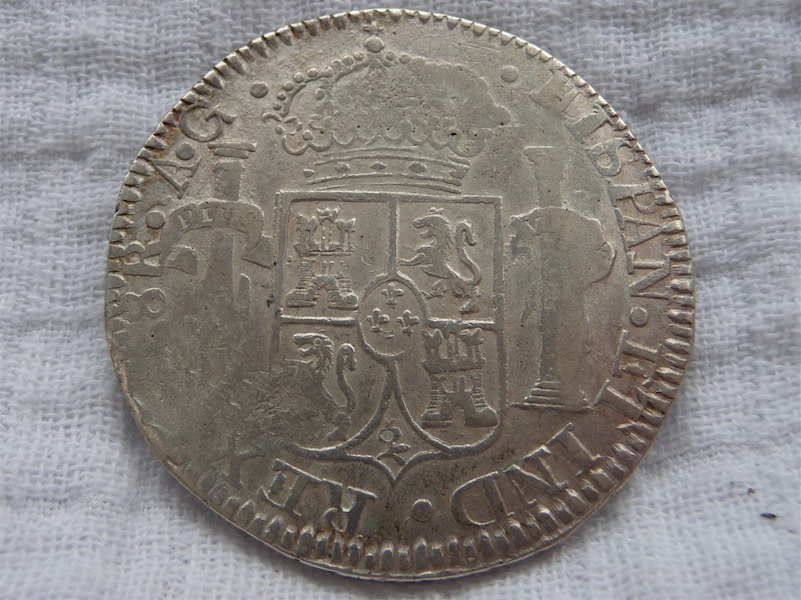 8 reales - 1821 Zacatecas AZ/RG : 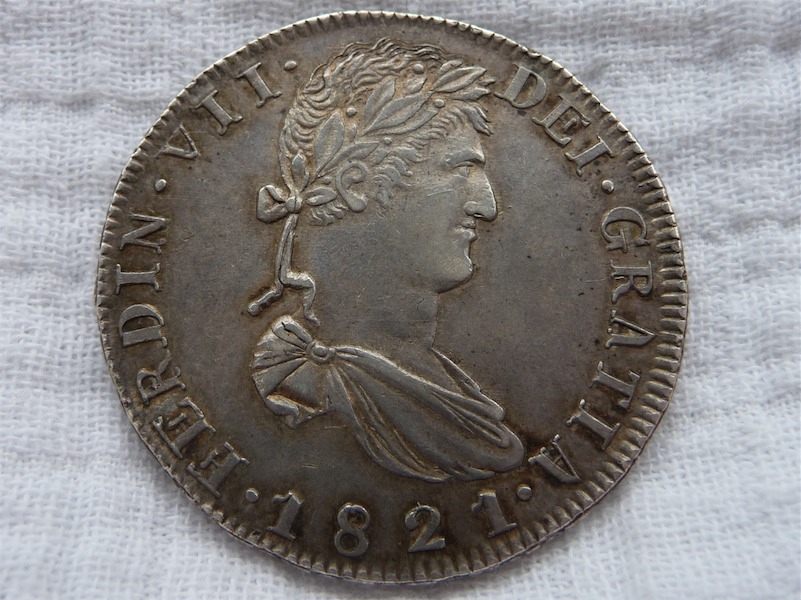 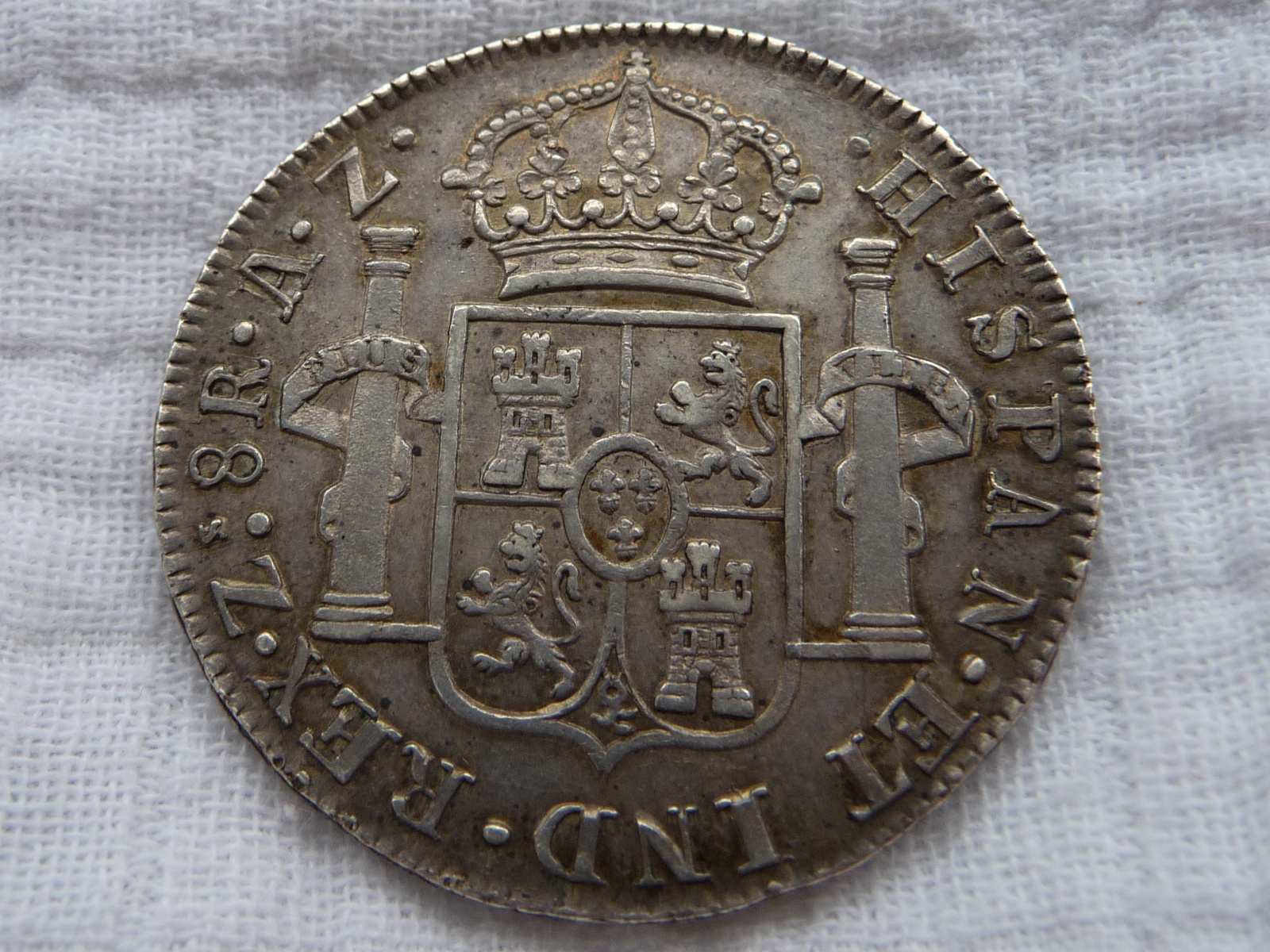 Edited by MathieuMa
07/28/2012 04:54 am
|
|
Pillar of the Community
Hong Kong
1270 Posts |
MathieuMa - your 1821 is very eye-pleasing and looks very nice, I believe it is genuine, I always don't believe those old counterfeiters could make such a magnificent coin by their subordinate machine. However, do you see the mouth of Ferdinand VII is very 'clear-cut'. I trace back to the related thread: http://www.coincommunity.com/forum/...PIC_ID=67682swamperbob had written (for another 1821 8R of same type): 'The primary diagnostic for me is the MISSING mouth. Even high grade strikes of this coin have NO mouth. I know of no other real 8R where the King has no mouth.' In Riddell Book no.44, there shows the same 1821 8R and it was classified as counterfeit though the finesss is up to 90%. Both arguments will reject your coin is genuine though I believe it is not fake. How do you think, MathieuMa?
|
|
Pillar of the Community
France
1591 Posts |
I'm 100% sure mine is not fake, considering its origin, the design of the coin and of the edge, and the over-essayer :)
Actually, Robert was talking about another portrait type, from a different essayer, but from the same year.
Check out the portrait on your coin : it's not the exact same type (the crown is missing some decoration, different eyes and mouth, and so on).
Zacatecas has been using many different portraits - during the was they couldn't get official dies from the crown.
I'm sure someone thought about it, but I'd be glad to see each different portraits of the king side by side :)
In any case, it's a very interesting coin you seem to have here, historically wise.
Contemporary counterfeits are sometime real pieces of art - if this proves to be one.
|
|
Pillar of the Community
Hong Kong
1270 Posts |
Would swamperbob like to explain why the No.44 of Riddell book classified this same 1821 8R as counterfeit.
|
|
Pillar of the Community
France
1591 Posts |
|
|
Pillar of the Community
United States
2120 Posts |
So I decided to buy this coin from my dealer, We settled on a couple dollars over melt, so basically no risk.
What would the approx value of my counterfeit be? I am assuming just melt.
|
|
Pillar of the Community
United States
5362 Posts |
Lot of open questions to answer here. I will try to do it in reverse order, (for my co-authors, I am taking a break from proof reading and doing footnotes because my eyes are giving me fits. I will mail results to date on Monday) Namachieli If you got the 1821 Zs coin pictured first for a few dollars over spot you got a bargain in my opinion. Personally, I would pay about 2x to 3x spot for any nice uncut Class 1 counterfeit as this appears to be. If upon testing it is a Class 2 (post 1830 containing silver above 70% but NOT Class 3 Modern) than it is a bit less of a bargain but 2X melt is still average. Remember the Class 2 types are not yet published and are NEW to the discussion of 8R coins. For anyone who has been following my posts for the past few years you may have noticed a migration away from the use of Boston to Class 2 to describe the silver bullion forgeries that were made in huge numbers. This evolution in names accompanied a series of new (but early) references that fell into my possession in a VERY brief time. This topic is fully covered in our book. MathieuMa The link to the last 1821 on ebay (no mouth variety) is actually on my watch list. I suspect it is Class 2 but not a great one because of corrosion. I have not made a final call on bidding or not. The link to the earlier auction of an 1821 Zs is ON my list now I had not yet seen it but it is likely a forgery - and likely a thick plate Sheffield. wonghinghi The #44 listed in Riddell is a REAL coin. His book lists examples of REAL coins and fakes. The 1821 with the well defined mouth is far more common as an original than as a forgery. But that said I do own three Zs coins in off metal (Class 1 counterfeits - under 70% silver) which have very prominent mouth features - just the wrong prominent features. The Riddell #44 is one that is CERTAINLY real. I used to believe that all "no Mouth" 1821 coins were Class 1 fakes. But I am no longer 100% sure. I believe that some are Class 2 and that there may in fact have been a King punch made with a WEAK mouth that if improperly set in a working die would make a NO MOUTH die. MathieuMa You are correct about your coin being real - the clear resemblance to the Zacatecas King Punch secures that mush NO DOUBT. wonghinghi In this connection you must have simply misunderstood Riddell's book. MathieuMa You mention Zs using many portraits because they did not have access to a proper King Punch. That is technically correct up to 1819 but in 1821 it appears that Zacatecas did make their own King Punch(es). So did the other mints Ga and Go. The jury is out on Do which may never have used a portrait King Punch. By 1821 and 1822 several of the branch mints were operating in a far more stable way. Also it is critical to recall that a Spanish portrait matrix block was NEVER issued to Zacatecas so there is "no royal" portrait type for Zacatecas. wonghinghi You say: Quote:
I always don't believe those old counterfeiters could make such a magnificent coin by their subordinate machine. Here I may have to disagree with you. The counterfeiters who produced some of these 8Rs were so competent that their work was accepted as real EVEN BY MINT OFFICIALS. Forgery was not a small back shop type operation in the 1820's but in some places was a modern factory operation capable of making THOUSANDS of essentially PERFECT copies a day. That is the primary reason we are writing the book to explain just this simple fact. But I can not explain here what it took nearly 180 pages of text to cover. There are today FORGERIES made AFTER 1830 that are sitting in TPG slabs from all three grading services. The 1820 Zs in high grade would likely be encapsulated as REAL. But what I am saying is that as a Contemporary Counterfeit (likely a thick plate Sheffield from England) it is CERTAINLY WORTH MORE THAN YOU PAID. It is better as a Counterfeit than any original of the same date and condition. This may be counter-intuitive but these Class1/2 intact Sheffields are TODAY almost unknown BECAUSE they sit in collections as real. They were fakes made so well that they are STILL OUT THERE CIRCULATING IN THE NUMISMATIC COMMUNITY AS IF THEY WERE REAL. They are forgeries that have stood the test of 200 years and have PASSED. |
| |
Replies: 30 / Views: 8,157 |






 Posted 07/24/2012 11:54 pm





