| Author |
 Replies: 20 / Views: 2,724 Replies: 20 / Views: 2,724 |
|
New Member
United States
20 Posts |
Does anyone bother to create and maintain a master catalog of their personal collection? Whats the best format you've found? As I'm just getting interested in collecting, I know that the best time to start a catalog is now before I have an obscene amount thats just a big "pile in a shoebox". Whats the collection method for you? Excel sheet? Database? Old school composition book? What do you record? I know it probably varies by policy, but does insurance normally cover coins against fire and theft? Obviously you would want to declare super coins explicitly on a policy, but I'm thinking about the rest of the collection. Initially the project is just for my own record keeping and future references, but the more I think about what I'll (hopefully) have invested in a collection, the more important it is to have some securities in place. I'm thinking of at least capturing the following: Coin Denomination Country Year Mint Grade/Grader Cert number if TPGSpecial designations (DMPL, CAM, Problems, etc) Mintage Total purchase price (maybe break out price + shipping/tax) Method of purchase (ebay, show, shop, trade, gift, found, etc) Date of acquisition Date of sale (although I'm not particularly inclined to sell) Images of obv and rev Notes of significance Maybe a TPG anticipated value at time of acquisition? Just curious what anyone else bothers to do. To me, it screams database. But thats a hazard of the job and the last thing I want to do is maintain another database  Josh |
|
|
|
Pillar of the Community
United States
1116 Posts |
The only database that I create is for items that are not placed into a coin album with the exception of my Type set. For some reason I started to keep track of my costs for the coins that I purchased for this album. What I did for this album was simply create a spreadsheet that listed all the type coins for this set. Then I entered just my cost and when I purchased the item. I guess I wanted to figure out the value of the albulm along with an idea of what the various coins were going for at the time of purchase.
My other albums I just don't have an interest in their cost but probably should so I could have a better idea as to just what this hobby is costing me. But honestly most of my albums contain coins that I have found in circulation and so my cost is minimal.
Some of my album contain coins that I have taken from mint sets.
Your question is a good one and perhaps I should keep better records but my hobby is for my enjoyment and I let my kids figure out the value of what I have after I've gone. This way they can try and figure out what I was thinking about a coin and what it is worth. Some of the coins that I have date back to when I was a kid and as such I have no idea other than face value.
I know this isn't the best answer because I really don't have a clue as to what the value is of what I'm holding. However, I really would be interested in seeing what other forum members ideas are to to this topic.
|
|
Bedrock of the Community
United States
20753 Posts |
 I sort of use an Excel spread sheet. AND here is what I've found out over the years. Picture all the topics you've mentioned, multiply that by about several thousand coins or more. Further think of how many times you may buy or sell a coin and have to change all that stuff. For example I have 9 of those 2 row Whitman Boxes for 2x2's and they are packed with coins in 2x2's. My entry for that is just lots of coins. |
|
New Member
 United States
20 Posts |
I wouldn't discriminate as not the "best answer" because its still an answer and all I'm after is the conversation. For you, the in depth catalog isn't/wasn't of interest. And maybe that's the broad spectrum answer. I certainly don't make judgements because we're all here with different goals for the same love. At this point in my life (still relatively young) I'd love to build a true collection. High grade series of coins that are more than the sum of its individual parts. Maybe in 30 years my intentions change. I'm a bit concerned that I'll become over obsessed with such a process. (I have tendencies...)
I read a post on here where the author referenced a coin he had bought 50 years ago for $50 and was now worth exponentially more. (I think it was an eagle?) Hell, I cant remember what I paid for the car I'm currently driving. Maybe thats why I'm considering the time to document everything I can think of regarding a piece. Even if there is no purchase price to a coin, there are still a bunch of details that could be preserved. If you're a roll hunter, maybe your details are different since the process is different.
One of the points you bring to the table is remarkably curious to me. Leaving a relatively unmarked collection for your heirs. I've only been around here for a little while, but I've noticed one of the driving forces for entering the community is trying to value a recent inheritance and being completely overwhelmed. While I think its a fantastic way to "force" the research of the next generation, I personally would prefer to not leave a complete mess for them. Maybe its way to hint at the vast wealth that's sitting in front of them and perhaps to rethink the temptation to do a bulk unload liquidation where they potentially get hosed in the deal. "figure out what I was thinking about a coin and what it is worth" I'd love to think I could leave my collection to an heir that would be this insightful!
Including the current value of a coin will hopefully only be relevant to the time of purchase as we would hope that value is higher in the future.
Maybe there are two primary reasons to catalog that should be considered at the onset. Are you a numismatist or are you an investor? (I'm not saying the two are mutually exclusive) Short term information if you're looking at a cost analysis and profit margin/ROI. Perhaps more relevant to those that flip a lot of coins or looking for a return. Long term if your looking to retain documentation for future generations. More from a true collection stand point. Depending on how long term, we would also want to consider the permanence of the documentation format. Can someone still access whats stored on a USB drive in a SQL db 100 years from now? Does the handwritten paper fade or become unreadable? Investing the time in a cataloging process could become part of the coin preservation process itself.
I don't think any of us want to REALLY know what we have wrapped up in this hobby!
|
|
New Member
United States
20 Posts |
@justcarl - I commend you on such a massive collection and absolutely agree that the shear volume of information could be daunting. I suppose I have the opportunity of starting while my collection is still the size of a zip-lock bag!! I've got a bunch of circulation coins that I hoarded as a kid just because they were cool and different and I'm now buying graded stuff in slabs. A handful of ASEs that I got as presents and whatever else grandparents like to give to the kids. Really wish I would have held onto more.
Perhaps the other reason I'm so interested in the process is that I'm still starry eyed by the coins and a bit overwhelmed by the information available and my lack of that knowledge. Its a way for me to learn as I go. My father has a small (a few hundred?) collection. That's really all I know of the collection as I've never actually gone through it to see what he has. I look at that task as daunting, overwhelming and a huge time expense if I stand to inherit the collection.
|
|
Moderator
 Australia
16963 Posts |
I maintain just such a "master catalogue". I use a database program written specially for coins ( Primasoft PC Coin Organizer Deluxe), though using Excel would be just as good. The built-in database contains far more entry fields than I can be bothered entering for every coin. Here are the fields I record for every coin: Country Denomination Year Mintmark Condition Composition Brief description of obverse Brief description of reverse Physical features (edge, shape, holes, etc) Location (which album, box etc it is in) Topics/Categories the coin can fit into (especially useful for when the coin club has particular themes each month) Purchase date Who purchased from Purchase price (I include everything in what I had to pay to obtain the coin: taxes, shipping, currency conversion fees, etc) Description (the catalogue number and any physical flaws or defects are noted here) Quantity (always "1", since I never keep duplicates) Sap Number (a simple count, more or less in chronological order. Each coin gets a unique Sap Number) Some fields which are filled in for only a few coins: Title (for commemorative coins, medals etc) Mint (the actual name of the mint, not the mintmark; usually useful only on ancient and mediaeval coins) Variety (if significant) Weight Diameter Provenance (if any provenance is known beyond "who purchased from") Signatures (for banknotes) Notes (if there is an interesting story behind the coin, there's room to write up or cut-and-paste a whole page here) Pictures (room for four) Some fields included in the database but which I never use, because they do not interest me: Entry date (the Sap Number basically fulfils this function) Mintage Designer Current market value Evaluation Date Sale price Sale date An important thing to note with my database is I started early; back when I only had a few hundred coins. So you are correct in saying that "the best time to start a catalog is now", because unless you're at the stage of life where you're selling off and downsizing things, your collection probably isn't getting any smaller, and the smaller the job is right at the start, the better. Besides the time needed to be spent entering each and every new acquisition, the biggest handicap with maintaining a computer database is the time needed to export and re-enter data as software and hardware formats have changed; the first version of the database was actually written on a Commodore 64 in the mid 1980s and was very minimalist (country, date, denomination, condition and Sap Number). By the time I upgraded to a PC, I had 2500 coins I had to re-enter by hand. Back in 2004, my new Windows XP computer wouldn't run my old database program and I had to find a new program that would import it properly. I had 6630 coins by that stage and it took me five years to finally tidy up all the niggly loose ends from the import. Fortunately, the company that sold that program was still around when I got this Windows 7 thing I'm using now, so I could purchase a Windows-7-compatible upgrade with no import trauma. I might not be so lucky at the next export session in a few years time. Don't say "infinitely" when you mean "very"; otherwise, you'll have no word left when you want to talk about something really infinite. - C. S. Lewis
|
|
New Member
United States
20 Posts |
I get a little frustrated with myself when I dont search properly before posting questions. It helps if I'm looking in the right section though :/ I just found http://www.numismetrica.com/ and http://www.libertystreet.com/shots21.htm elsewhere on this board. I'd still like to carry on the conversation though as to who actually bothers to catalog and the long term thinking of some of you guys! Theory is as interesting to me as the implementation. I'll probably respond with a little more detail tonight after work |
|
Valued Member
United States
397 Posts |
I don't keep a catalog per say of my collection. Instead I use a spreadsheet program to track the amount of CRH I do, and then I make a notation of what coins I find (or what coins I don't).
The overall goal is that at the end of the year I can come up with some final tally of how many coins I've hunted through and what I found.
So in some small way, that list shows what I have because I am listing what I have found.
|
|
Pillar of the Community
United Kingdom
2139 Posts |
I have an Access database that I created to hold details of my collection, and later on I used a copy to hold details of metal detector finds (not mine, I hasten to add, I've never found anything except 17th C & 18th C musket balls). I've used it for 4 purposes
- to help me decide whether to acquire something - I can see at a glance whether I've already got a better specimen
- to help me when identifying coins
- to create a list of the most valuable items for the insurance schedule/premium calculation
- to create a catalogue of finds for the municipal archaeological department
However, there's a lot more that I could do including storing pictures of my coins. The database for coins has the structure 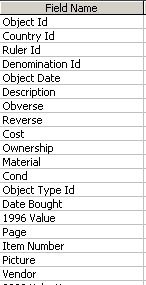 Fields with Id in their title refer to linked tables. |
|
Pillar of the Community
United States
2604 Posts |
This is a really good topic, keep the comments coming. Folks in my coin club were asking around about this. I thought i'd do a presentation on what different folks do or what software people use to document their collection. I recognize there is an array and different folks will like different levels of details.
|
|
Pillar of the Community
United States
2604 Posts |
I use an Excel Spreadsheet and provide a description, date of purchase, how much I bought for and the seller. I keep thinking I need pictures also, but don't have that.
|
|
Bedrock of the Community
13014 Posts |
I dont have a catalog per say but most of my coins are in some sort of binder or album so theyre all in the same place. Some others are in the PCGS slab box as I havent gotten the lighthouse albums for them yet. If I just had a bunch of random coins that werent really that were of marginal value above face I probably wouldnt bother to catalog those just like I dont catalog my bullion silver. Like carl said thats a lot of effort that could need a lot of changing but I do keep some sort of album for the rest.
With some of the series like my commem series Ill also use the PCGS set registries as a way to keep track of what I have and still need. Very low effort for slabbed coins and can be checked in just a few seconds.
|
|
Bedrock of the Community
United States
20753 Posts |
Quote:
One of the points you bring to the table is remarkably curious to me. Leaving a relatively unmarked collection for your heirs. I've only been around here for a little while, but I've noticed one of the driving forces for entering the community is trying to value a recent inheritance and being completely overwhelmed. 1. I'm old and have no one that I know of that is interested in nor knows anything about coins. 2. When my time comes, I highly doubt that the value of my entire collection will be a concern of mine at all. 3. After I'm gone the only thing that could make me ocme back is hearing that someone just dumped it all in a bank. 4. I USED to catalog lots of those items mentioned here but at my elderly age, I don't want to spend the last of it documenting STUFF for someone else. 5. Not sure if true but if you seen those movies about Alexader the Great, at his end, when asked who he is he leaving it all to, I think he was supposed to say whoever wants it or something like that. Exactly how I feel about every thing I have. And WOW, Sap, you really do have a lot of documentation.  I'm way to old for all that now. |
|
Bedrock of the Community
13014 Posts |
I feel like its one of those things where if you did it all along youll continue, but to try and go back and do it is just a nightmare
|
|
Bedrock of the Community
United States
11951 Posts |
I was thinking everyone keeps good records of their coins. So that when you sell a coin at a profit . we can claim the profit on income tax.  |
|
Pillar of the Community
United States
1746 Posts |
I use MS Access for my database. Here is the structure:
ID (a unique serial number I track them with)
Year
Mint Mark
Location (where I keep it, album, 2x2, etc)
Denomination
Type
Notes
Grade
Qty
Price Paid
Retail Estimate
I find it easy to use Access, as I use it at work. I have many queries and reports that I can print out to bring to coins shows. I enjoy computers, so it is part of the hobby, too.
|
| |
Replies: 20 / Views: 2,724 |









 Posted 08/06/2012 09:45 am