As the last Alphabet of coins seemed quite successful I thought I'd do another one. Hopefully someone will start a similar themed thread.
Again I've tried to pick interesting coins rather than just shiney ones and as a good portion of them are really translations of dynasties sultanates etc, in different languages and alphabets the strict A, B C... is not always followed ... to the letter :)
ALGERIA

This Algerian coin, actually a token, was issued during the French control of the country. It's a 1916 10 centimes, made of aluminum and issued for use in Alger. Although it's a token, it is consistently listed in Krause and most of the examples I have seen exhibit a lot of wear so it must have been heavily circulated as a coin type for use in transactions.
BIAFRA

Biafra was a tiny country that separated from Nigeria in 1967. It only lasted for three years before it was again reintegrated. When Nigeria became an independent country in 1960 the borders of the country were somewhat arbitrarily drawn and did not reflect cultural, religious and ethnic divisions ��" hence the attempt as secession. The war between Biafra and Nigeria was particularly bloody.
Apologies for the terrible photograph but it was difficult to get a good image as it's very small and also made of alimumium. I could probably do better now, but the coin is filed away. This is a 1969 3 pence, a denomination reflecting the British influence in the area.
CEYLON

This is a 1 cent coin from Ceylon, part of the British Empire until February 1948 when it achieved independence, and known as Sri Lanka since 1972 when it became a Republic. I am fond of these large base metal coins from this time and region ��" they all have a similar look and feel and are nearly always well designed and manufactured.
DENMARK

This is a 2 Skilling coin from the rule of Christian VII who had the throne of Denmark between 1766-1808. Rather obscurely, he seems to have been the subject of a 1935 British film called the Dictator.
EAST AFRICA

The East Africa referred to by the title actually covered what is now Kenya, Tanzania and Uganda ��" so this coinage can be seen as an earlier form of monetary union.
FINLAND

When this coin was made Finland was still attached to the Empire of Russia and was administrated as a autonomous Grand Duchy with the Russian emperor acting as a constitutional head of state. This coin is a 1905 10 Pennia An interesting fact about Finland is that the actor Christopher Lee fought for the Finns during the Finnish-Russian conflict during World War II.
GERMAN EAST AFRICA

Of all the major European powers of the 19th century Germany had the least overseas colonial possessions. One of them however was German East Africa ��" which covers what is now Burundi, Rwanda and most of Tanzania. All these possessions were lost after World War 1. The coin shown is as 1890 1 pesa.
HUNGARY

Ferdinand was born in Spain, the son of the Joanna the Mad and the Habsburg Archduke Philip the Handsome, who was heir to the Holy Roman Empire.
On the accession of his brother Charles to title of Holy Roman Emperor in 1519, he entrusted Ferdinand with the government of the Austrian hereditary lands, roughly modern-day Austria and Slovenia. Ferdinand was Archduke of Austria from 1521 to 1564.
After the death of his brother��"in��"law Louis II, Ferdinand also ruled as King of Bohemia and Hungary (1526��"1564) and it is from this period and location that the coin was made
IRAQ

A coin 1953 50 fils from the Kingdom of Iraq showing the portrait of Faisal II. There were two designs for the 50 fils coin issued in for this king, the 1955 one is common, but this one is much less so.
JAMAICA

My sister went to the Caribbean for a holiday...
Jamaica?
No, She went of her own accord.....
This 1899 farthing from Jamaica shows Victoria who was head of state there at the time. The British monarch is still head of state to this day. Although the suite of monetary denominations of Jamaica at this time reflected that of the UK up to a penny, the size and metals used did not.
KUTCH

Kutch was one of the suite of Princely states of India ��" a quasi independent region within the British administrated territory. This large silver 5 Kori coin is dated 1936 and cites Edward VIII as Emperor, one of the few coins which bears his name. These coins, plus a few base metal types from Africa are often used as substitutes for those trying to get a "one from every monarch" for the UK.
LIBYA

Libya is the ancient Greek name for north Africa and the present day country sits squarely in the centre of that coastline. It was one of the few Italian overseas territories but was nominally administrated by the British and French for a few eyars after World War II until independence in 1951. This is a 1952 5 millimes issued for Idris I who was the monarch of the kingdom of the time. It overthrew the monarchy in 1969.
MARCIANOPOLIS

This coin is from the city state of Marcianopolis and was issued during the time of Macrinus / Diadumenian, who were the father and son ruling family of the time (217/218 AD). While Macrinus was the Emperor there are many coins of the nine year old Diadumenian issued by both the official Empire mints and also by the provincial mints who continued to issue local coinage to satisfy a local need. There were hundreds of these local mints, most old Greek city states which had maintained some degree of autonomy, but there were also new towns created by ex legionaries that could issue their own local coinage also.
This coin shows both Macrinus and Diadumenian in the obverse. The reverse shows Apollo (Lykeios pose) naked, standing, his right hand is over his head, in his left hand is holding a bow; next to him ��" serpent entwined trunk. E to centre left
The famous sculptor, Praxiteles, created a statue for the grounds of the Lykeion ��" a complex sited to the north east of the city where temples and seats of learning were found. The coin engravors obviously copied the "Lykeios pose" for this reverse image. The large E represents the denomination of 5 assari.
The lettering on the obverse is
AVT K OΠEΛ CEV MAKPINOC K M OΠE ANTΩNINO/C
which are abbreviations for
Imperator Caesar, Opellius Severus Macrinus, Caesar, Marcus Opellius Antonius
The reverse has
VΠΠONTIANOV MAP-KIANOΠOΛEITΩN
Which loosely translates as "coin of Marcianopolis under the governship of P. Fu. Pontianus".
When I bought coin this it was the finest example known but I haven't been following the auctions recently so there may be a nicer one out there somewhere. I think the skill of the coin engravers for this "provincial" coin was amazing.
NETHERLANDS

This is a 2.5 Guilder from 1855 from the Netherlands. It was basically the crown type coin of the area and time.
OMAN

A 1975 10 baisa coin from Oman. For such a minor coin I really like this one.
PALISTINE
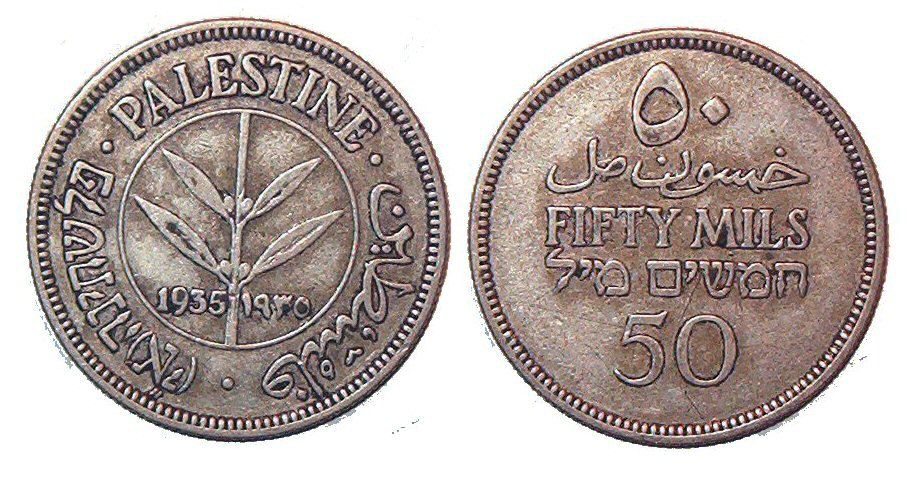
The coins of Palestine during the British mandate are quite a nice set to collect as there are not that many and reasonable examples can be obtained for reasonable amounts of money. This one is a silver 50 mils.
QATAR AND DUBAI

Rather than Qatar as the "Q" letter I have shown one from Qatar and Dubai. I quite like the design.
RUM (Seljuks)

The sun and lion motif is an ancient one emanating from Persia. Although the Seljuks of Rum were based in what is now Turkey, their ancestry shares that of the Persian empires and the motif was used extensively in their coinage.
SASSANIAN EMPIRE

The Sassanian Empire centered on what is now Iran, but extended westwards to the Mediterranean and eastwards to Afghanistan and Pakistan and held power from about 225AD until 650AD.As with the Seljuks of Rum, it was the long lasting Byzantine Empire to the west that counterbalanced it's power. This drachm is of Khusru II who, legend has it, had over 3000 conqubines.
TRIPOLIS (PHONICIA)

I have shown this second coin of Diadumenian to illustrate the way local mints portrayed the child emperor in a way to suit their own needs. This coin was issued from the town of Tripolis (that's an old city in what is now the Lebanon ��" not the one in Libya), in the province of Phonecia.. Here he is shown with a much more Africian look ��" possibly the most truthful as he was born in Mauritania (the Roman Province ��" not the present day country). This 25mm coin is tarrifed as a 16th of a stater and is quite rare.
The obverse lettering is
M O�"IA�"OVMENIANOC KAI
meaning - Marcus Opellius Diadumenianus Caesar
The reverse is
TPIΠO/ΛITΩN /ΘKΦ
(Coin) of the people of Tripolis ��" remembering the heroes of Rome, patrons of safe sea voyages
he Dioscuri were the sons of Jupiter (also Castor and Pollux or Tyndarides) and heroes of TRome. Often seen with lances and horses.
URTUKIDS

This coin is from a dynasty of the Urtukids ��" or Artukids or Mandrin ��" I've seen it spelt both ways depending on the translation so I could have used it for an A or a M or a U
It's an AE dirham of Nasir al-Din Artuq Arslan, dated 620AH. It's interesting because the obverse looks very like a Roman coin. Although the dynasty was much further east than the Romans and much later they do seem to have carried on that style. Their coins are really quite interesting ��" I'd really like more ��" but they are scarce.
VIETNAM

This Vietnam coin was issued by the Nguyen Emperors between 1802 and 1897. The lettering style is much more fine that most of the cast cash type coins of this region of the time.
WESTERN SATRAPS

The Western Satraps were and ancient Indian Dynasty that existed at a similar time to the Roman Empire in the central and western part of the subcontinent. Sometimes this is called the Gupta Dynasty. Their coinage consisted of these small drachms which show the ruler and .stylized script that is tricky to read and often off the small flans in later issues. It is however very informative if it can be read, giving the ruler, the date and the rulers father ��" which has been useful in chronological work. They mostly weigh a couple of grams so the workhorse silver coin was much smaller than that seen in the Roman Empire ��" though they did manage to hang on to the purity a bit better in later years.
XIAN-FENG
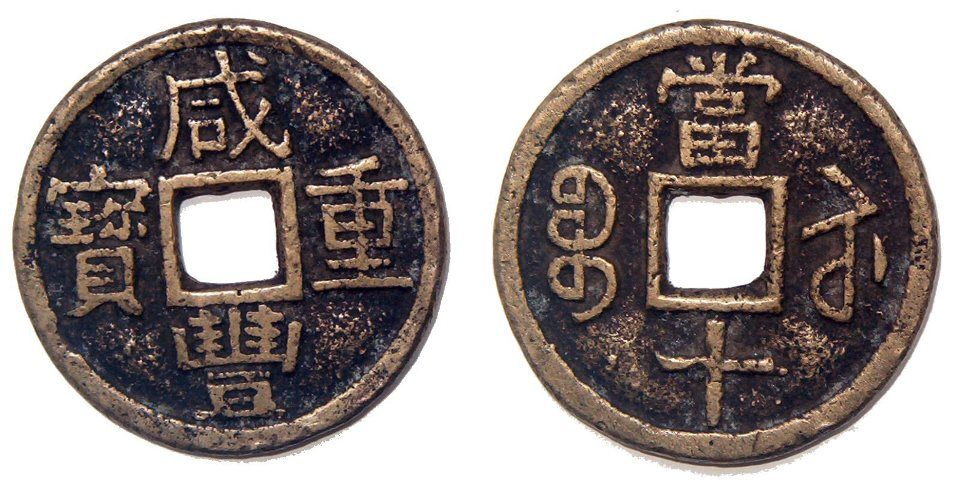
This is a coin of the Chinese Emperor Xian Feng.
It's a 10 cash issued from the Kiangsu Provence
YUGOSLAVIA

A 1925 2 Dinar coin (in Nickel-Bronze) showing the ruler at the time ��" Alexander I. Strictly speaking he was king of the Serbs, Croats and Slovenes, not Yugoslavia at the time this coins was minted.
ZANZIBAR

This is a 1 Pysa from the Sultanate of Zanzibar, minted in 1304AH (1886AD) Quite an exotic sounding place and this particular coin is quite nice I think.
I hope this was of interest.






 Posted 09/09/2012 11:26 am





