| Author |
 Replies: 8 / Views: 3,839 Replies: 8 / Views: 3,839 |
|
|
Formerly nancyc
Australia
5385 Posts |
I only have 4 x 1936 Halfpennies, and when I was checking through them, I noticed that they all seemed to have a similar feature. Please look at the images and if you have any, can you confirm whether or not the ones you have show the same pattern of wear in the same place as I have indicated. There are 2 images of each coin side by side, one plain, the other with the featured areas indicated. Halfpenny 1936 C1 - least wear 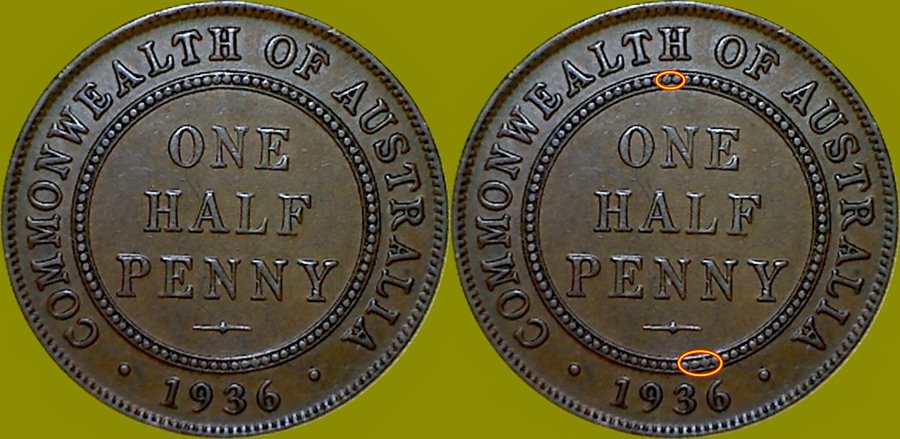 Halfpenny 1936 C2 - 2nd least wear 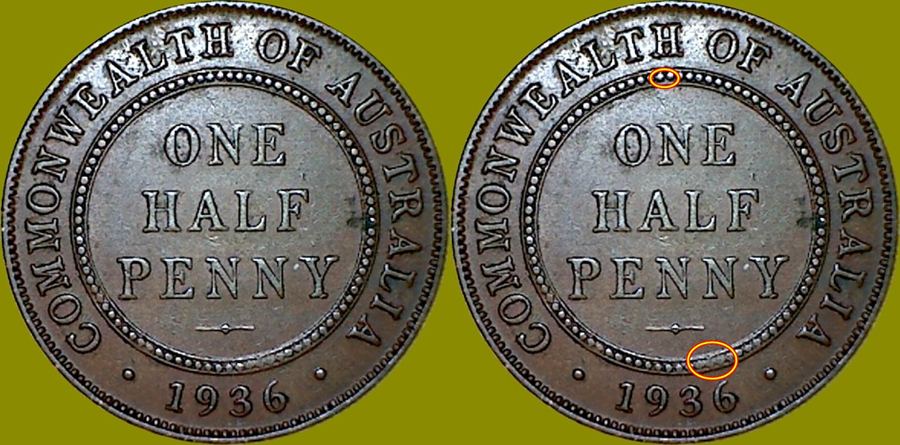 Halfpenny 1936 C3 - 3rd least wear 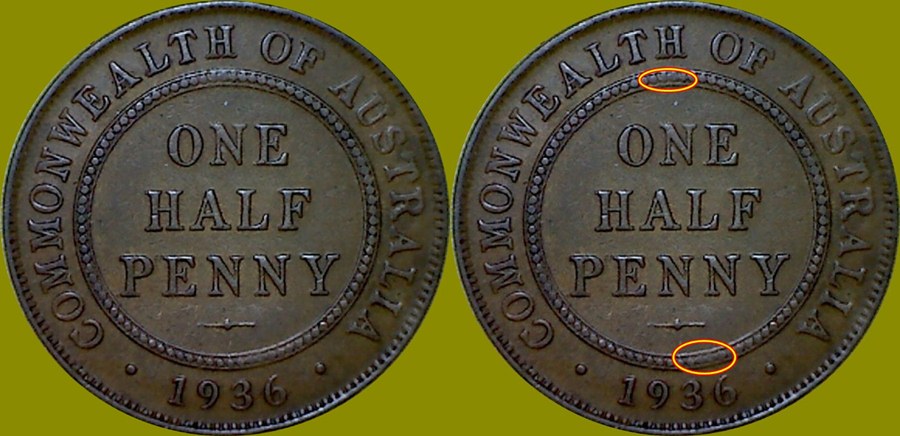 Halfpenny 1936 C4 - Most wear 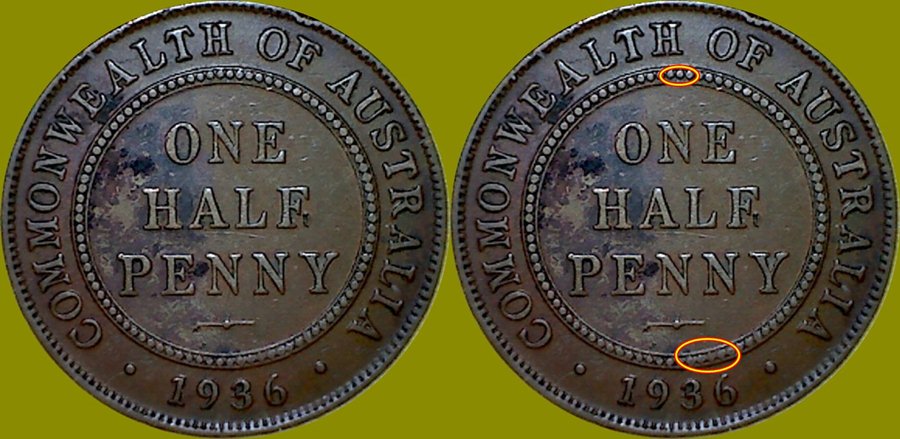 I find it extraordinary that with just 4 coins, the wear pattern is almost exactly the same on all 4, or is it possible there was a bit of a weak spot on the die which got worse as more coins were struck? I hope someone has heaps of these and might be able to shed some light on the subject. life is a mystery to be lived not a problem to be solved
|
|
|
|
Pillar of the Community
Australia
4411 Posts |
I think it was originally some weakness in strike Nancy. I dug out a few from a bucket and they all had a little wear around the bottom beads as you showed. Even my UNC example has those beads slightly less defined than the others.
|
|
Formerly nancyc
 Australia
5385 Posts |
Thanks enworb!  life is a mystery to be lived not a problem to be solved
|
|
Pillar of the Community
Australia
674 Posts |
Nancy, I have about 30 1936 halfpennies and most have the 'wear marks' you indicate.! About 5 or six seem to be quite clean, will attempt a photo.!
|
|
Formerly nancyc
Australia
5385 Posts |
Looking forward to seeing them, thanks robster.
life is a mystery to be lived not a problem to be solved
|
|
Pillar of the Community
Australia
674 Posts |
1936 Halfpenny Wear Pattern.  Nancy the common wear on these coins is one particular 'dot'. Perhaps this is the 'high' point of all these coins.!  |
|
Pillar of the Community
Australia
4411 Posts |
I think that area is perhaps more prone to a weak strike, rather than to extra wear.
|
|
Pillar of the Community
Australia
852 Posts |
If you get the exact same defect on multiple coins and you can identify different die markers (polish marks, die cracks etc) then the fault isn't on the working die but on multiple working dies with the error on the hub used to prepare working dies. If it is on all 1936 halfpennies then it occurred during hub preparation but if it isn't on all of them then either the hub was damaged during use or 2 hubs were used (such as occurred in 1920 when more than one hub was prepared and each hub has distinctive hub markers). It is also possible that the error wasn't just on the hub but on the master and there may be a number of years with this fault (for example in 1916 the Indian obverse derivative master used in India had a defect that is found on all the hubs used in India and Australia until a replacement was received in the late '20s from the master in The Royal Mint). That error is why it isn't possible to fake a 1930 penny by using a 1920 penny with a changed "0" as the Indian obverses are different. Its a technique I use it to identify 1920 pennies struck with the 1921 obverse (rare, less than 1%), 1921 pennies with the 1920 obverses (not that scarce), 1922 Indians with the 1920 and 1921 obverses (about half each) and 1924 and 1927 Indians with the 1920 obverses (all). |
|
Pillar of the Community
Australia
674 Posts |
Awesome explanation sir.! Thankyou for taking the time to educate me and you have given me another reason to recheck my group of pennies from the 20's. Having just renewed my interest in this hobby I have already discoverd a myriad of different projects to explore.! Best Wishes.
|
| |
Replies: 8 / Views: 3,839 |
|






 Posted 09/22/2012 02:36 am





