| Author |
 Replies: 26 / Views: 2,634 Replies: 26 / Views: 2,634 |
|
Bedrock of the Community
United States
14454 Posts |
I was just window shopping over at Great Collections and saw this 20¢ piece that is in a NGC details grade slab. But the thing I don't understand is it says for the reason it is in a details holder is because it has a planchet flaw on the Reverse http://www.greatcollections.com/Coi...C-AU-Details . I would think this would be an error instead of a reason to put it in a details holder. Can someone explain why they did this because of a planchet flaw and have they always done this? I thought the reasons something was put in a details holder was because something was done after the coin was minted not something that was actually there when the coin was minted. |
|
|
|
Valued Member
United States
70 Posts |
That is interesting they didn't label it an error, if it is a planchet flaw as stated on the label.
Not sure why.
|
|
Pillar of the Community
United States
3755 Posts |
Not sure why either. I know they do that for laminations as well. But they don't do it for something like a clipped planchette. It makes no sense.
|
|
Pillar of the Community
United States
2295 Posts |
Maybe they felt it was modified ( PMD) in some way? Is there a way to ask NGC about it? |
|
Valued Member
United States
140 Posts |
It's both a Rev. Planchet Flaw and Detailed coin.
|
|
Pillar of the Community
United States
1704 Posts |
If a coin is sent to NGC they will not attribute it as an error unless you specifically request and pay for that attribution. I see no plausible reason why on the same label they would identify a coin as having a planchet defect which is typically regarded as a mint error and then use that as the reason to give the coin a details grade. The label for this coin should indicate it is a mint error, reverse lamination under the grade. My understanding of a grading service using "details" is that the coin has been cleaned, altered, damaged or otherwise has a post mint caused problem. If that were my coin I would have sent it back for them to relabel it as a mint error and leave details off of the label. Ed ANA LM-3175 |
|
Bedrock of the Community
 United States
14454 Posts |
I just don't understand why they put a planchet flaw in a details slab. It would seem if there were other problems that the coin had they would have mentioned it on the slab as I have seen up to three things listed like Improperly cleaned, bent, and ex-jewelery and I don't see why this would be any different. You can clearly see the planchet flaw was there when the coin was minted so there is no way it was done outside the mint and I just never thought that anything that was done to the coin during the striking of the coin could be called a problem where it should go in a details holder. I guess if they do lamination's the same way it must be one of NGC's policies to do this type of thing but I sure don't understand it
|
|
Bedrock of the Community
13014 Posts |
|
|
Pillar of the Community
United States
5903 Posts |
You can pay the attribution fee for NGC to label what the mint error suppose to be, if NGC agree they would put it in, but it doesn't mean that the error coin in question is not cleaned or mess with in the past. My last experience is this 1941-S Large S label with harshly cleaning after the attribution, it doesn't say what type of cleaning it was done to it, perhaps over dipping or polish that I wasn't able to detect. 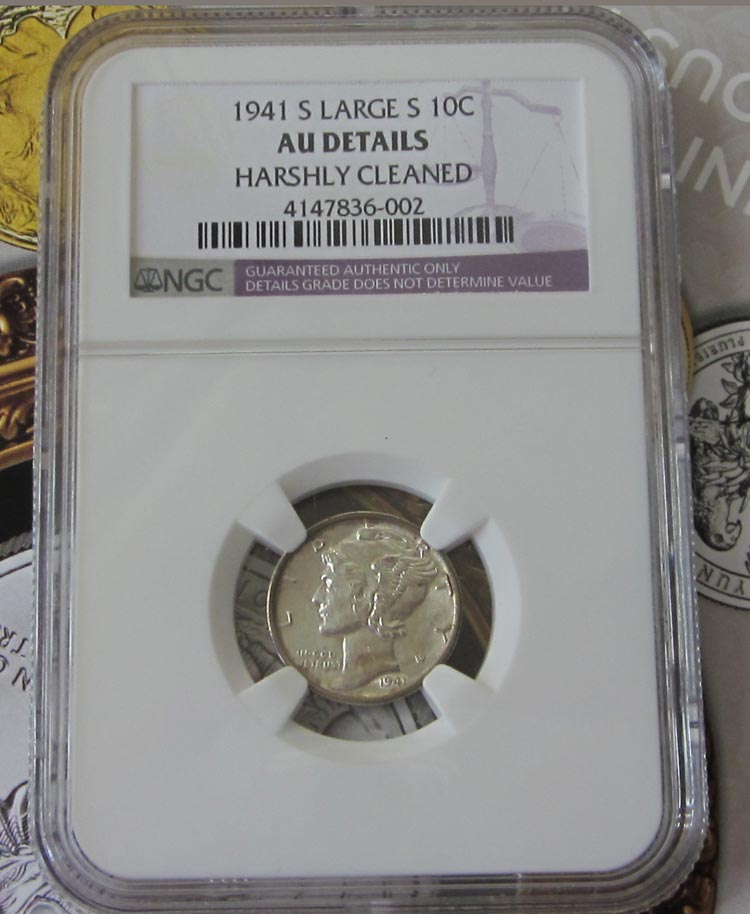 |
|
Bedrock of the Community
United States
12437 Posts |
Laminations are basically ugly mint-made flaws and will typically detract from the value of a coin, I would liken them to damage rather than an error. PCGS also detail grades coins with peeling laminations(83) and planchet flaws(93).
Think about it this way- an error should increase the value of a coin but would you really spend $400+ on a coin with a big hunk of metal jaggedly peeled off the surface?
|
|
Valued Member
United States
108 Posts |
biokemist6 is correct in his overall assessment of planchet flaws. Eye appeal is amongst the most subjective areas of grading. It is also the greatest influencer of marketability of a coin. In that respect, planchet flaws are detracting and affect the grade of the coin. Even the ANA Grading Standards identify planchet defects as detractions that negatively affect grade. Now, that is not to say that there are not those who collect such coins. Every oddity has its niche. However, with respects to grade, whether the damage occurred at the mint or post-mint is not the issue...it is still damage that has created a detraction on the coin, thus affecting the grade. Another thing to remember is that the TPGs were originally designed to create a completely sight-unseen market for coin "investment". In such case, I would personally prefer to know the coin was damaged with a planchet flaw with the details being AU than to have the coin "EF-40, planchet flaw." The "details" grade gives me more information regarding the coin than a lower adjusted grade. Ideally, such a situation should be "EF-40, rev. planchet flaw, AU details". |
|
Rest in Peace
United States
4849 Posts |
I purchased a high AU 1876-CC Double Eagle a couple of months ago in an NGC AU details "Planchet Flaw" slab. It cost about $1500 less than it would of in a problem free slab, and I bought it for that reason. I agree that it detracts from the eye appeal, but at the same time, I dont know if I would still call it a "problem" coin...since it came that way from the mint. It does have in impact on value though as obvious in my case, I am considering resubmitting it as an error.
|
|
Pillar of the Community
Australia
4411 Posts |
For me a decent planchet flaw or lamination would be an attraction not a detraction.
|
|
Bedrock of the Community
United States
14454 Posts |
this is the first time I had seen it (maybe because I usually do not even look at details coins) and when I did it kind of threw me for a loop as its not something I had ever heard of being called damage
|
|
Pillar of the Community
United States
4897 Posts |
Part of the reason you do not see a lot of early copper in slabs is because of the way TPG 's value planchet flaws. If you like early copper flaws are a given. |
|
Pillar of the Community
United States
3755 Posts |
While I see bios point of view, I do not agree. This being the personal part of it, I like laminations and all that. Errors, even a part peeling off, are, to me, pretty cool. Regardless of whether you like it or not, it should NOT be a details issue. Quote:
than it would of Nononononononononono, it is NOT would of! It is would've, the contraction of would have. Argh! |
| |
Replies: 26 / Views: 2,634 |







 Posted 10/11/2012 11:34 am





