| Author |
 Replies: 18 / Views: 5,173 Replies: 18 / Views: 5,173 |
|
Valued Member
Australia
236 Posts |
Hello apologies if this could have been posted in a better place. Although I first registered a while ago I am still a virtual newby. Just after some opinions on a 1952 Australian Halfpenny which has about 25 degree rotational error plus a definite central groove around what is normally a plain edge. I will put up some photos and any thoughts will be appreciated. Thanks all. 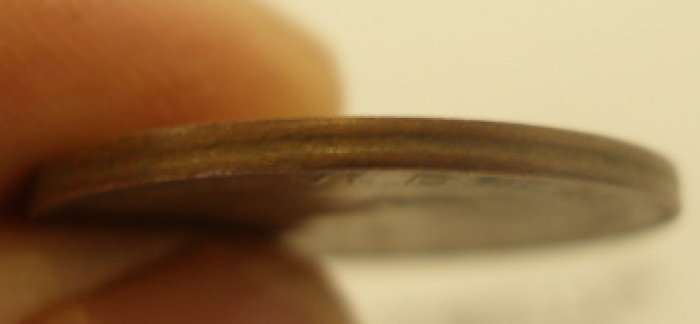 Edited by darge
12/05/2012 6:21 pm
|
|
|
|
Moderator
 United States
14463 Posts |
I am not sure about your Australian Halfpenny, but if that was a US coin, my first thought was maybe it was placed in an acid bath. The copper inner core dissolves faster than the outer layers. How does the faces of the coin look?
|
|
Pillar of the Community
Australia
4411 Posts |
What does it weigh? Its possible the rotation was mafe by gluing two halves together. Otherwise I have no idea.
|
|
Valued Member
 Australia
236 Posts |
Hello I'm sorry about not responding I was expecting an email if anyone replied. The weight is 5.7 grams and it is supposed to be 5.67 grams so that is very close, my scales could easily be out .03 gram. Having a bit of trouble getting the obverse pic. 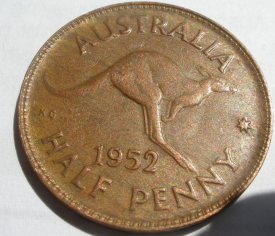 |
|
Valued Member
Australia
236 Posts |
Trying for the obverse face.
I keep getting this error :
"Gateway Time-out
The gateway did not receive a timely response from the upstream server or application.
Additionally, a 404 Not Found error was encountered while trying to use an ErrorDocument to handle the request."
Anyone have any idea why? Thanks.
|
|
Valued Member
Australia
236 Posts |
Still trying for the obverse. 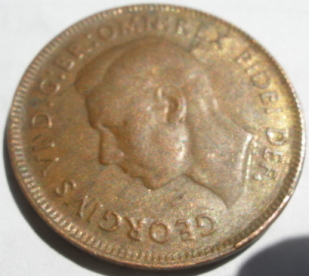 |
|
Pillar of the Community
Australia
515 Posts |
It's possible it has an imperfection in the metal and it's the very beginnings of a split planchet.
|
|
Valued Member
Australia
236 Posts |
Hi! I have had a hard look at the groove and I believe it has been stamped into it. I believe it is far too consistent to be a planchett error. I wish I could get a photo because there is one bit that has a pattern stamped into it. I'll try ... but I'm not too optimistic.
|
|
Valued Member
Australia
236 Posts |
Here goes : 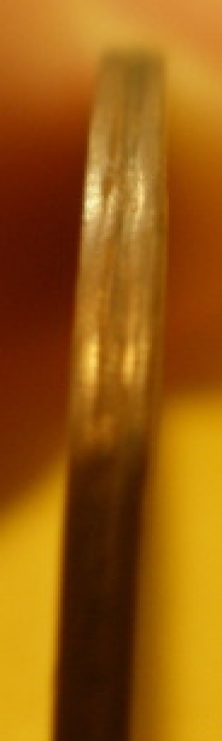 |
|
Moderator
Australia
17012 Posts |
If it has a groove like this running through the middle of the rim, as well as a 25 degree rotation, then my assumption would be that it's actually two coins that have had one face ground away, then the two half-coins have been joined together.
The big question is, of course, why anybody would do this. Usually such things are done to create double-headed or double-tailed "trick coins", or some kind of impossible "mint error" such as King George V obverse on a kangaroo reverse. But that doesn't seem to have been the case here; that obverse "belongs" with that reverse.
It's very odd. But I'm pretty sure the edge is not the result of a mint error.
Don't say "infinitely" when you mean "very"; otherwise, you'll have no word left when you want to talk about something really infinite. - C. S. Lewis
|
|
Valued Member
Australia
236 Posts |
Hello sap Thanks for your input. My thoughts followed exactly the same path as yours, hard to see any logic in it, especially to get so close to correct weight also. That's a lot of trouble for nil seeable gain.
The thing that keeps niggling at me is that I have seen exactly that edge detail on another coin but can't place it.
I'd love to find it is a mule. Somewhat obviously. LOL
I will let you all know if I ever solve the mystery.
Thanks for all the advice. darge
|
|
Moderator
Australia
17012 Posts |
The edge somewhat superficially resembles the "security edge" on certain foreign coins, such as Hong Kong and India. This security edge is applied to these coins at the striking stage; the collar die actually carries a ridge which causes the indentation on the coins. 2 eurocent coins also bear a similar edge.
Needless to say, Australian mints in 1952 were not striking coins for anywhere except Australia, so it can't be a "collar die from a foreign coin" that accidentally got used instead. And I can't think of any possible malfunction of the minting process that accidentally creates a security-edge-effect. It has to be post-mint damage; the only question is what kind of damage.
Don't say "infinitely" when you mean "very"; otherwise, you'll have no word left when you want to talk about something really infinite. - C. S. Lewis
|
|
Formerly nancyc
Australia
5385 Posts |
Quote:
I was expecting an email if anyone replied This will happen if you click on 'Topic Subscription' which appears at the top right, and also at the bottom of each topic.  life is a mystery to be lived not a problem to be solved
|
|
Pillar of the Community
Australia
515 Posts |
Here's a 52y half penny I have. I've put the 2 images together and it's taken pretty close up with the Dino Microscope. The defect in the edge extends around about half the coin and when I saw the pic in this thread I immediately thought of this coin as very similar.  |
|
Valued Member
Australia
236 Posts |
Thanks nancyc I have subscribed now and should be able to keep up. Thanks for those images purplepenny, I have further info along the same lines. I have 38 Perth Mint 1951 halfpennies and in them I found 5 with a pronounced groove and another 12 or more with some degree down to a faint ridge. I have 19 London or Birmingham Mint halfs and there is not the faintest suggestion of a ridge or groove. I did find 2 plains with one having an obverse 4 so that was a nice bonus. I would like to have 60 1952 halfs to do the same. I have a photo. 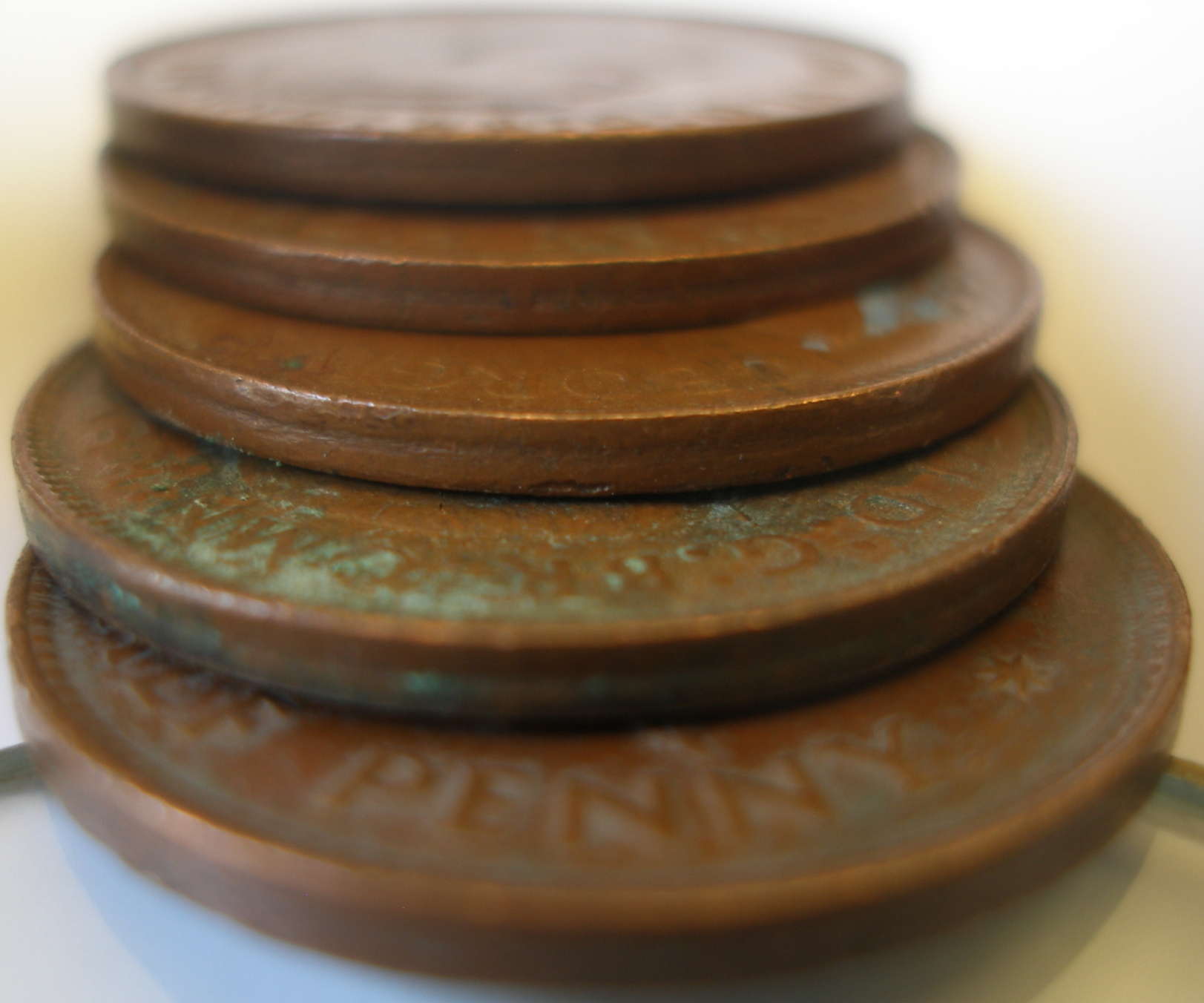 |
|
Pillar of the Community
Australia
674 Posts |
I ripped through a bunch of 50's halfpennies last night and found a few similar "grooves in the following coins- 1950- a couple, 1951 Y.- a few, 1951 Melb.149 denticles- a couple, 1951 Melb. Obverse 5- a couple, 1952-several, 1953 low dot- a couple.! All varied from quite obvious to faint and not all were around the entire rim.! Coin pool was approx. 300.! Hope this helps.! Will follow with interest  . |
| |
Replies: 18 / Views: 5,173 |




 Posted 12/05/2012 6:54 pm





