| Author |
 Replies: 23 / Views: 5,126 Replies: 23 / Views: 5,126 |
|
Pillar of the Community
United States
5155 Posts |
As my "coin" hobby turns into an obsession and my fascination with these ancient relics goes off in every direction, I started reading about Huns. I viewed in the last couple of months, many different types with too many that I would be willing to shell out for.(no reference to Chinese proto-coins intended..get it "shell" out.  )Anyways, I started reading about Hephthalites, or White Huns. There history is spotty at best, and there is not alot of information out there free on the internet regarding them, but there are a few good sources. Like... http://www.grifterrec.com/coins/huns/huns.htmlNeedless to say - I found the history of Central Asia in Ancient times to be rather complicated. A vast land filled with people of all types, speaking a ton of different languages. These people in particular are described by the Chinese historians a race of people from beyond the Great Wall. As the only Huns that didn't associate with others. These people are described as the only people in the land who had "white" bodies, and as not being Mongoloid like the other Huns. I once read an artical about Europoid mummies and other art work that was found in China, in much of the same era. Althought there origin remains a mystery.They were supposdly opposed to the teachings of the Buddah, and regarded highly regarded the Fire Alter of there Gods in place of Persian Gods, and Hinduism was favored. They were also described as an illiterate people with no script. In a nutshell, Between 370 and 750 ad this Nomadic confederation defeated the Persians in the West, displaced people including the Kidarites of Red Huns in Afghanistan, and wiped out the Kushan Empire, in take territory from the Guptas. Upon the conquest of Persia by the Muslims in the mid 7th century the, Hephthalites had been wakened and divided by Persia and its allies in the West, as well as failed campaigns deep in the Indian continent. Divided the Hephthalites would disappear into history, there last hold outs would be in Northern India and Afghanistan. This coin is from the White Huns. AR Drachm Senmerv Crown Type. Tri-lingual. Nezak (Nspk) Huns Kingdom of Zabul Vakhu (Vasu)-Deva, Sub-ruler of Shahi Tigin Circa 720-738 AD Ref. Göbl Hunnen Em. 244 31.8 mm x 3.28g. Die position=12h Obverse: Bust of Vasu Deva right in Persian style. Bull head above crown ; 'thunderbolt' countermark, Gold plug countermark. Brahmi legend in field. Cursive Bactrian Greek Legend around. Reverse: Zoroastrian fire altar and attendants. Pahlavi legend in fields, Cursive Bactrian Greek Legend around. Note: Holed. Gold Plugged. 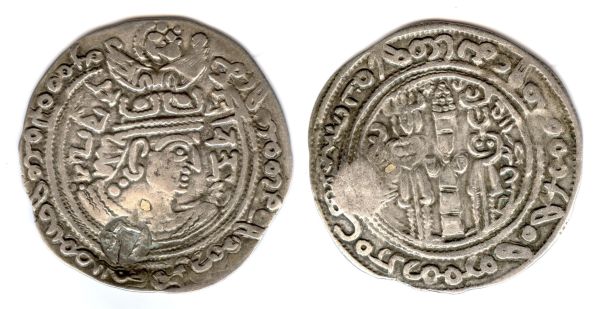 |
|
|
|
Pillar of the Community
 United States
5155 Posts |
Well I think the detail and the fact it has three languages on it is cool!
|
|
Pillar of the Community
United States
5010 Posts |
woa cool, that is an interesting modification of the sassanian coin, and the lettering is crazy. absolutely GREAT coin!  |
|
Pillar of the Community
United States
2044 Posts |
The history and the coins are complicated in that area and in the India region.
|
|
Pillar of the Community
United States
5155 Posts |
I think its a real good example of mastery of language and artistic style, very skilled engravers. I almost think these are more sophisticated then most Sassanid issues they imitate.
|
|
Pillar of the Community
United States
4778 Posts |
Can't help but notice at 6 o clock on the reverse the cursive script forms the word "cool", which is what this coin def is Interesting pickup Anoob! |
|
Pillar of the Community
United States
5155 Posts |
Holy smokes it does say cool thats awesome! Thanks for pointing that out VK.
|
|
Pillar of the Community
Canada
1411 Posts |
|
|
Pillar of the Community
United States
567 Posts |
Sri Bahamana Vasu Deva, Gobl type 244. Mint = ZAM (in pehlevi), date = 65 (685 AD).
Mitchiner 97.
|
|
Pillar of the Community
United States
5155 Posts |
Thanks JCM, I knew there where people out there somewhat familiar with these coins. I must say the art and script is remarkable.
|
|
Pillar of the Community
United States
567 Posts |
Thanks.
This one ooks almost die type with the Mitchiner plate coin. No reauthorization stamp on the plate coin in M though. Nice piece.
|
|
Pillar of the Community
United States
1316 Posts |
Anoob, sorry I haven't posted yet, show's over, you have no idea how much work go's in one of these, also we have club Wed. night too!!, I cook for 40 people, I have 14lbs chicken cooling, getting ready for white chix. chile ..MMMM  .. . Back to your fantastic coin, love the stamp, coin's awesome.. will get a smackdown coin soon... |
|
New Member
United States
31 Posts |
These are attributed frequently to various huns, but I do not think its hepthalite at all. If anything hunnish at all, I would say probably more Alchon or Nezak. Hepthalites did not create their own types, they always made Sassanid imitations.
Regarding the background of this area of the world, I would highly recommend "From Persepolis to the Punjab" published by the BM. Its the latest authoritative reference. Also, from the site you listed Tom has a link to a Ph.D dissertation I found helpful concerning peer review of various writings. A lot of this research is being published in Russian, and this paper reviews all Russian research as well.
Hunnish coinage is one of my specialties, and I am actually preparing a paper for a presentation I am giving at the Twin Cities Ancient Coin Club next month if anyone is close by and wishes to attend. I am covering Kidarite, Nezak, Alchon, and Hepthalite coinage, and will have about 50 different coins on display. I own the coin you show OP, but not sure if I am including it, as I am unsure which hun tribe it might be, or if its Turkish.
|
|
Pillar of the Community
United States
5155 Posts |
Well I wish I was closer, to the twin cities. I would love to attend. I have a growing interest in these types of coins. I noticed when these coins are listed, they are listed as Turco-Hephthalite, White Huns. I would love if you could send me a transcript of your presentation if one is available. I am not sure that these coins are "Hephthalite" in the traditional sense either. What they are sold as and what they are often two very different things as I have discovered with alot of ancient coinage. (I think it adds to the intrigue). I find this particular coin interesting due to the multilingual legends and fields. Its something you don't see everyday. I would love any other information your could provided on the coins of these various cultures. I am all ears...ugh well eyes.
|
|
New Member
United States
31 Posts |
I will be talking to Tom and seeing if he wishes to have my paper linked on his website when I am done. I also promised him to photograph my collection, as I have many coins missing on his site, I just need to get it done.
As a starter, though, I would highly recommend that Ph.D dissertation he has there. Its great reading both on possible origins of chionites/hepthalites as well as their culture.
One of my other specialties is Sogdian coins, another esoteric and interesting field somewhat related to the hepthalites, but that is a different thread. :)
|
|
Pillar of the Community
United States
3486 Posts |
Non plaudite. Modo pecuniam jacite.
Do not applaud. Just throw money.
I like that, and I could read it without help from a translator program. Is it actually to be found in a Roman text?
Four years of Latin and I still remember quite a bit.
|
| |
Replies: 23 / Views: 5,126 |






 Posted 01/21/2013 9:13 pm





