| Author |
 Replies: 10 / Views: 3,390 Replies: 10 / Views: 3,390 |
|
|
Pillar of the Community
 United States
2703 Posts |
Hello All, Lately I have expanded from the French Feudal States and started collecting portrait coins from the Italian states. There are many beautiful coins from this area. Last week I bought this Milan teston of Gian Galeazzo VISCONTI (1395-1402) from a dealer in France. It has a small test mark or scratch, but I was thrilled to get it anyway. Does anyone collect this area? Does anyone know the significance of the dragon on the back which appears to be eating a poor fellow? Any reference books you can recommend? Thanks!  |
|
|
|
Moderator
Australia
17012 Posts |
I have a few Italian States coins, mediaeval and early modern. None of mine are as nice as yours!   The coat of arms of the House of Visconti, which ruled Milan, was a serpent eating an infant. A bit of Googling revealed the legendary background: an ancestor of the house supposedly killed a child-eating serpent/dragon sometime in the 800's AD. The Italian automobile brand Alfa Romeo uses the same symbol on it's badge. This website illustrates this and gives some other theories on the origin of the Visconti serpent. The reverse of your coin actually seems to show an ornate helmet, made to look like a winged serpent. The actual coat of arms is in the small shield below the helmet. Don't say "infinitely" when you mean "very"; otherwise, you'll have no word left when you want to talk about something really infinite. - C. S. Lewis
|
|
Moderator
 United States
6563 Posts |
Very nice coin! I'm trying to collect OFEC (One From Every Country) and I only own a few dozen Italian coins from the 1900's and a Vatican coin. I'll find me some eventually. Sap can I call you wiki from now on?  |
|
Pillar of the Community
 United States
2703 Posts |
Hi Sap,
Thanks for rapid response and links!! I am very interested in seeing the medieval or early modern coins you have and hearing about the history behind them.
This one came from a dealer in Alsace who has a web site with a few hundred very nice French coins and competative prices. Focused on finding French ecus and testons, I had never bothered looking through his section of foreign coins until a couple weeks ago. The lesson for me is: Always take time to browse through all the coins on a dealer's web site. You may not find exactly what you are looking for - you may find something better!
|
|
Moderator
Australia
17012 Posts |
quote:
graceoutcast said:
Sap can I call you wiki from now on?
Just don't call me late for lunch.  Sorry. Australian humour. quote:
t360 said:
I am very interested in seeing the medieval or early modern coins you have and hearing about the history behind them.
OK, you asked for it. Here are some of my mediaeval ones. They're easier to find because they're all in one album; the moderns are scattered among the rest of the World A-Z albums. 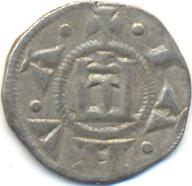  Genoa, silver denaro, undated (sometime 1100-1200). Late Mediaeval Italian coins were low on artwork, but the silver was usually good. This coin from the Republic of Genoa is pretty simple. Obverse is the city name in crude Latin letters: IANVA. "ianva" means "gate" in Latin (the word is related to the name of the Roman deity, Janus, and our month of January), and that's what appears as the main obverse design element: a city gate. Reverse is a simple cross, and the name of the German-Italian King Conrad III (CVNRADI REX), who was first to recognise Genoa's autonomy. The grateful Genovese perpetuated Conrad's name on their coins long after the king had died. 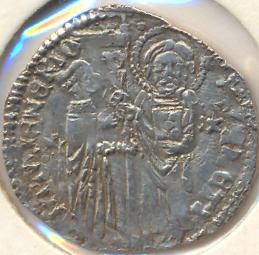  Venice, silver grosso of Doge Antonio Venier (1382-1400). A popular and widely copied trade coin of the late middle ages. Obverse shows the Doge standing facing St Mark, patron saint of Venice. Reverse is a very Byzantine-looking Christ Enthroned. It's easy to tell this is an earlier coin: after what was seen as the the excessive narcissism of the coins of Doge Nicolo Tron (1466-1473, whose coins are much better looking than this), all Doges were portrayed on the coins in a kneeling position. 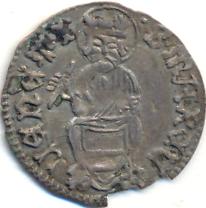  Imperial Venice in action. This neat little coin is from the Venetian-occupied city of Cattaro, now known as Kotor, Montenegro - not strictly Italian, but an Italian colony. I'm not sure when it was made, but the style seems to indicate late 1400's or 1500's. This one on CoinArchives appears to be much the same as mine and is a half-grosso dated to 1552-1553; I sure didn't pay that much for mine! It was given to me by a local dealer and sat in my mystery file for several years. The city was Venetian from 1420 to the end of the Republic in 1797. The obverse depicts Saint Mark of Venice (S.MARCU UENETI) in a very regal pose, holding the colonial coat of arms. The reverse shows the local patron saint, St Tryphon (S.TRIFON CATARI). Don't say "infinitely" when you mean "very"; otherwise, you'll have no word left when you want to talk about something really infinite. - C. S. Lewis
|
|
Pillar of the Community
United States
2703 Posts |
Very cool, very cool. These are some interesting coins! I really like your write-ups. You must be a regular contributor to professional numismatic publications? If not, you should be with your broad knowledge of coins. Thanks again!!
|
|
Moderator
Australia
17012 Posts |
Don't say "infinitely" when you mean "very"; otherwise, you'll have no word left when you want to talk about something really infinite. - C. S. Lewis
|
|
Pillar of the Community
United States
2703 Posts |
Sap,
I really enjoyed reading your articles on your club's web site. Looks like fun; maybe I'll find a club around here to join.
|
|
Pillar of the Community
United States
2703 Posts |
The striking portrait on this 1766 grosso from Lucca caught my eye, so I had no choice but to order it online a few days ago from a dealer in Germany. (It hasn't arrived yet) 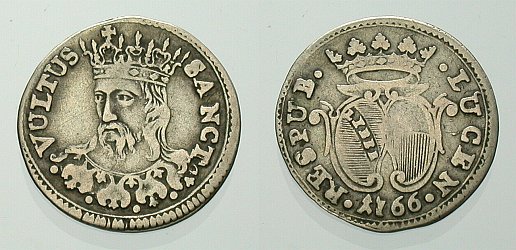 The portrait is of Saint Vultus. |
|
Moderator
Australia
17012 Posts |
That's not a bad "modern" coin from Lucca - it's certainly more artistic than my mediaeval denaro, my only example of a coin from that city. The sanctus vultus on your coin (and many other coins of Lucca) is actually Christ, as depicted on the Holy Face, a venerated crucifix in Lucca. Don't say "infinitely" when you mean "very"; otherwise, you'll have no word left when you want to talk about something really infinite. - C. S. Lewis
|
|
Valued Member
Netherlands
376 Posts |
Simple question to me.
Picture shown with question ought to be a silver testone with duke Galleazzo Maria Sforza of Milan issued between 1474 and 1476. A testone is coming from testa which means head. It is a little bit later than the name mentionned in the question. A genuine piece has a weight of 9.65 grammes in S950.These testones appear more on the market then there were struck and has been counterfeited numerous times.
|
| |
Replies: 10 / Views: 3,390 |
|







 Posted 04/16/2007 9:20 pm


