| Author |
 Replies: 21 / Views: 6,309 Replies: 21 / Views: 6,309 |
|
New Member
Australia
10 Posts |
Hi I was hoping that I could get some opinions regarding reales that only seem to have one start/ stop point on their edge.
I am relatively new to collecting coins and have only just found the web site and have been trying to educate myself in regards to verifying the reales and have gained a lot of insight from the previously posted discussions- so thanks for all those who had an input.
I have ascertained that swamperbob and jfransch may be able to help as they appear to be very experienced in regards this area but anyone else is very welcome as well.
The questions I have is in regards to the laurel edges of the milled Pillar reales.
From what I understand it is held that there is a need for 2 positions on the coin's edge where there is a start/ stop overlap- this is based on there being 2 parallel hardened steel dies that did the cutting.
However would it not of been possible for the top parallel cutting die to be not used but replaced with a blank block to clamp the coin and just use the fixed die to do the cutting for some reason- such as wear or a broken surface in the top die?
I ask this because I have a Mexico mint 1756 8 reales that I can only find one edged start/ stop position. It weighs 26.85 dry and I have performed a Specific density test and get a reading of 10.52 which as my scale only goes down to 1/ 1000 Gram appears to fall in at the right range allowing for tolerance of my home based measurement apparatus.
I was thinking that the example of some coins having die rotation indicated that in certain cases the top or moving die was placed in back to front. Is that correct- as it is the only way I can see that the laurel design would go in opposite directions?
If there was some temporary problem with one of the cutting dies could it be that production was kept going with just one die while the other was resurfaced?
One other question I had is if the dry weight of a silver coin is in range of what the nominated weight should be and the diameter and thickness is identical would it not mean that either it was comprised of real silver or it would have to be a high percentage of lead with some other alloy to reduce the mass of the lead which is slightly heavier than silver?
I ask this to check to see what the specific gravity reading would be if a coin did have around 80% lead. I take it that it would be a lot higher than around the 10.4 for high percentage silver?
Hope I have not confused you which the way I have phrased my questions and thoughts.
I do appreciate your opinions and time.
Also as I have not scanned all the posts fully is there any update on when Swamperbob's reference book is coming Downunder and how to get one in Australia? If you are there Swamperbob is it true that a personally signed copy is free to the first Aussie convict to request one?
Thanks for everyone's time.
|
|
|
|
New Member
 Australia
10 Posts |
Old age everyone - I forgot to clarify what I was trying to say in regards to my comment- "If there was some temporary problem with one of the cutting dies could it be that production was kept going with just one die while the other was resurfaced?"
This would then mean that the coin would do a full 360 degree rotation and there would be just the1 join or stop start point on the coin's edge.
|
|
Valued Member
United States
324 Posts |
A lot would depend on whether the edge mill they were using had extra long dies with a repeating design or if it only had dies long enough to roll one coin at a time. My castaing machine is only large enough to put one coin through at a time so one blank die would leave half the edge blank. I am not too familiar with the edge of the coin you are referring to, is the design raised or incuse? If raised, you could easily use a blank die and one extra long die to roll the design, but the spacing would have to be perfect on the edge die. If the design is incuse, you would run into problems of the edge dies running over the previous design unless perfectly spaced and aligned. All in all, I would say that the right setup would work the best and maybe your coin was done with a well spaced set of edge dies that doesn't show a second mark.
Joe
|
|
Pillar of the Community
United States
1801 Posts |
The edge design should show 2 overlaps. Simple physics dictates that if you are rolling a coin along two parallel dies, there should be two points at 180 degrees from each other that show the point at which the imprint from the one die made its way around the coin to overlap the imprint from the other die. That said, there are always variations. I have seen coins that were authentic in every way I can diagnose yet I could not find a single overlap. Possible that the images lined up perfectly? The examples I have seen were all dated between 1762 and 1768,a period of time when the planchet size seems very consistent and the production standards were very high. (I am always suspicious of a coin from that period that does not look very sharply and cleanly struck.)
As for the image running in 2 directions, that occurs on 8 reales from Mexico and Guatemala up to 1763. The edge showing different direction on an 8 reales from a different mint or outside those years would be a very suspicious coin.
I have never seen a legitimate coin with only one overlap, most of those coins also show other signs that raise suspicion of a counterfeit, though possibly a contemporary one or the type Swamperbob refers to as bullion counterfeits minted to full silver weight to satisfy the insatiable demand in China for pillar and Portrait Spanish colonial dollars.
Please post pictures of your coin, including photos all around the edge and with close up of the different feature on the obverse and reverse. I would love to be enlightened to a single overlap coin that is certifiable as legit. (Though that said I put no faith in the TPGS)
|
|
New Member
Australia
10 Posts |
Thanks Badger mint and jfransch for your comments.I found a post by Swamperbob back in July 2011 not sure if it applies to the early Milled Pillar dollars. Also found one from MathieuMa. Posted 11/07/2011 1:36 pm Swamperbob ________________________________________ Mathieu - There are always TWO overlaps - sometimes they are simply not very visible. If the coin diameter aligns exactly with the design interval - you can have coins that have VERY HARD to spot laps BUT the blanks were edged in a way that these have to be TWO. I have never seen a description of a single sided edger being used in the NEW World. Perhaps someone at sometime used a one sided edger (which would produce 1 lap) but it would be far less efficient than the 2 sided edger which was developed in the 16th century. So for the issues in question - there are always two overlaps even if you can not see them clearly. This would then mean that the coin would do a full 360 degree rotation and there would be just the1 join or stop start point on the coin's edge. Posted 11/07/2011 06:53 am MathieuMa ________________________________________ Actually depending on the date and mint, there can be one or two overlap ... at least on the ones with leafs. The pattern should be regular on genuine one - and the circles ... circles (inside and outside). I would agree that for their to be only one overlap unless only one edging die was in use- it would be a rare statistical occurrence for the coin to be positioned at exactly the right position on the edge die for the laurels to match up in regards to lapping fully or at least to the naked eye aided by a loupe- but not an impossibility. I am just trying to eliminate possible explanations for a coin to be within the correct tolerance for a genuine specime- other than it is forgery comprised of the correct silver content. I suppose with Silver at $60+ an ounce the manufacturing of a coin out of pure silver would still make it profitable enterprise seeing that 8 reales seem to be selling for between $200 - $350? At last I have finally educated myself to downsize the original photos to upload the photos and I suppose the obverse and reverse side will cry fake and my worries about the edges will be irrelevant. Anyway it is something that theoretically is of interest for othe rcoins and other's opinions are apppreciated. So thanks again for eveveryone's time. 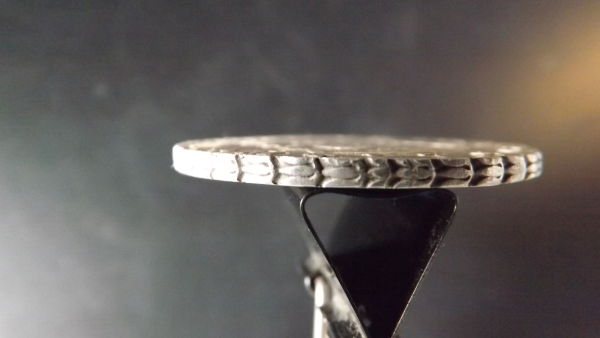 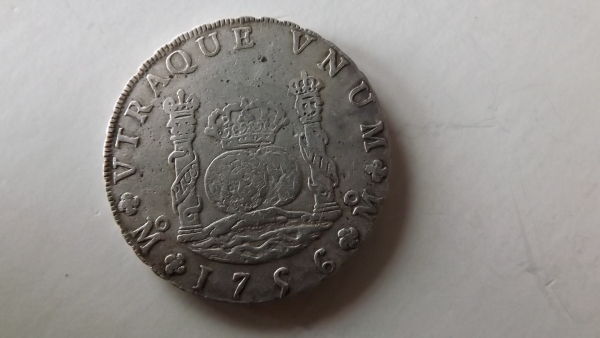 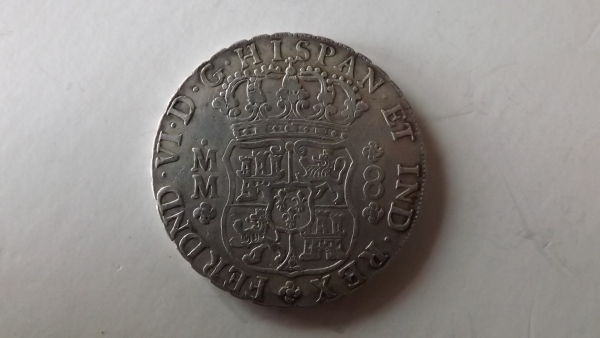 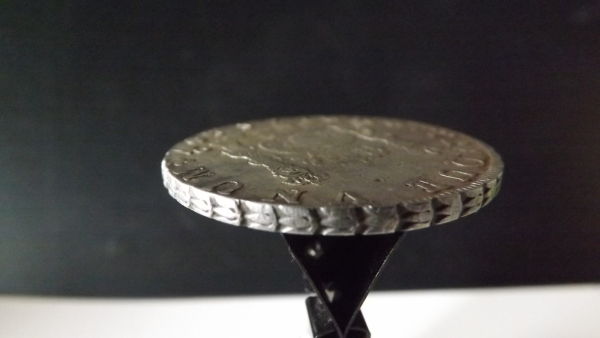 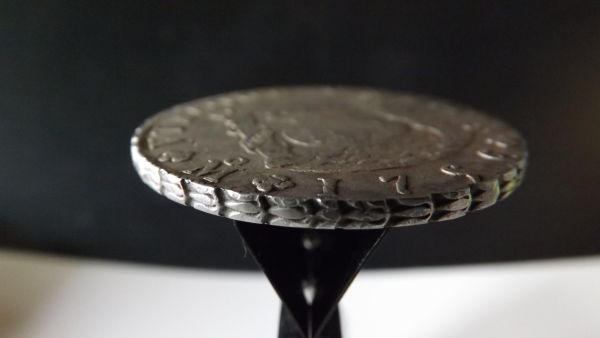 |
|
Pillar of the Community
Hong Kong
1270 Posts |
|
|
Pillar of the Community
France
1591 Posts |
Thanks for putting that topic back up wonghinghi, it's a reference ! collectacoin : I'm sorry, but you have a copy ... it takes some time to get used to the edge, but once you have learned how they should look, it's the easiest thing to check (which is missing most of the time on ebay though ...) |
|
New Member
Australia
10 Posts |
Thanks for every one's replies.
The thing is then if it is a fake it must be comprised of genuine silver if the diameter and thickness and specific gravity is within the correct tolerances or is there another explanation?
|
|
New Member
Australia
10 Posts |
Thanks Wonghinghi for the site reference it was one that I printed off as well as saved. I have attached a photo of the edge at a different angle am I correct in saying that the edge was cut prior to the face strike? Also can cast forgeries be edged both pre and post the face striking? Also if the forgers were using high percentage silver would they still cast it or would they be cutting plantlets and then striking them with dies and producing the counterfeits in the same manner as the original coins were made? 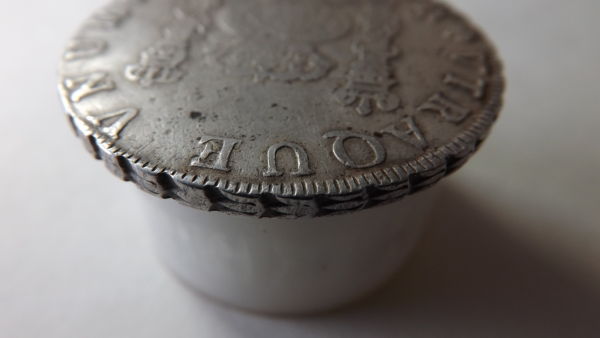 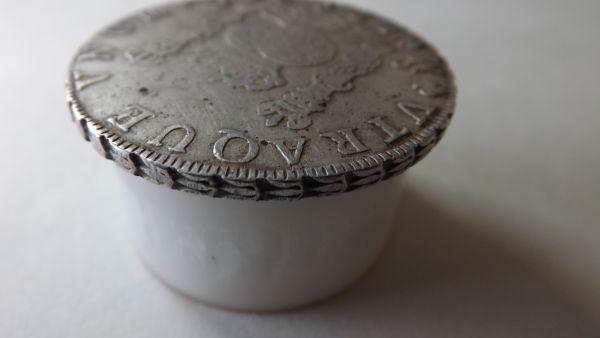 |
|
Pillar of the Community
Hong Kong
1270 Posts |
collectacoin, I don't think your coin is made of genuine silver, you had better to check the S.G. of it. I have 4 pillar coins: 1739, 1753, 1763 and 1771, all Mexican, have S.G. ranges from 10.214-10.318, corresponding to 84.13%-90.86% silver. They are all genuine in my opinion. S.G. is useful to pick out those debased counterfeit silver coins but S.G. can never answer how much silver content inside a coin accurately because every object has its weight and its S.G., this does not mean they have any corresponding silver inside.
So your assertion : "The thing is then if it is a fake it must be comprised of genuine silver if the diameter and thickness and specific gravity is within the correct tolerances" is not correct. Henry
|
|
New Member
Australia
10 Posts |
Hi wonghinghi Thanks for your contribution to my education I understand what you are saying regarding sp and that other metals can be combined to comprise a figure that is in the same range as what silver should be.
The thing is from what I have been researching- to have close to the same sp if the coin was the same diameter and thickness lead is basically the only economical metal to utilise as it has a slightly higher sp than silver.
However I understand that lead has a grainy feel to it and can tarnish or discolour within a short period so would it be plated with silver?
This coin has a sp of 10.215
I was also thinking that a fake coin must have it's edges poured with the rest of the coin as if it was edged pre or post two over lap would show is this correct?
Thanks for your time.
|
|
Pillar of the Community
United States
5362 Posts |
Just a few random late thoughts.
Most critically is that the manual edging mill did NOT have long edge dies like the later powered machines machines capable of edging multiple coins.
The short dies were more economical to make. Wasting a lot of steel would never have been done. Die steel was expensive and a double long bar is twice the work for the die maker.
The set up described is impossible for temporary use of a "normal" edge mill.
Some later issues did have edge laps that were VERY hard to locate because the punch diameters were well controlled so that die length could be matched with circumference perfectly.
The coin that is pictured is a counterfeit and it was edged before it was struck on a flat press.
Regarding the SG at 10.52 - that is too high. Also check your scale. Most digital scales that have 4 place read outs have instructions with fine print that indicates an accuracy level. Check that out because I have see some cheaper scales that read out to 4 places with up to a 2% accuracy limit which is worthless for SG. Precision is the name of the game. If your 4 digit scale cost under $1500 new you can bet it is not accurate enough for two decimal SG's.
I bought a very nice and accurate analytical balance at a sheriff's confiscation sale. Drug dealer scales are confiscated and sold at auction. A typical high school lab level scale with three beams is most common. That scale which is accurate to 1/100th gram will give you 1 place SG results and is accurate enough to detect debased counterfeits. The 4 beam balance that I own cost a small fraction (about 5%) of the original price and is a college lab level (or professional lab model) accurate to 1/1000th gram if placed inside a glass cabinet to preclude air movement. I normally do not use that set up it is overkill. I think the scale must have been stolen but since the sheriff sold it I am off the hook - I hope.
Coin silver should test 10.3 (or 10.31 with weights accurate to 1/1000th gram). Just because you round the math to 2 decimal places does not mean your results are accurate to two decimal places. I suspect once you take into account scale accuracy that you may have a result accurate to +/- 0.5 so that your coin may be anything from 10 to 11. But 10.52 is far too high for coin silver.
Regarding alloys used to mimic silver. Since the 1880s thieves have learned that a lead tin alloy can be made easily and cheaply to exactly match silver density. It is the basis for the stuffed 8R coins that were so common in the period right before 1900. Absolutely no ring and soft - easy to shape to fit snugly in a hollowed out silver coin.
|
|
New Member
Australia
10 Posts |
Hi Swamperbob I appreciate your input I really want to be able to have the ability to distinguish the forgeries and the more knowledge I can glean from everyone's experience is very helpful. I have just obtained The milled Columnarios Of Central And South America, Numismatic history of Mexico from the pre-Columbian epoch to 1823 and am waiting in anticipation for Voulme 1 and 2 of the Compendium VIII Reales Compendio de las Piezas de Ocho Reales.
However while they will assist in identifying the reverse and obverse details the topic of counterfeiting techniques is not covered â€" unless it is in the Compendium VIII Reales Compendio de las Piezas de Ocho Reales discuss the topic but I would not think so.
I value your comments as you have gained your expertise from actual study of counterfeit coinage which I believe is a good way to understand and explain logically why a coin cannot be genuine as if the technique is known then the result of the use of that technique can be seen in the end and illuminate any doubt.
Can I ask what is involved in regards to edging a coin before it was struck on a flat press? Does the flat press actually cut the edge or is it an impression made by placing a collar ring under pressure?
I can understand what you are saying regarding measuring with scales that are not calibrated finally enough however you miss read the reading in my post the SG at 10.215 which is in line with the recommendations.
I have checked several coins that are genuine and the scale does place them in the 10.2 to 10.38 range so while there will be some degree of inaccuracy the scale which is specifically for the jewellery trade it would seem to be acceptable.
That is why I have been pulling what is left of my hair out. I am not disagree that the coin is fake but for my own inquisitive mind I am trying to determine if the counterfeiter used the correct mix of silver/ copper to help assist in disguising their work.
Am I right to say that if it is not silver then it would have to be a clad of medals who's sp averaged out to the same of that of silver?
As seen from the table below to get a sp of 10.215 if the coin was not comprised largely of silver as its diameter and thickness is the same â€"it would have to be predominantly comprised of lead- as lead is the only metal other than gold or platinum that would bring the sp up to match silver when other metal s such as copper, iron etc up.
However in its normal state lead tarnishes rapidly to a dark grey colour, and has extremely poor wear resistance and would have a different surface to that of this coin from my understanding. It could be lead with a silver plating but then it would still need to have another metals to bring the sp of the lead down.
As I said what I am trying to determine is if in order to obtain a correct sp for fake coins â€" is real silver being used?
If I can establish a clad of other metals whose sp average that of silver that is plated with silver then it will-although not illuminate that silver is being used will provide another explanation to explore.
Thanks again for your time and sharing of your knowledge
|
|
Pillar of the Community
United States
5362 Posts |
collectacoin Thank you for your remarks. I am trying to pass along what I learned. But I have been at this a long time now and it takes time to get the knack of spotting some of these errors.
By a flat press I was referring to a two die system pressing the planchet - except that the drive is usually hydraulic not a screw manually operated. There is no collar die it is just brute pressure that deforms the coin surface.
I suspect a single edger die was used which could be either round or flat resulting in a single overlap. Single die edgers always produce one lap unless a coin is intentionally edged twice. Then they often get the lap lengths wrong.
The mix of metals that is used to mimic silver is lead, tin and sometimes antimony. It is far harder than unalloyed lead but still soft enough to work easily. The color is also better and there are several ways to deposit silver onto it.
The lead tin core can not be used to make a Sheffield plate as it has far different physical properties so striking or rolling such a sandwich results in a poor coin.
I suspect your coin is simply too thick. From the pictures it is clearly too thick - unless you edited the photo and narrowed it. The proportions look off to me. You should check the thickness with a good micrometer.
You did not answer about the scale accuracy. The read out on the scale means very little if it has an accuracy of o.2% or 1%. That is a function of the chip in the scale and the spring if it is mechanical. I really only trust a balance neam scale that can be leveled and which you can examine the pivot for wear.
|
|
Pillar of the Community
United States
1801 Posts |
Hello Collectacoin, I am impressed, you actually found a copy of "The Columnarios of Central and South America", I assume the one by Gilboy? That I itself is a major achievement in collecting pillar dollars.
I am sorry that your first post turned out to be a counterfeit, but stick around the forum here, learn from SwamperBob and you will learn what signs to look for. Collecting 8 reales can become an obsession and there are always new areas to branch out into. I have been collecting for 30 years and still keep adding new coins to the collection. Welcome aboard.
|
|
New Member
Australia
10 Posts |
Hi Jfransch, It is by Gilboy and you are right the book along with the 2 volumes of the Compendium VIII Reales Compendio de las Piezas de Ocho Reales apparently are collector items worth more than most 8 reales but as I have seen posted it is more prudent to invest money into the appropriate reference books to gain knowledge than to drift or sail into ignorance that can waste thousands on fake coins. You are right it can become an obsession- not just the historical education you obtain but as in this regard it stimulates your powers of perception, reason and scientific knowledge â€" such as how to perform a sp test and then put it all together as a detective and hopefully produce a logical determination that stands before others to support your stance. I also agree that there are many new areas to branch off and specialise in that is why I have decided to try and restrict myself to 8 reales as to try and cover all the reales as well as the Austrian/ German pre 1800 talers that I started to collect is impossible- at least for an old head like mine. I only wish that I could download every ones knowledge on reales especially yours and Swamperbob's years of experience into a section of my brain. ( not saying that there are others that do not know just as much or more â€"just I have just started to trawl this forum and not that you both seem to be forefront in regards to 8 reales). It is frustrating as it seems it will take years to get up to speed on just the many different mints and their designs and abnormalities â€" not to mention the counterfeit in that was down by in th e1800 and even prior if my memory serves me correct. I have attached a drawing on the edging machine that apparently was used around 1772 â€" it shows long bars that were engraved to do the edging but I cannot seem to discern if they were long enough to produce just one edge by reversing the movable top engraving bar to support my theory. Most likely Swamperbobs reply is 100% correct that the bars would not be produced long â€" I suppose it is the rebellious sceptical gene in me that need to exhaust all possibilities so I apologise Swamperbob I should just listen to your years of experience- Most Of us Aussie convicts have hard heads. I have just started to skim through my copy of the The milled Columnarios Of Central And South America, Numismatic history of Mexico from the pre-Columbian epoch to 1823 and it was interesting to read the following;- "Yet whereas no limit appears to been fixed for each denomination in England , in Spain they were set out in detail though it is very possible that the limits were observed with lips more than with the heart and mind. For silver coins they were: 8Rs Up to 4 grains (0.1996g) 4Rs Up to 3 grains (.01497g)......" "In the Spanish dominions on the other hand, by the order of 9 June!728, lightweight coins were put aside for the payment of staff salaries(!) and, should any mint have surplus "febles", it could send them on to less fortunate sister intuitions." "The diameters of the coins rarely varied but the thickness was determined by the number of coins that had to be obtained from a given quantities of metal." Very interesting to note that weights may not of always been as strictly enforced as some state especially when mints were privately managed and not by the Spanish State as in later years even though there was severe penalties if caught. The Author also makes a comparison to that of England when the moneyers customarily struck a quarter of the guineas several grains too heavy and another quarter too light. Only the correct and lightweight coins passed into circulation with the Gold merchants collecting the heavier coins and reshipping them back for reminting at the correct reduced weigh which resulted in them picking up 2 or 3 per cent profit on each coin. Apparently the practice was given the nick name- "Come again Guineas" Anyway thanks for the welcome I hope I do not outwear it with too many questions. 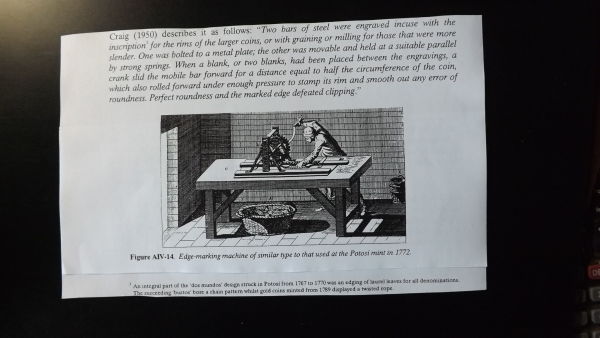 |
| |
Replies: 21 / Views: 6,309 |
To participate in the forum you must log in or register.
 
- Counterfeit Detection: ANA Video - Introduction, With Brian Silliman And Jim Robinson Ep. 1
- Counterfeit Detection: ANA Video - Mistakes, Risk Factors, And Counterfeits & Alterations, Ep. 2
- Counterfeit Detection: ANA Video - Pimples And Pits, Looking At Cast Counterfeits, Ep. 4
- Counterfeit Detection: ANA Video - What Year Is That Cent? Key Date Coins, Ep. 5
- Counterfeit Detection: ANA Video - Diagnostics Of The 3, 5, And 10 Cent Coins, Ep. 6
- Counterfeit Detection: ANA Video, Counterfeit Quarter Dollar Diagnostics, Ep. 7
- Counterfeit Detection: ANA Video, Counterfeit Classic Commemorative Coins Diagnostics, Ep. 8
- Counterfeit Detection: ANA Video, Counterfeit Silver Dollar Diagnostics, Ep. 9
- Counterfeit Detectection: ANA Video, Classic US Gold Coin Diagnostics, Ep. 10
- Counterfeit Detection: ANA Video, Diagnostics Of Chinese Made Counterfeits Of US Coins, Ep. 11
- Counterfeit Detection: ANA Video - Wrap Up Recap With Brian Silliman And Jim Robinson Ep. 12
- 2026-P Jefferson Nickel Possible Die Chips, Die Cracks And Other Anomalies
- Commems Collection Modern: What If? 1993 Bill Of Rights Circulating Coinage - A 1990 Attempt
- Split Grading - An Idea That Would Drive Collectors Mad
- 1960 D Lincoln Memorial Cent (Small Date) BIE
- Is This 1888-S A VAM-10, 10A Or Something Else?
- 1994 Brazil 10 Centavo - With Die Clash
- US 1 Cent 1856 Altered From 1858?
- 2009-P Quarter, Puerto Rico, Reed / Edge Error Or PMD?
- 1937-D Walking Liberty Half Dollar. Set Upgrade.
- Post Your Coins And Medals Featuring A Snake.
- Counterfeit Detection: ANA Video - Introduction, With Brian Silliman And Jim Robinson Ep. 1
- Counterfeit Detection: ANA Video - Mistakes, Risk Factors, And Counterfeits & Alterations, Ep. 2
- Counterfeit Detection: ANA Video - Pimples And Pits, Looking At Cast Counterfeits, Ep. 4
- Counterfeit Detection: ANA Video - What Year Is That Cent? Key Date Coins, Ep. 5
- Counterfeit Detection: ANA Video - Diagnostics Of The 3, 5, And 10 Cent Coins, Ep. 6
- Counterfeit Detection: ANA Video, Counterfeit Quarter Dollar Diagnostics, Ep. 7
- How Far Back Can We Go? Ninth Edition!
- Counterfeit Detection: ANA Video, Counterfeit Classic Commemorative Coins Diagnostics, Ep. 8
- Counterfeit Detection: ANA Video, Counterfeit Silver Dollar Diagnostics, Ep. 9
- Counterfeit Detectection: ANA Video, Classic US Gold Coin Diagnostics, Ep. 10
- Counterfeit Detection: ANA Video, Diagnostics Of Chinese Made Counterfeits Of US Coins, Ep. 11
- Counterfeit Detection: ANA Video - Wrap Up Recap With Brian Silliman And Jim Robinson Ep. 12
- Post Your Coins With A "five" Denomination
- Is This 1888-S A VAM-10, 10A Or Something Else?
- Around The World With Coins - A Coin Geography Game
- Post Your Coins/Medals/Tokens That Are Intentionally Dual-Dated
- Post Your Coins Issued By The Mint As Colourised Coins.
- All Members, Post Your Most Recent US Coin Purchases!
- Post Your Coins With Coats Of Arms, Shields, Crests, Crowns, Etc.
Disclaimer: While a tremendous amount of effort goes into ensuring the accuracy of the information contained in this site, Coin Community assumes no liability for errors. Copyright 2005 - 2026 Coin Community Family- all rights reserved worldwide. Use of any images or content on this website without prior written permission of Coin Community or the original lender is strictly prohibited.
Contact Us | Advertise Here | Privacy Policy / Terms of Use
|
| Coin Community Forum |
© 2005 - 2026 Coin Community Forums |
| It took 0.59 seconds to rattle this change. |
 |
|










 Posted 02/04/2013 7:45 pm


