Poll Question
So here I go! Let me sink my teeth into the soft underbelly of my problem-du-jour. This something has been hashed over again and again, and I feel that now's the time for a fresh round:
The Sheldon Scale MUST Die. [IN TECHNICOLOR]
Here lieth my manifesto against this relic that is nearly as old as American coin collecting, itself. (Granted at this point it's more of a rant as it's not as well sourced and laid out as a manifesto.):
1) The Sheldon Scale is not one scale, but two separate scales duct-taped together.
Sure, Sheldon didn't have duct tape in his era, but that didn't stop him. We all know the divide: 1-59 is "circulated" where 60-70 is "uncirculated." The problem is that there are plenty of AU coins that are much more pleasing to the eye (and are much more *intact*) than your average MS60.
Furthermore, where the "circulated" scale is much more quantitative (generalized patterns of wear and metal loss are quite easy to track) the MS scale breaches into art and divination and is FAR far to granular. How many bag marks and hairlines does it take to land an MS64? Is strike taken into account? Isn't it? Sometimes yes, sometimes no.
What about toning? I've seen some really UGLY coins (due to toning) in the high MS range, and frankly should one be paying more money for an ugly coin than one that really shows off its design?
2) We don't even use the whole scale.The "circulated" side of the scale isn't a steady progression. Out of 1-59, only 13 (*sometimes* up to 19) grades are used. These vestigial "between grades" add nothing to the scale. (When was the last time you say a G5 or an AU51 on a slab?)
Comparing this to the sudden 10 points of granularity on the MS scale where the coin isn't supposed to have any wear at all, and things are very poorly laid out.
For something to be a true *scale* or *spectrum* there should be some even, quantifiable, regular measure that progresses through it (be it linear, exponential, logarithmic, etc..)
3) The grade MS70/PF70 does not exist. And yet we have it.
There is no such thing as a "perfect" coin and when people see MS70 that's what they think they're getting.
Everyone has seen PF70s with hairlines and fingerprints, or problems that develop after the coin is encapsulated. Also, comically, in some graded series that are submitted directly for grading (such as ASEs) they tend to only come in two flavors: PF69 and PF70 in a pattern that defies their actual quality due to their submission in bulk to TPGs by dealers and how TPGs cherry-pick them.
If it's a joke, why use such a designation?
4) TPGs keep pushing to make it more granular.A picture is worth 1,000 words. I posted this info-graphic a couple years back to try and express my frustration with how TPGs handle pennies:
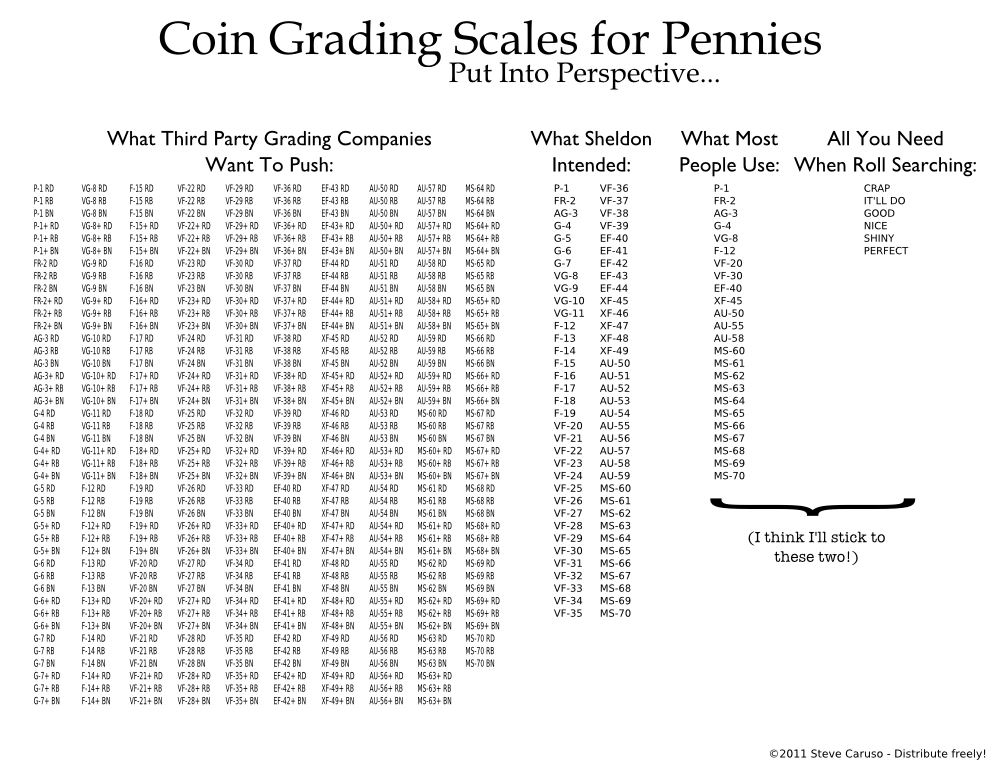
Granted, this is an exaggeration, but making things more granular is for marketing purposes only. Additional designations are also a problem, as you can see (be it the color of the copper, or "+").
5) The scale was NEVER intended for this in the first place.Sheldon wanted to use this as a means to grade particular coins as a multiplier of base value at a particular period in history. In essence, he was trying to find some means to regularize prices and dictate value. Today the stage has changed and prices are all over the place, making that original vision unsuitable.
Extrapolating this scale onto modern coin collecting is in many ways like using an adjustable wrench to drive phillips-head wood screws into concrete. It's the wrong tool, and the wrong vector for the job.
So here is my radical suggestion: The 10 Point Scale. (Yes! I'm *going* there.)
Here's how it works:
1) "10 points" is a small lie. It's really 0-9. There is no 10. 10 is imaginary.
2) The coin is graded on quantifiable physical characteristics and rated from 0-9 vis a vis how well the *design* of the coin comes across. 0 is it's identifiable. 9 is the higher 1/3 of MS. Bad strike, late die state, and wear are treated
equally as they all mean the design is not as crisp as it should be. No designations like FBL, or FS, or FH, are then needed. End of story.
3) Other good considerations are given a "+1". Very appealing toning? Red? DCAM? PL or DMPL? +1. (Yes, this does mean that there could be a "9+1", but
it will NEVER be written as "10" on principle! :-) ).
4) Distractions are given a "-1". Scratches or damage on an otherwise beautiful coin? Dings on the rim? Really UGLY toning? Serious bag marks? Cleaned? -1.
5) Coins with "+1" and "-1" are simply listed as "±1." (Ex. " 8±1: Gorgeous toning and a rim dent", etc.)
I would consider expanding this to a scale of "16" or "20," provided the progression is *even.*
So, what to you all think? Suggestions? Comments? Your own rants?











 Posted 02/20/2013 12:30 am


