| Author |
 Replies: 22 / Views: 7,370 Replies: 22 / Views: 7,370 |
|
New Member
United States
9 Posts |
|
|
|
|
Pillar of the Community
 Canada
9904 Posts |
"Dipping" is not considered cleaning...
-from PCGS website
|
|
Valued Member
197 Posts |
Why would you think that. It's within tolerance (for 1859). ALL 1858 & 1859 were 25.4mm and 4.54 g. Any wear on the coin and it will be less than 4.54g. Somehow, I don't think that the Bank of Canada is/was a collector. Spend $50 to have it certified for your $2 coin.
|
|
Valued Member
Canada
286 Posts |
 Looks like a simple N9 Not in the greatest shape either looks cleaned IMO Keep dreaming big though you never know when you will find a rare one! |
|
Pillar of the Community
United States
1376 Posts |
I have seen lower grade Vicky 1858 and 1859 cents weigh as little as 4.10 grams. The weight variation on these was so wide (primarily due to loose planchet thickness tolerances during the rolling operations) that you cannot determine a brass cent by weight.
http://www.victoriancent.com2011 & 2025 Fred Bowman Literary Award, 2025 Guy Potter Literary Award, 2022 Paul Fiocca Award, & 2020 J. Douglas Ferguson Award. Life Member of RCNA.
|
|
New Member
 United States
9 Posts |
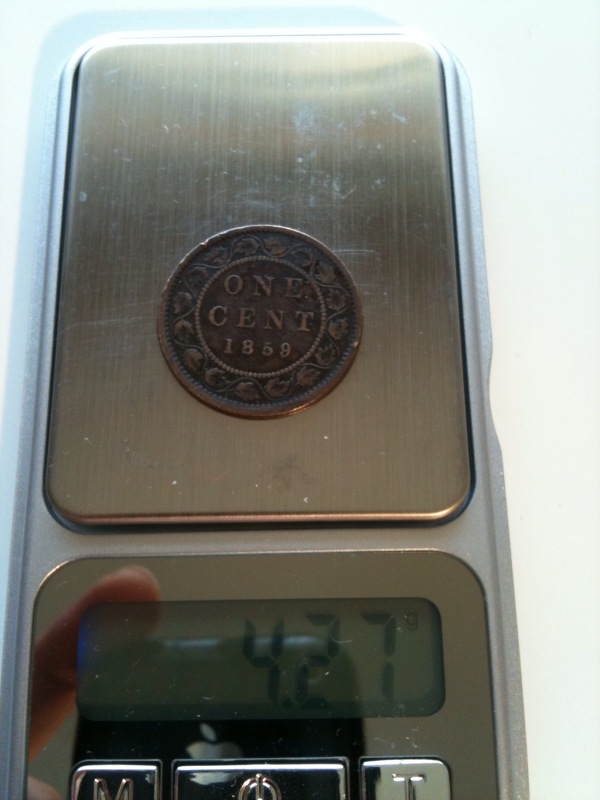
coin is 150 years old,and all understands, any wear on the coin and it will be less than 4.54g.No one is talking about dimensions  |
|
Pillar of the Community
Canada
3234 Posts |
I did see a true brass 1859 many years ago and didn't know what I was looking at. I could have bought it but didn't know of the importance at the time. It was very shiny and there was no darkness or staining in between the letters etc. ..and it was quite worn also My loss..  . ..it was labeled "fake" in it's cardboard 2x2 holder by the old collector......... |
|
New Member
United States
9 Posts |
1859 cent dimensions 25.4mm this coin is 25.66mm.Can anyone explain? |
|
Valued Member
United States
493 Posts |
darutis, why don't you send it to a third party grading company like CCCS or ICCS. They can authenticate it for you. :)
|
|
Pillar of the Community
Canada
695 Posts |
I agree send it to a third party for grading. From what I have read on this in more than one thread, you seem to be doubtful regarding the opinions that you have received. If that is the case, you really should send it out for a "professional" opinion. Although from being here a while, you HAVE already gotten opinions from a couple of Victorian large cent pros.
|
|
Valued Member
197 Posts |
Since you posted your large cent in both of the Canadian coin forums of this site, this one seems to be where you are the most persistent. So I will cut and paste my comments from the other forum in this thread in this forum so that it's all together:
"The bronze (or any alloy) is rolled out into thin sheets/strips by massive, weighted rollers and the planchets (blanks) are/were essentially punched/cut out of the sheets or strips. The cutting/punching dies are all exactly the same diameter (25.4 mm). So any planchet made from there will be exactly the same diameter, whether it was copper, brass, steel, plastic, leather or whatever material was/may be being used. The planchets were each to weigh 4.54g with variations allowed for a small tolerance. This was 1859 and the rolled sheets that the planchets were struck from varied a little in thickness from strip to strip, so the weight of each planchet may have started out not all exactly the same. If a newly struck coin was supposed to weigh 4.54g in uncirculated condition, then an AU may have weighed 4.50, and XF 4.45, a VF 4.35 and so on because the metal was being worn away. I would imagine that there are some coins down by the 4.0g weight and still readable. Not every coin started at 4.54 .. many were lighter. The variation in weight between a brass coin to a bronze one is extremely small, based only on alloy composition .. the densities are not all that different in the alloy mixtures that are possible. Any amount of wear in the coin eliminates any alloy weight difference found.
I'm not trying to be harsh, just trying to keep my reality hat on. What you were saying is the same as thinking that you can tell a person's hair color over the phone by only knowing his weight and shoe size. There is a small group of us working on the 1859 brass cent project, with the first part of the project published in the March 2012 Canadian Numismatic Journal. Try to get a copy. There are 2 more phases to go with it and I think that, in something upcoming, we need to amplify the identification problem that people seem to be having. You can't go by size and weight or even color, since I've seen scores of 1859's that look really yellow in color, but any number of chemicals, natural or man-made will turn bronze yellow, including lime/lemon juice, CRC, vinegar, and any number of household cleaners. Just be happy that you have a 150+ year old coin for your collection .. 1859's are neat, but yours isn't brass unless you send it somewhere to have it tested. You can't pick up a coin with a mintage of 9 million and say that it's brass (a handful known) based upon a phone call or one sentence from a website that gives diameter and weight."
Every single one of the 10 million planchets ordered by Canada(not yet a country) for the 1858/1859 Large Cents came from the same contractor, ordered to be all the same alloy, and were run through the same machines. Brass coins are not a different size than bronze ones ... they were all cut from the same sheets. There was no "special run" made to produce brass 1859 coins ... they were the result of improper mixing in the melt pot or crucible. Some of the strips or sheets may have had slightly different alloy compositions when they were rolled out .. primarily due to the densities of metals involved and the mechanics of the pour itself into ingots or billets from the pot. Once rolling into sheets from the small ingots started, an entire strip or strips, or just portions of the strip, concentrated an alloy that was heavier in zinc than the rest of the batch.... viola, brass instead of bronze.
If you think that you have a brass large cent, by all means send it out to get certified. I'm just trying to save you some money. After looking at 10's of thousands of 1859's (my pets) over the last 30 years, I can say, with almost 100% certainty, that you don't have a brass cent. Visions of sugarplums are clouding your perceptions.
|
|
Pillar of the Community
Canada
3234 Posts |
Would the brass cents have also struck up poorly seeing as that composition would have been a harder material than the regular composition of 1859?
|
|
Pillar of the Community
Canada
9904 Posts |
Brass with low zinc content is relatively soft.
"Dipping" is not considered cleaning...
-from PCGS website
|
|
Valued Member
197 Posts |
They were struck a little more poorly .. more flow to the planchet when struck. The brass was a little softer than the bronze, from those examples that I have seen and seem to lose definition a little towards the edges ... but there are not many examples to look at that are open to viewing.
|
|
New Member
United States
9 Posts |
Bill in Burl  to be honest,I've already lost my 50 busks  it appears that bankofcanada information,about currency received from Nowhere so Bill tell me,After looking at 10's of thousands of 1859's How many coins have seen a larger diameter than the 25.4mm? |
|
Pillar of the Community
Canada
1581 Posts |
Quote:
Brass with low zinc content is relatively soft.
At some point, low zinc brass is BRONZE. 1858/1859: 0.95 copper, 0.04 tin, 0.01 zinc So, what percentage of zinc is needed to call it brass? |
| |
Replies: 22 / Views: 7,370 |










 ok perhaps only twenty thousand
 what you think?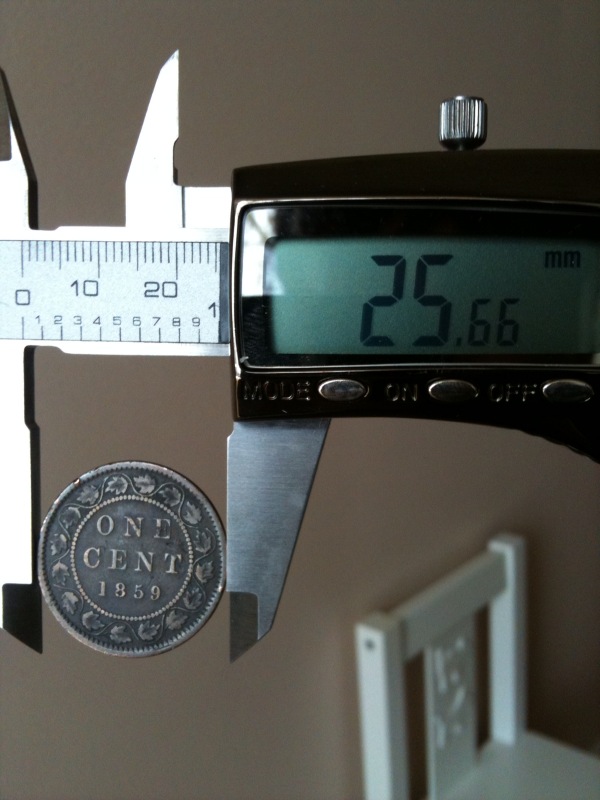


 Posted 02/23/2013 5:40 pm


