Coin Community Family of Web Sites Join Thousands of Coin, Bullion, & Money Collectors
Specializing in Modern Numismatics 300,000 items to help build your collection! Vancouvers #1 Coin and Paper Money Dealer Join Thousands of Coin, Bullion, & Money Collectors Royal Estate Auctions - $1 Coin AuctionsCoin, Banknote and Medal Collectors's Online Mall Royal Canadian Mint products, Canadian, Polish, American, and world coins and banknotes.


Username:
Password:
Save Password
Forgot your Password?


This page may contain links that result in small commissions to keep this free site up and running.

Welcome Guest! Registering and/or logging in will remove the anchor (bottom) ads. It's Free!

Contemporary Counterfeit Mexico 1824 Hookneck 8R...?

To participate in the forum you must log in or register.
Author Previous TopicReplies: 14 / Views: 3,069Next Topic  
Pillar of the Community

United States
1962 Posts
 Posted 03/05/2013  7:33 pm Show Profile   Bookmark this topic Add realeswatcher to your friends list Get a Link to this Message Number of Subscribers
Bob had discusses his experience with these vs. period fakes of Iturbide in this thread:

https://goccf.com/t/122186

This came and went on the Bay quickly the other day:

The seller also had a few other obvious CCs listed... But, IDK, this hookneck to my eye just looks like a more modern cast replica. I asked the seller about it after it had gone and he said:

"The few contemporary items currently listed all came from a very old family collection in which contemporary items were a 'side-line' to the primary collecting objectives of the family. The collection had remained dormant since about 1940 so all of the items go back to at least that date. I understand that there is a visual difference between this coin and the others but I don't believe there were any 'quality standards' or any other standards in the manufacture of contemporarily made items which would open the door to broad differences in visual (and other) appearance. I should also add that in my experience this coin is not that unusual in appearance from other's I have seen through the years."

I think it's unusual if only because to me (not a hookneck expert...) the detail looks quite faithful, like it was pulled straight from a genuine example, which is of course not really typical for the contemporary forgery Cap & Ray 8R. But that's armchair...

Bob, thoughts?
http://www.ebay.com/itm/MEXICO-CONT...261179952362

Pillar of the Community
swamperbob's Avatar
United States
5362 Posts
 Posted 03/07/2013  12:28 pm  Show Profile   Bookmark this reply Add swamperbob to your friends list Get a Link to this Reply
realeswatcher This is unfortunately a GREAT example of what happens when a little information causes a lot of misunderstanding. It is also why collecting counterfeits can be hazardous to your wallet.

The coin is a cast counterfeit as you suspected - there are NO CONTEMPORARY counterfeit Hookneck coins that use a transferred image.

As a modern counterfeit these have been selling for $10 -$15.

Somewhere I have in my notes the name of the two brothers responsible for this particular coin. They were from Mexico City. They began making them in the late 1950's or early 1960's and they were originally sold for $1 each as tourist souvenirs. They were in production until the 1990's I believe. They were sold for $5 in the later stages of production. They are still tremendously common.

This exact version is actually pictured in Hooknecks as an example of a Modern Counterfeit. The "earlier" versions used a reeded edge intentionally so that they could not be accused of counterfeiting.

But more recent versions use a bad imitation of a Republican edge. There is also a very common cast copy of the 1823 Mo version. These more recent copies can actually be called Numismatic Forgeries.

That fact that this happens demonstrates the old addage that you should
Quote:
"buy the book before the coin"


There are under a dozen known contemporary counterfeit varieties of the Hookneck 8R and perhaps fewer than 50 exemplars still in existence. All known varieties are fantasy engraved die strikes. There are NO known varieties from any mint other than Mexico City and ONLY 1824 is known to exist. Also there are NO minor denomination Hookneck contemporary counterfeits either.

When any rarity pops up - PLEASE make sure you know exactly what you are doing. The price of $140 is TERRIBLY low for a high grade non-cut Hookneck 8R Contemporary Counterfeit.


Valued Member
Germany
194 Posts
 Posted 03/10/2013  7:08 pm  Show Profile   Bookmark this reply Add dosmundos to your friends list Get a Link to this Reply
Okay, I didn't get to be around here for a while, so I see this only now, but fortunately Swamperbob has completely and precicely stated what this is all about.

I bought one of these at a market in Cuernavaca in 1999 as a souvenir. The seller didn't even try to dupe me with it. This reproduction (I wouldn't even want to call it a counterfeit) is so modern and lousy that I gave it as a present, along with a hand full of other modern reproductions, to the local coin club as show and tell pieces for the beginners.

I think the most telling point about the whole story is that the guy on ebay actually wants us to believe that this coin is a "contemporary repro" dating back to at least the 1940s. Well, apparently he has found the one sucker he was hoping for...
Pillar of the Community
swamperbob's Avatar
United States
5362 Posts
 Posted 03/11/2013  03:09 am  Show Profile   Bookmark this reply Add swamperbob to your friends list Get a Link to this Reply
The mistake made calling this Numismatic Forgery a Counterfeit is what the collecting community as a group fails to appreciate. The seller here was guilty of FRAUD in writing his description.

Larson in his FANTASTIC book "Numismatic Forgery" was the first to draw a hard and fast distinction between the two classes of fake coins. A Forgery is not the same thing as a Counterfeit - period. We need to start drawing this distinction clearly.

The coins made originally to circulate are COUNTERFEITS. The ones made to DEFRAUD collectors are FORGERIES.

To a collector of fraudulent coins that is an ENORMOUS difference. Numismatic Forgeries are virtually worthless - every single last one. Counterfeits are historical and at times rare and valuable.

It is surprising that so few collectors have come to realize this.

Most US dollar collectors now know beyond any doubt that the micro -O Morgan dollars are with one exception all COUNTERFEITS. They were made to pass for a dollar. But they still sell for thousands. They have VAM numbers.

Most collectors in general know that the 1804 Dollar and the 1913 V nickel are COUNTERFEITS too. But they sell for 7 figures.

The key is they are rare counterfeits made at or near the time the originals were made and for some time they FOOLED the experts and everyone wants one.

Pillar of the Community
United States
1962 Posts
 Posted 03/13/2013  01:27 am  Show Profile   Bookmark this reply Add realeswatcher to your friends list Get a Link to this Reply
Honestly, I use "counterfeit" and "forgery" interchangeably... not really sure there's anything intrinsically different about those words. Either way, I think terms like "contemporary", "circulating", "modern", "numismatic, etc. need to be used as descriptives to clarify what's what. As far the distinction between "contemporary counterfeit made to circulate" and "numismatic forgery made to deceive collectors"... whether people use the right nomenclature or not, I would think most semi-serious coin people intuitively understand this, no?

Now, the seller... To be fair, the 1833 Durango he listed is a legit contemporary fake. Now, the hookneck he offered... Though he clearly stated "contemporary" with no qualifications mentioned, he only the offered the 1940's or earlier info upon my questioning. Bob says it's 1960-era... that's close. From casually recognizing his username and checking FB, he seems to be a fairly decent Cap & Ray person... I tend to think he wasn't being directly deceitful (i.e., that he knew for a fact it's just a modern repro but tried to pass it off)... However, he might at the least be guilty of wishful thinking and lack of proper scrutiny.

Now, what does the 3rd piece tell us? Another purported contemporary... this time of another scarcity, the rare 1833 Go with assayer JM rather than the common MJ. This one, I don't know... My gut on the 1824 was cast repro. This 1833 GoJM kind of looks like it has some age to it, BUT... again sort of looks like an exact replica detail-wise... AND, of course, happens to be that super-rare date/asyr. THAT alone would make me assume it IS just a 20th century numismatic forgery...

Also curious, a certain well-known counterfeit collector I recognize put a very strong bid in... BUT fell short to a user with FB of 2 - I guess a seasoned collector made a new user ID!! (note, definitely doesn't appear to be a shill... and it wasn't me!).

So Bob or DosMundos, perchance has that 1833GoJM been known to surface together with that hookneck copy?
Edited by realeswatcher
03/13/2013 01:32 am
Pillar of the Community
swamperbob's Avatar
United States
5362 Posts
 Posted 03/13/2013  03:52 am  Show Profile   Bookmark this reply Add swamperbob to your friends list Get a Link to this Reply
realeswatcher You say;
Quote:
I use "counterfeit" and "forgery" interchangeably.


Not wanting to start an argument but at the same time wanting to try to illustrate my position clearly I will have to comment.

That form of term interchangeably is exactly what I see as the problem. Numismatics no longer uses precise terminology for its own purposes. Using one term for both activities which are in their own rights different on many levels makes it more confusing than it needs to be.

Counterfeits and counterfeiters have been around since money was first used in commerce. Counterfeiting is an activity that is far older than collecting of coins. Or of making copies to deceive collectors. It involves replication of a commodity type item and not a collectible. Profit derives from substitution of a less costly item.

Forgery usually is applied to paper money, documents, painting and sculpture. Except for paper money the list of forged items is mostly collectibles. All of the items derive value not from intrinsic content (what the item is made of) but for what value is attached to the item by a collector or government by virtue of who made it and when.

Forgery is the newer phenomenon of the two and often is associated with duplication of items to defraud the collector market as opposed to any circulation or utilitarian use. It some cases the material value of a forgery can exceed the material value of the original but the fraud is based on the inputED value of the item.

That is why it is appropriate to refer to knock-off watches, clothes, shoes as Counterfeits and not as forgeries. The watches are a useful commodity not a collectible. A Picasso is forged not counterfeited. A Susan Anthony dollar is counterfeited not forged.

Then you say
Quote:
Either way, I think terms like "contemporary", "circulating", "modern", "numismatic, etc. need to be used as descriptives to clarify what's what.


The problem with the use of the adjectives you suggest is that come of them are actually confusing. They do not clarify at all. Modern and Contemporary are two such terms that are at times inaccurate or can be easily confused as to what do they really mean.

Take Contemporary for instance. I have actually heard one ebay seller use the term in the sense of meaning a very recent forgery of a coin. When challenged about using contemporary to mean recent his replay was along the lines that there is Contemporary furniture - Contemporary Art - those are recent in origin. So a Contemporary Counterfeit coin must be recently made as well. That was the fellow's logic.

Then there was another fellow who's text described a coin as
Quote:
NOT MODERN fabrication, a OLD Contemporary variety, an antique and an authentic original variety.


Believe it or not but the auction involved the identical reeded edge 1824 Hookneck coin that was made in the 1960's. I wrote disputing his language and I told him he was selling a counterfeit and that his description was wrong for the particular coin.

We went back and forth a few times but - his reply was interesting. Here was his logic.

1. The coin was not a counterfeit because no reeded edge 1824 Eight reales were ever made. How can you counterfeit something that never existed?

2. It was not a modern fabrication because no one refers to the 1960's as Modern anymore.

3. The coin was an OLD ANTIQUE because it was older than his car which was registered as an antique.

4. The authentic ORIGINAL variety referred back to the reeding which made it a different variety of hookneck 8R and as such it was an original coin of the reeded edge variety that had an authentic look to it.

Language that is vague in its definitions leads to this type of semantic deception.

Please define IS?

Contemporary is a term that is relativistic you need a second factor a context to make it truly meaningful. So contemporary means different things in relation to different objects. We are contemporary members of this forum.

Therefore if a coin circulates for an extended period of time Contemporary can span a period of centuries as in the case of the MTT. How many years after the original coin is made does Contemporary no longer apply? Ten, Twenty or Four hundred. It really varies by the coin involved an does not add much new useful data.

Modern is even worse. Lets say you have a copy of an First century Roman coin made in 1880. Is that "modern"? How many people would get confused calling 1880 modern.

Or how about a 2002 Pound counterfeit or a 2002 Australian $2 counterfeit - they ARE Contemporary Counterfeits. There is no numismatic market for a average circulated version of either coin. So there for now are NO KNOWN FORGERIES of either coin.

Even circulating can be confusing. Some coins have very brief circulating lifetimes while others persist in circulation for centuries. Circulation is not really precise either.

For me Counterfeit used for an economic commodity and Forgery used for a collectible item with a value that is set by the collectibles market (inputed value) is easier. It is also a bit more precise.

I won the 1833 D counterfeit (it is a fantasy mint mark D not actually a Durango.) I also asked about my competition on the other 1833. I think you are right a new ID hiding whom? That was a buy bid on my part just not set high enough. I had been using $500 but I didn't want people running me up so now I use random buy bids. Depending on how rare the coin is. I know of 6 of the 1833 counterfeits so I stayed low. Anyone pushing me lately may own a $100 plus counterfeit for their trouble. The coin itself is a contemporary counterfeit definitely NOT modern and Not Numismatic. It is in fact part of a Riddell related family that existed in 1845.

You are absolutely right about the seller in this case. But he did make an error even if innocent. But so did the buyer. Neither actually knew what they were doing.




Valued Member
Germany
194 Posts
 Posted 03/13/2013  06:25 am  Show Profile   Bookmark this reply Add dosmundos to your friends list Get a Link to this Reply
Had a really good laugh there!

„1. The coin was not a counterfeit because no reeded edge 1824 Eight reales were ever made. How can you counterfeit something that never existed? "

1824 Eight reales existed. If you make a copy and don't mark it as such, it's a counterfeit or a forgery. The fact that you or the original producer were stupid or careless enough not to get the original design right doesn't make it less counterfeiting or forging.

"2. It was not a modern fabrication because no one refers to the 1960's as Modern anymore."

Numismatists do. And architects. And art historians. Well, pretty much anybody who deals with anything that was produced or created over a longer period of time (like coins, buildings and art)

"3. The coin was an OLD ANTIQUE because it was older than his car which was registered as an antique. "

Can't argue against that. Most US Americans don't have the slightest idea what "old" really is since nothing in their country is older than 200 years. So how would this poor sucker know...

(to you US Americans in the forum: there is a certain amount of irony involved in this comment. Of course there are things older than 200 years and there are US Americans who know that)

"4. The authentic ORIGINAL variety referred back to the reeding which made it a different variety of hookneck 8R and as such it was an original coin of the reeded edge variety that had an authentic look to it."

Didn't get this. Just gives about the right impression of the guy's state of mind

I've had the discussion about "contemporary" and "modern" many times before.
"contemporary" means "while the original coin was in circulation / used as means of payment"
"modern" means "when the original coin was no longer used as means of payment", which could well date a few decades or even centuries back.

While a Roman coin made in Renaissance times is a modern fabrication by this definition. Yes, this of course leads to confusion. But since such coins exist and form a field of numismatic study and collection of its own, I am sure there is a special term for these coins.

Obviously, "contemporary" leans towards counterfeits made to circulate, while "modern" almost certainly means "forgery to dupe collectors".

"Modern" would also be coins that never existed, even if their time of production lies much closer to the original event than to our present time. I am thinking of the Mexican Revolutionary fantasy issues of the 1920s or 1930s. Describing these coins as "modern fantasies" almost always confuses some people who argue that they can't be "modern" if they date back almost 100 years...

Another example would be fantasy countermarks invented for collectors, a practice that dates back at least to the late 19th century when the first large collections of coins of the New World were formed.
Pillar of the Community
United States
1962 Posts
 Posted 03/13/2013  09:34 am  Show Profile   Bookmark this reply Add realeswatcher to your friends list Get a Link to this Reply
I think the last two posts pretty much settled the notion that there just IS no simple terminology here... it has to be described in context.

FWIW... the Spanish of course use the term "falsa de epoca" (fake of the time), which is (supposed to be) pretty much commensurate with "contemporary circulating counterfeits" and is fairly short/to the point. The problem I find is that it gets misused frequently... Basically anything that looks the SLIGHTEST bit not brand new gets incorrectly and/or purposefully labeled "falsa de epoca".

Anyway, back to the old fake Spanish dollars. So that 1833 GoJM IS actually a contemporary piece... OK, now looking at Riddell, only one 1833 GoJM is shown (#308), and neither the obv or rev matches this piece... From the reverse lettering, it DOES look like this reverse might be the same as that shown on #304? This one and that 304 rev are both pretty close to a genuine Go 1833 eagle...
Pillar of the Community
swamperbob's Avatar
United States
5362 Posts
 Posted 03/13/2013  8:57 pm  Show Profile   Bookmark this reply Add swamperbob to your friends list Get a Link to this Reply
The 1833 Go coin does use elements seen on the 304 coin but also on another Riddell variety (it may not be an 1833) - I do not have my notes handy on that issue. I am kind of geared to Portraits.

Regarding the topic of terms - it is a problem because we do not INSIST upon using PRECISELY defined language. Until we do we will never correct this problem.

The issue comes down to the fact that WE as numismatists should have the ability to make the decision on what terms mean in our own hobby, but since the 1960's we have been too used to the "lazy" way of describing things with "common usage terms". No one insists that correct terms are used - it is not user friendly. The result is a dumbing down of the hobby in general.

Counterfeit and Forgery were at one time distinctly different in their meanings. This was in general usage and in the eyes of the law. That was of course when language not TV was the method of communicating ideas.

The meaning of modifiers like contemporary and modern clearly will mean different things to different people in society. The more modifiers we use the more confusion - we should if possible STOP using BOTH terms for just that reason. We don't need more modifiers and if-then clauses.

We need to call a forgery an forgery and a counterfeit a counterfeit and correct everyone that uses the terms imprecisely.

There is an opportunity following Larson's lead to shift gears and use the TWO categories of simple FRAUD in their original way.

The target audience that is defrauded, the coins that are actually made and in large measure the profits derived from forgery are DIFFERENT than those of counterfeiting. The end results are simply NOT identical products or crimes.

One category can be thought of as historic (in the vast number of cases) a thing mostly in THE PAST - The other one is a RIGHT NOW. The RIGHT NOW one (forgery) hurts the hobby so it is high time that we get the act cleaned up and simplified so that these constant misunderstandings can be reduced and we can all focus on the task of eliminating FORGERY. The elimination of Counterfeiting is a government undertaking that is best handled by them.

However, as long as collectors do not recognize there are two varieties of FRAUD - forgery and counterfeiting and insist that the terms are to be used correctly for our context the problem will remain.

By the way, the fellow I was arguing semantics with was a coin dealer with well over 20 years of experience. Not a particularly good dealer in my opinion. He was basing his line of defense on "average usage" of the terms by common people. The fact that the hobby has no clear definition of terms creates that opportunity for defense. He did not express these arguments tongue in cheek - he meant them. They were his defense to ebay.

The ANA is not in the business of clearing things up it seems - they are more concerned with driving the bubble of high grade rarities of enormous value (and profit potential) for dealers and grading companies. Money is more interesting than history. But is that where we as collectors want the hobby to go?

Read published numismatic articles and there is a hodge podge of terms used in ways that conflict with one another. It is a mess. Scholarship has been replaced with crass publication. Some articles I have read recently are worthless drivel written at a third grade level.

If we all just sit by and watch - that is where the future is headed.

And for Dos Mundos - Argument # 1 that the Reeded edge Hookneck 1824 coin could NOT be a Counterfeit because it was never actually made was a successful defense against a charge of counterfeiting that was actually made in the 1960's against the original manufacturers of the 1824 reeded edge variety. The court held that indeed no such coin with a reeded edge had ever been manufactured and that any competent numismatist would know that. Therefore the coin was ruled NOT to be a Counterfeit.


But because the coin was offered in a fashion that could be deceptive to an uninformed person of average intelligence (non-numismatists) then the crime being perpetrated was a matter best prosecuted as a crime of FRAUD and FORGERY of a non monetary item.
New Member
Ireland
2 Posts
 Posted 03/30/2013  1:00 pm  Show Profile   Bookmark this reply Add ConorW to your friends list Get a Link to this Reply
Swamperbob - complete amateur here. I bought a 1804 Mexican 8 Reales which (with some help) I have figured out is a fake or a counterfeit. Would like your help in telling me which. I have read through a lot of your posts so I can give you this info: weight 24.98g, specific gravity 9.3, assayer is marked as FT (not TH). The 8 of 8R has a small pedestal and the castles seem to have rectangular type windows above the top windows. Otherwise the rim edging looks to be correct - as per your posts. Initially thought it was genuine (and some dealers have told me it is genuine) but once I bought a scales to weigh it I realised not. If you can give me any more info on fake vs counterfeit I would really appreicate it. I understand you are writing a book on this so it might be of interest to you. Not v tech savvy so cannot post pictures (they are too big) but if you want I can e-mail them to you. Best regards Conor
Pillar of the Community
jfransch's Avatar
United States
1801 Posts
 Posted 03/30/2013  1:24 pm  Show Profile   Bookmark this reply Add jfransch to your friends list Get a Link to this Reply
Hello Connor and welcome to the forum. I would enjoy seeing the pictures of your 1804 8 reales as well. Would you consider emailing them to me? Private message sent
Pillar of the Community
swamperbob's Avatar
United States
5362 Posts
 Posted 03/30/2013  4:12 pm  Show Profile   Bookmark this reply Add swamperbob to your friends list Get a Link to this Reply
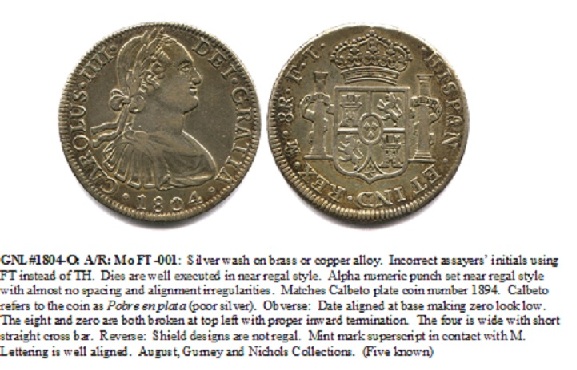
ConorW We do record an 1804 Mo FT Class 1 counterfeit. It was already listed in Calbeto's book as # 1894. It seems to match your description even the SG. I consider it to be a decent looking copy definitely from an experienced die maker.

It is in the middle group of slightly more common types with 5 examples known in 3 collections. It is possibly one of the Birmingham styles. We expect to see a few more of these after publication.

Here is the book entry. Size limits what you can see here.


Contemporary-Counterfeit-Mexico-1824-Hookneck-8R...?

It is just a bit of a surprise that any professional coin dealer would not spot the coin as counterfeit. The portrait is incorrect. But if anyone has trouble with this one they will really have fits with the ones that are closer to real looking.


Pillar of the Community
swamperbob's Avatar
United States
5362 Posts
 Posted 03/30/2013  4:18 pm  Show Profile   Bookmark this reply Add swamperbob to your friends list Get a Link to this Reply
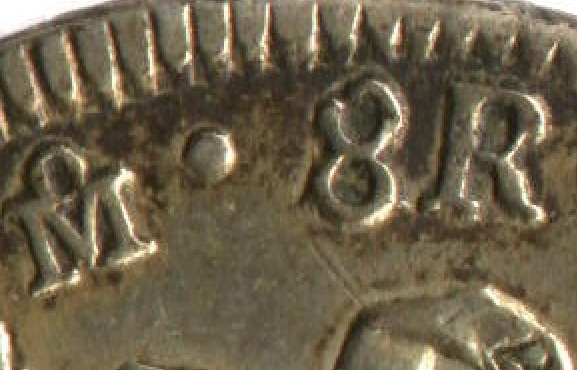
Here is a blow-up of the mint mark and the denomination - is this the pedestal?


Contemporary-Counterfeit-Mexico-1824-Hookneck-8R...?

This is the same picture as in the book so the blow-up capabilities in the book are about this good in a digital format.
Edited by swamperbob
03/30/2013 4:19 pm
New Member
Ireland
2 Posts
 Posted 03/31/2013  06:38 am  Show Profile   Bookmark this reply Add ConorW to your friends list Get a Link to this Reply
Yes that's the one alright. When you say Birmingham does that mean it was made in UK? If so that would make sense as I am in Ireland. The one I have is a bit worn, is it worth anything do you think?
Pillar of the Community
swamperbob's Avatar
United States
5362 Posts
 Posted 03/31/2013  3:36 pm  Show Profile   Bookmark this reply Add swamperbob to your friends list Get a Link to this Reply
ConorW Yes, by Birmingham I do mean UK. They were a primary source of counterfeit 8 Reales from about 1796 to at least 1870. This one is likely early because they are all known to be heavily debased and the later copies tend to be full alloy silver.

It would depend on how worn it is to estimate value and if there are drill holes, test cuts or serious scratches.

Most worn but still clear types start at $50 US and go up. The coin in the photo is in the $200 - $250 range as one of the best known of the variety.

If you can get a photo taken let me know - I will add your example to the known inventory and I can estimate the value. Once you have pictures to send let me know and I will mail my email address to you.
  Previous TopicReplies: 14 / Views: 3,069Next Topic  

To participate in the forum you must log in or register.


Disclaimer: While a tremendous amount of effort goes into ensuring the accuracy of the information contained in this site, Coin Community assumes no liability for errors. Copyright 2005 - 2026 Coin Community Family- all rights reserved worldwide. Use of any images or content on this website without prior written permission of Coin Community or the original lender is strictly prohibited.
Contact Us  |  Advertise Here  |  Privacy Policy / Terms of Use

Coin Community Forum © 2005 - 2026 Coin Community Forums
It took 0.48 seconds to rattle this change. Forums