| Author |
 Replies: 8 / Views: 1,377 Replies: 8 / Views: 1,377 |
|
|
Pillar of the Community
 United States
2365 Posts |
I just received this 1816 Large Cent and am struggling with the grade. It has some strong details but the dentils are worn. This confuses a newbie like me trying to use PCGS Photograde. Any assistance will be appreciated.   Member ANA and EAC "You got to lose to know how to win". Dream On by Aerosmith Edited by cipster
03/18/2013 5:41 pm
|
|
|
|
Pillar of the Community
United States
4431 Posts |
IMHO, a VF-30. I'd use a little acetone to perhaps lift that verdigis. It's quite likely that a gentle swabbing will lift a good deal of surface matter from the somewhat porous planchet; thereby, conserving an otherwise attractive coin.
|
|
Pillar of the Community
United States
4897 Posts |
|
|
Pillar of the Community
United States
5854 Posts |
Details look EF-40 to me but it may be labeled environmental damage because of the porosity. Many early large cents have weak rims which probably varies between die pairs and states. The rim looks like it should belong on a G/VGish coin but the rest of the coin is clearly a higher than that. I think the coin began with a weak rim as it just doesn't make sense to me that the rims wears so much more than other parts of the design. I don't consider myself an expert at grading early copper so others may be able to shed more light but I usually place much more emphasis on central design than on the periphery. I was able to find an example on Heritage in about the same grade with weak rims. |
|
Moderator
 United States
16694 Posts |
VF30 here too.
swcoin.ecrater.com
|
|
Pillar of the Community
United States
9809 Posts |
 VF on the edge of EF. "Buy the Book Before You Buy the Coin" - Aaron R. Feldman - "And read it" - Me 2013! ANA Life Member #3288 in good standing since 1981, ANS, Early American Coppers Member (EAC), Colonial Coin Collectors Club member (C4), Conder Token Collector Club member (CTCC), Civil War Token Society (CWTS) member, Liberty Seated Collectors Club (LSCC) & Numismatic Bibliomania Society member (NBS), USMex, Member in good standing, 2¢ variety collector. See my want page: http://goccf.com/t/140440 |
|
Bedrock of the Community
United States
17884 Posts |
This is a 16 N-4 and R-2 variety where the dies didn't fail so they used them for a long time and eventually the denticals pretty much wore off the die. This is a MS-64 example of a M-LDS piece. Look at the denticals on it. 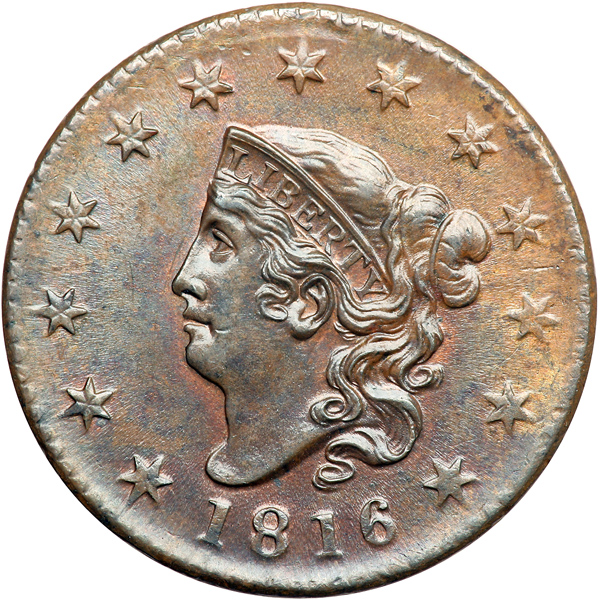 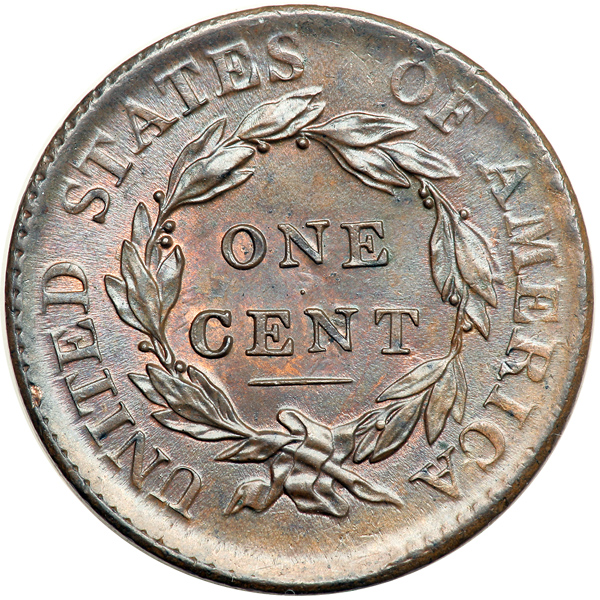 |
|
Pillar of the Community
 United States
2365 Posts |
Thanks so much to everyone for your expert opinions. It makes a lot of sense now that I see high grade N4 coins with weak denticles.
Member ANA and EAC "You got to lose to know how to win". Dream On by Aerosmith |
|
Bedrock of the Community
United States
18893 Posts |
I agree with D0ubl3Eagle in regards to the rims. many of the very early coppers had soft planchets. Also, the strike varied causing weakness in part of the coins. in this case I think we have a softer strike as attested to by the stars. based on the amount of wear on the high spots, I would grade this VF30. It could push a VF35, but I don't think it could go to the EF range. thanks for posting. I am a huge early copper fan.
|
| |
Replies: 8 / Views: 1,377 |
|







 Posted 03/18/2013 8:27 pm





