| Author |
 Replies: 11 / Views: 3,143 Replies: 11 / Views: 3,143 |
|
|
New Member
Australia
5 Posts |
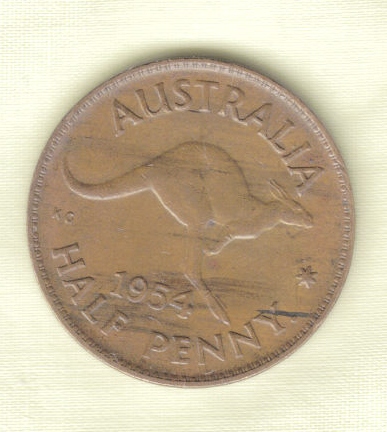
Hi, I've come across several Pennies with these stripes across them, can anyone tell me what this is from? I didn't really give it much thought when I first saw it, them I saw it again and again and now it's driving me mad? thanks Image:  stripes too.jpg stripes too.jpg84.31 KB |
|
|
|
Moderator
 United States
6563 Posts |
I have one similar to that and I'm curious too. I always thought it just run over by a car.
|
|
Valued Member
United States
459 Posts |
These striations/strata are "mottle effects" from an improper or inadequate mixing of copper, tin, and/or zinc when smelting and planchet production takes place(as with my Indian below). However, I am uncertain of the exact composition of your Aussie Penny, but I would bet it is also made from copper and tin or zinc. I really dig these examples and I hope this answers you question. I could elaborate further if you wish. [URL="http://imageshack.us]  [/URL] |
|
Moderator
 Australia
16988 Posts |
Streakiness like that seems to be common on Australian pennies, particularly those struck at the Perth Mint. It's apparently caused by a poorly-mixed alloy being used to make the coins, with blobs of different composition, "like choc-chips in a cookie". When the metal ingot is rolled prior to the blanks being punched out, the blobs are stretched out into a pattern like that. When the coin was shiny and new, you probably couldn't see it, but over time the parts with different composition have oxidized at different rates. Edit: Benji beat me to it. Must... type... faster...   Don't say "infinitely" when you mean "very"; otherwise, you'll have no word left when you want to talk about something really infinite. - C. S. Lewis
Edited by Sap
05/03/2007 10:31 am
|
|
Valued Member
United States
459 Posts |
Thanks Sap for the elaboration...well stated. This brings up another question. Has anyone ever witnessed this phenomenon in modern Cu coinage? Copper is not my cup of tea, but I can't ever remember encountering a modern with mottling. Perhaps current minting methods and QC prevents this from occurring and/or they are pulled before leaving the Mint.
|
|
Pillar of the Community
United Kingdom
2217 Posts |
Well I've noticed this in a lot of coins, I think a lot of them were British. So it's poorly mixed metals in a bronze alloy huh?
Is it me, or is it just an extremely common thing...
|
|
Moderator
Australia
16988 Posts |
I can think of three possible reasons why you wouldn't see the effect as often in modern copper coinage:
- better quality control, as Benji said.
- they're not as old, so the different oxidation rates haven't had time to mature yet. Let 'em ripen for another decade or two and the streaks will appear.
- don't forget that much modern "copper" coinage is merely copper-plated; if the copper plating is normally electrically applied, this should create a smooth even film of metal, without clumps of inconsistency on the surface.
Don't say "infinitely" when you mean "very"; otherwise, you'll have no word left when you want to talk about something really infinite. - C. S. Lewis
|
|
New Member
 Australia
5 Posts |
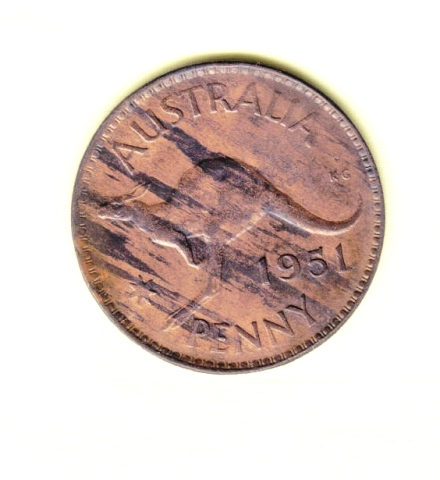
Thanks everyone for your replies, I have just come across another one which I was actually quite impressed with, what do you think? Image: stripes.jpg76.06 KB |
|
New Member
Australia
14 Posts |
people commonly refer to these as lamination flaws.
There can be two types of parallel lines of different colour on copper coinage - the one mentioned above by Sap and Benji, and another where the surface layer has 'peeled' and the exposed surface has become toned on exposure to the air i.e the blackness observed on that halfpenny. The peeling effect can be caused by carbon powder not being correctly absorbed into the alloy mix and then being spread in a thin layer under the surface when the sheets are rolled prior to the planchets being punched out. The carbon absorbs moisture, expands and lifts thin layers from the surface of the coin which then turn a different colour.They are generally in parallel areas across the coin because the rolling of the sheets spreads the carbon
The most spectacular of the streaky planchets occurs where you get 'blond' or white sections on the coins where the alloy wasn't mixed correctly.
I will dig a few coins out to illustrate
|
|
Pillar of the Community
Australia
1360 Posts |
|
|
New Member
Australia
14 Posts |
This is a 1941 Australian penny and is a good example of the alloy not mixing correctly. The surface of the coin is smooth - ie no lamination flaws. The light coloured areas are not the result of cleaning or damage, its the actual coin colouring as scanned  |
|
Pillar of the Community
United States
4589 Posts |
from coppercoins's book -pertaining to 1909 Lincolns. Many of the cent of this era show odd stripping that often effects the entire planchet. These anomolies are often called "wood grain look" These were caused by the impurities in the alloy mixture used to makethe planchets.
|
| |
Replies: 11 / Views: 3,143 |
|








 stripes too.jpg


 Posted 05/03/2007 10:21 am


 stripes.jpg


