| Author |
 Replies: 15 / Views: 2,037 Replies: 15 / Views: 2,037 |
|
|
Valued Member
Canada
127 Posts |
Obvious line running through DEI to REX. It runs under the lettering and does not seem to affect the lettering. Any idea what this is? Is it just a stupid scratch or something else. If it were a scratch, would it not show on the lettering as well. My thought is that it is just a scratched planchet (excuse my ignorance if I am completely on the wrong track). 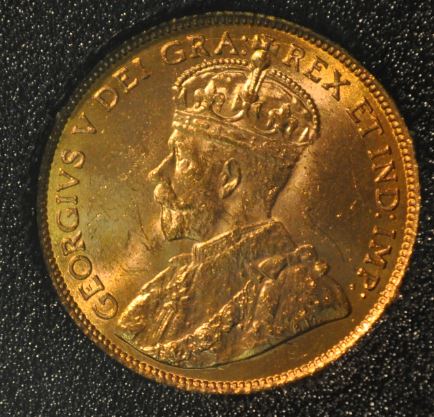 |
|
|
|
Pillar of the Community
Canada
2430 Posts |
Many of the 1914 $5 Gold coins have the same.
Die Crack
|
|
Valued Member
 Canada
127 Posts |
Solved it. Put it under my daughters microscope at 40x and determined it was just a long, thin and shallow groove, but not the usual sharp scratch. Under glass at 10x was just not enough for my eyes. Sorry about posting it, but this grading process is intriguing me. Any opinions of the grading?
|
|
Valued Member
Canada
451 Posts |
Umm DarrylDarryl sorted it out for you I think with his explanation of a die crack. A die crack happens when on of the dies develops damage at the end of it's working life. It is not damage to the coin it really is more like a birthmark.
|
|
Pillar of the Community
Canada
618 Posts |
How can it be a die crack if the legends are not
effected? The groove is under the legends--Therefore a planchet error?
|
|
Valued Member
118 Posts |
You have doubling. You can see it the photo.
|
|
Valued Member
Canada
127 Posts |
Doubling? Curous - where do you see that?
|
|
Valued Member
Canada
451 Posts |
 Here's a die crack on a 42 50 cent piece. It doesn't affect the legends |
|
Valued Member
Canada
127 Posts |
Hmmm - the groove/die crack on my 1914 $5 is identical to the one running through the D:G on your 42 50 cent piece. I wonder how that happens to the planchet in the manufacturing process?
|
|
Pillar of the Community
Canada
618 Posts |
Mighty fine coin--that groove would not down grade it at all. Great luster.
|
|
Bedrock of the Community
Australia
21792 Posts |
With the $5, if it is a die crack, it should show up as tiny raised ridge, not a groove.
If there was a scratch, groove or crack in the die, it would show up in relief (raised) on the coin.
If there is a ridge on the die, (most probably part of the design, or less probably damage to the master die), it would show up as a valley or dull scratch on the coin (incuse).
|
|
Valued Member
Canada
127 Posts |
sel-69 I think your last point is the likely explanation. Thanks. It must have been something on the master die that caused the 'incuse'.
|
|
Bedrock of the Community
Australia
21792 Posts |
To give a little better idea of the coining process:
1. A master die is prepared from the original artwork (this die is incuse, i.e. detail is below the field areas on the die face)
2. Hubs are prepared from the master die (these hubs are in relief, i.e detail is raised above the field areas on the hub face) The hub looks like a coin, in this case, without the final date numeral.
3. Working dies are prepared from each hub (detail incuse on the die face)
4. Coins are struck from the working dies.(detail in relief on the coin).
With a total of 295,638 $5 coins having been struck, probably only 12 or so working dies would have been used. Dates would have been cut into each working die. Perhaps no more than three '191' hubs would have been required.
I stand to correct myself a bit.
If there is a shallow but dull VALLEY on the coin, there must have been a RIDGE on the working die, that would have been caused a partial crack failure on one of the hubs. Metal under striking pressure would have easily flowed any small crack detail in the lettering detail made by the hub. The lettering would appear unaffected.
I feel sure that a scratch on the planchet would have been obliterated by the the die strike, unless the planchet damage would have been especially grievous.
If I am right, I wonder how soon the hub was withdrawn, and how many $5 coins similar to yours exist?
That raises the possibility that you coin may be an interesting die variety.
|
|
Valued Member
Canada
127 Posts |
That was a splendid explanation. It would be interesting if anyone else had the same on their 1914. Thanks.
|
|
Pillar of the Community
Canada
2430 Posts |
My premium select has the same.
|
|
Valued Member
Canada
127 Posts |
darrydarryl - that would be nice to see. Not sure if this makes it a die variety but it sure is interesting.
|
| |
Replies: 15 / Views: 2,037 |
|










 Posted 03/30/2013 6:20 pm


