| Author |
 Replies: 41 / Views: 11,214 Replies: 41 / Views: 11,214 |
|
|
|
Pillar of the Community
United States
648 Posts |
Very nice coin! GR58 $12.00! great deal!
Very interested to see SG on your coin wonghinghi
That is a very broad statement on the COA
Are the denticles corroded?
colonialjohn does the SG change with leaching and is the copper replaced with something?
|
|
Pillar of the Community
United States
1758 Posts |
No the more oxidized metals in the silver alloy (i.e., copper and zinc) simply are removed. Nothing is replaced as these pieces simply head to pure silver LUMPS. Not sure of the other trace elements like gold, platinum, lead, arsenic & bismuth are removed with any large degree. I analyzed about six pieces of El Cazador pieces in various states of corrosion by XRF analysis. The reale pieces that really have little signs of motifs left and say the weight is ~ 50% - these register at 98-99% Ag - with drastic drops in their Cu and Zn levels.
JPL
Edited by colonialjohn
04/02/2013 2:19 pm
|
|
Pillar of the Community
United States
5362 Posts |
wonghinghi Are you Mr. 1086? I saw this coin for sale by cerebro and at the time I classed it as a likely casting made from ElCazador silver. Have you checked for an edge seam. This is the type we sent to be graded and they did. The ones we had showed clear traces of edge filing and tiny remnants of the edge seam spaced all around the edge of the coin.
BTW read what Jerry Gordon's BBCA certificate says. He certifies it is 90% silver. That it is 150 years old and that the Spanish Milled Dollar was the most widely circulated coin in world history. That is not a certification that it came from the El Cazador at all.
The seller cerebro only says "I was informed that this coin certified by Jerry Gordon BBCA was from El Cazador Spanish shipwreck." Which actually says NOTHING except someone told him it came from the El Cazador.
|
|
Pillar of the Community
Hong Kong
1270 Posts |
My ebay id is 02086188. Yes, the coin was brought from cerebro. I will check carefully is there an edge seam from the coin? I will answer all question later. Henry |
|
Pillar of the Community
France
1591 Posts |
It's not a good sign when you see Bob chasing the same coin as you, unless you collect counterfeits :D
|
|
Pillar of the Community
United States
5362 Posts |
I was interested but only to a point much lower than the final bid. My snipe bid was too low to register. But with most of the Class 2, 3 and 4 coins that is very normal. If you see me going high - say anything over $50 - then you can be pretty certain it is a Class 1 Contemporary Circulating Counterfeit,
|
|
Valued Member
United States
98 Posts |
I have a couple of El Cazador 8R coins. I can show non-collectors awesome coins and they just don't get it .. but everyone seems to 'get' shipwreck coins.
|
|
Pillar of the Community
United States
2543 Posts |
Quote:I bought a 1783 8R on ebay recently and it is claimed a ElCazador specimen, and with a COA (as follows), can anyone tell me this certificate is a valid guarantee to my coin? Talk about covering your butt ......... well he guarantees that your 1783 "8" is at least 150 years old. So your coin is at least guaranteed to be a contemporary counterfeit ? Since the El Cazador sank 229 years ago, the guarantee that the coins are at least 150 years old leaves a lot of room for doubt that they are El Cazador coins. |
|
Pillar of the Community
United States
5362 Posts |
denco7 Or the guarantee could have been written 79 years ago. 
|
|
Pillar of the Community
United States
648 Posts |
swamperbob  That is so out of the box! I never thought ; how old the COA was  |
|
Pillar of the Community
Hong Kong
1270 Posts |
dencot: Quote:
the El Cazador sank 229 years ago, the guarantee that the coins are at least 150 years old leaves a lot of room for doubt that they are El Cazador coins. Yes, you are right, I was too careless and ignorant not to know more about El Cazador before buying the ship-wrecked coin. But, could it be (the COA said) the coin was from another shipwreck accident? I can see coin collectors (esp. US) always have a predilection about El Cazador. For me, I really don't know too much about it, but only want to know how to identify a genuine ship-wrecked coin. Does a wrong COA mean a wrong (counterfeit) coin? At first I am so worried my coin is a counterfeit but I take it on my hands and examine it times over times, it is a very even corroded coin, the underneath details are still there. The weight and diameter is okay, how can I do further to prove its authenticity? This is what I want to utimately. John, do you think your technology can do it? John: Quote:
I have recorded some in the 98-99% Ag range along with silver surface enrichment effects. Its common to see them with this coppery surface ... its the copper ... bleeding out ... in some cases. Do I misunderstand you? If the Cu and Zn had already leached out from the coin, it should leave a silver lump there so the coin should be in silvery appearance as I see what my coin is. What do you mean by coppery surface? Coppery surface should be slight brownish. swamperbob: Quote:
The ones we had showed clear traces of edge filing and tiny remnants of the edge seam spaced all around the edge of the coin. So far I don't see anything abnormal (for my standard only) with the edge, no edge filing and no any tiny remnant of the edge seam else. I will do the S.G. for this coin next Monday. If this coin was really made by 90% silver and really a shipwrecked coin, how did the S.G. value change, increased or decrease, anyone want to make a guess? I attach more pictures about the edge of the coins for you to judge. Is this an abnormal feature? 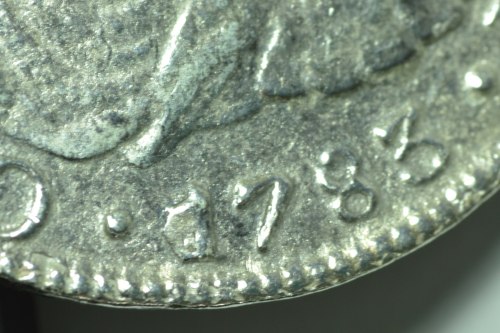 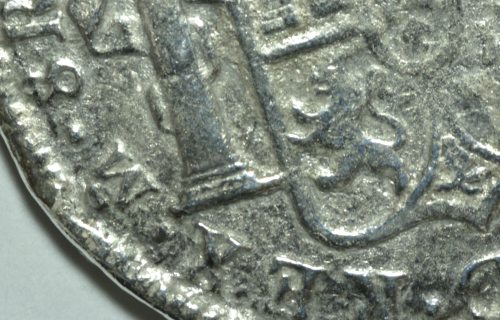         |
|
Pillar of the Community
United States
2543 Posts |
Quote:
That is so out of the box! I never thought ; how old the COA was .........now that would be a neat trick worthy of Houdini, print out COA's in 1934 for a treasure that won't be found until 1993 ........... talk about clairvoyance.  By the way GR58, was watching the TV coin show last night and saw your coin matched with a 2R Pillar Dollar from the El Cazador. The set was selling for $330. |
|
Pillar of the Community
United States
1962 Posts |
Very simply, Wonghinghi's piece is either:
-- An actual El Cazador piece that was highly polished ***OR
-- A recent (1990's up) cast replica thereof
It is NOT any kind of contemporary counterfeit, older cast... or from any other shipwreck. There was an enormous amount of 1783 Mexico 8R salvaged from this wreck... from market observation, it MUST have been the large majority of 1783 Mexico 8R made that year. No other wrecks have produced anything more than a trickle of this date. Without any doubt - any 1783 which have been mass marketed are ABSOLUTELY El Caz (or possibly casts thereof).
Relatedly, don't get caught up in the semantics/precise language used on the COA... The packaging on these sucker-bait sets isn't usually too precise. Pieces that are obviously El Cazador have often NOT been advertised as such, apparently so as not to oversaturate the market over the last 10+ years. Take for example those "America's First Silver Dollar" sets in the plastic case showing Washington crossing the Delaware... OBVIOUSLY El Cazador, yet they are vague about it (even incorrectly stating "Caribbean" rather than Gulf of Mexico... well, they kind of connect).
That said..... whether this piece and others like it could in fact be CAST FAKES/REPLICAS of El Caz pieces... another story. Certainly would have made a lot of sense when silver was under $10/oz... and given the nature of shipwreck coins (and especially, who would be buying these), very few people would notice.
|
|
Pillar of the Community
United States
5362 Posts |
The SG should remain roughly the same. The copper at the surface leaches out by elctrolytic action leaving behind the silver. But the coin does NOT compress in size nor loose significant volume (it is NOT riddled with holes like swiss cheese). If there was any measurable difference in SG it would be small and in an UPWARD direction.
Regarding the edge I see no seam at the center of the pattern - but at the bottom of the edge pictures in almost every shot I see a feature right at the lower edge of the coin that looks like it extends past the edge itself.
If the pictures are accurate representations of what it looks like in hand - I believe I see a mold seam right at the lower corner where the edge and face meets. This may just be an optical illusion caused by lighting but a close up microscopic examination of the edge should differentiate the two.
What I had heard was that the really badly corroded coins - the un recognizable ones were melted and some of the silver was cast into replicas using molds made from better looking salvaged originals. These were marketed as "Authentic salvaged silver coins." They were called authentic not genuine and it was only the silver that was salvaged.
|
|
Pillar of the Community
United States
1801 Posts |
Ok I want to throw in my Two Cents worth. The Certificate in question, one of the Jerry Gordon generics, makes no mention of the Cazador, no mention that it applies to your coin and no mention of any wreck. It is as if I issued a certificate that stated US Morgan silver dollars were made of 90% silver and are all over 92 years old. What a pointless certificate. I could include it with any coin I want, real of fake and it would still be a true statement. Most, if not all, legitimate Cazador certificates reference the wreck, they were trying to capitalize on the romance and history of the wreck. The Cazador yielded a boatload (pardon the pun) of 8 reales dated 1783 and a spattering of other coins all dated all prior to 1784. The original coins were very poorly handled and exhibit signs of being tumbled, cleaned, polished and just about every other process that makes a coin collector cringe in pain. I was personally unaware of the melting/casting of the really bad coins but it had been done by others (be real careful of the jewelry coins at the Mel Fisher museum but at least they are identified as castings). Actually I do take issue with Swamperbob's comment about the Cazador coins depressing the market for shipwreck coins, the influx of new collectors caused an increase in the value of the other harder to locate coins that are in short supply (check out the El Lerri wreck off Matacumbe Florida, I only know of about 5 or 6 coins with actual certificates claiming providence to that wreck and they command really high prices, same with some of the other 1733 and 1715 fleet sites. Locating the mother of all commercialized wrecks, the Atocha, flooded the market with Atocha coins and drove the price of Margarita coins (sister ship lost in the same hurricane) through the roof.) There is a whole market out there of people that collect by certificate the way I collect by date and assayer. To each his own. Cazador coins are very interesting pieces of history, I own a few myself, including a few I need to examine that my son picked up at a small local coin show for $15 each about 10 years ago and see if they are castings (I never really paid any attention to the possibility of being fake, they are so ugly to start with) One last thing to reiterate, the coin in the original posting is a really nice example of a Cazador coin other than the usual 8 reales. It's a keeper. |
| |
Replies: 41 / Views: 11,214 |






 First Page


 Posted 04/02/2013 2:17 pm


