| Author |
 Replies: 16 / Views: 3,387 Replies: 16 / Views: 3,387 |
|
Valued Member
United States
355 Posts |
Hey all,
I've got a friend who will be traveling to Helsinki, Finland in a couple of weeks. Any time I know of a friend leaving the country I usually give them a couple bucks to bring me back some of the coinage from the country they're visiting. However, its usually been non EU countries. This time its a country from the EU so I'm assuming that Euros are the coins that are circulating. Which brings me to my point...In these EU countries, do the old coins circulate with the Euros or have all the pre Euro coins been removed from circulation?
|
|
|
|
Pillar of the Community
United Kingdom
1582 Posts |
Most still have the old coinage as well. In fact the euro is very unpopular and is taking its time to take over, except places such as France... they seem to love the euro.
You will never soar like an eagle if you hang around with turkeys.....
Edited by MetDet71
04/12/2013 4:33 pm
|
|
Pillar of the Community
United Kingdom
2930 Posts |
Is that true? I dont think any shops accept old currency. The republic of ireland and portugal certainly dont.
|
|
Pillar of the Community
Germany
1238 Posts |
Well, what you hear about the euro in the UK is often quite different from reality. ;) No, of course the pre-euro coins do not circulate in the euro area any more.
Christian
|
|
Pillar of the Community
Belgium
506 Posts |
Pre-euro coins no longer are legal tender. Double circulation has been limited to a few months. Several national banks did continue to accept the pre-euro national coins for some time. Some continue to accept old pre-euro banknotes. With masses of the latest issuance of national coins still at large, they most often sell for less than their prior nominal value. A dollar is worth four Deutsch Marks again. Who would have thought those times were to return?  |
|
New Member
United States
33 Posts |
Be sure to ask your friend to watch for euro coins from all the different countries also. I have a friend who went to France and brought back euro from about 7 or 8 countries.
|
|
Pillar of the Community
Germany
1238 Posts |
Quote:
Several national banks did continue to accept the pre-euro national coins for some time. Some continue to accept old pre-euro banknotes. And others still redeem the pre-euro money, coins and notes. That is also why here in Germany for example some stores advertise that they will also take your old cash. But that has nothing to do with what you can find in circulation. @Blue-M: Sure, in theory you can find coins from all 20 euro countries anywhere in the euro area. Practically that may be a little different. In Luxembourg for example the "mix" will be more interesting than in Finland. Also, the countries that issued euro cash first now have both "first generation" (old map) and "second generation" (new map) coins. Similarly, in three weeks the first €5 notes with the updated design will be issued. Christian |
|
Valued Member
Finland
294 Posts |
Chrisild is right, Finland is a bit of isolated from other euro countries so there's not so much variety in our coinage. Most common foreign euros are from Estonia, Germany, France, Spain and the Netherlands. It is also good to know that we don't use smallest cents at all (1 and 2 cents). So there's 6 denominations you can get: €2, €1, 50c, 20c, 10c and 5c.
|
|
Moderator
 United States
14463 Posts |
I checked, and I actually have 2 coins from Finland in my Birth Year Set. 1968 Finland 5 Pennia 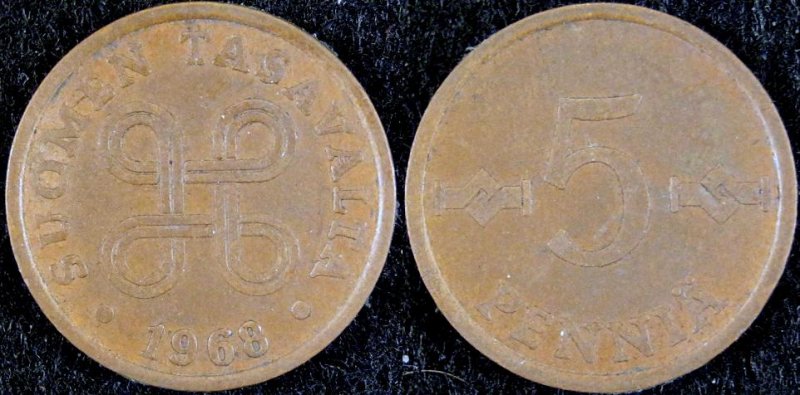 1968 Finland 10 Pennia 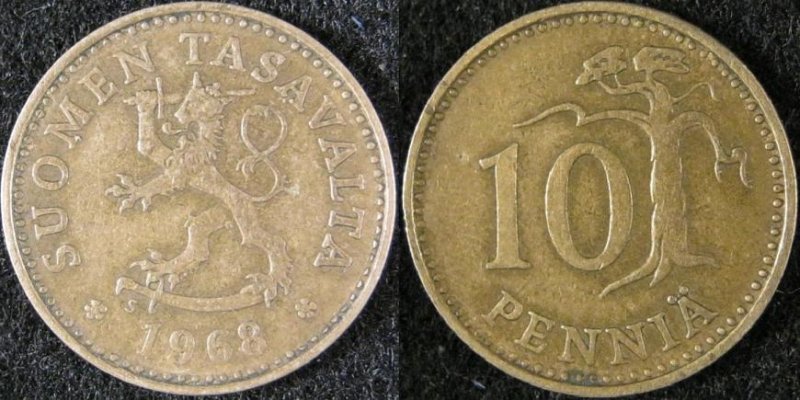 |
|
Pillar of the Community
Australia
9786 Posts |
|
|
Valued Member
Netherlands
173 Posts |
In the EU-countries (where we use the eurocoin) are the eurocoins the only circulating coins.
Offcourse you can youse the German eurocoins in Spain, Italy etc.
Last year, Netherlands and Finnland made a change with 1, 2, 5 en 50 cent rolls.
|
|
Pillar of the Community
Germany
1238 Posts |
|
|
Pillar of the Community
United States
511 Posts |
Quote:
I usually give them a couple bucks to bring me back some of the coinage from the country they're visiting. I do the same thing, but it's relatively expensive for the eurozone. I think the most interesting coins are the bimetallic 1 and 2 euro coins. So if you were to want a small handful of these coins they would cost $10 or $20 or more due to the exchange value. "A couple bucks" might only get you one coin! |
|
Pillar of the Community
Belgium
506 Posts |
Commemorative 2 euro coins are issued by all EU member states using the Euro. You can have a look at what has been minted last year: http://www.ecb.int/euro/coins/comm/...2012.en.html(for 2013 there's three coins announced so far). Despite large mintage numbers (up to 30M for Germany), I think few of those may become more valuable. One through five cents are worthless copper plated steel coins. As mentioned, Finland doesn't produce the 1c nor 2c for circulation. Those coins in sets have their scarcity value (and may get paid the 'greater fool' price if you don't buy the story.) Edited by Gwyde
04/15/2013 09:18 am
|
|
Pillar of the Community
Germany
1238 Posts |
Quote:
(for 2013 there's three coins announced so far) Not that it matters much in this context but ... six €2 commems have already come out this year. ;) There will probably be about 20 different issues in 2013. No details from Finland so far, but I'm sure there will be something from there as well ... Christian |
|
Pillar of the Community
Belgium
506 Posts |
Quote:
Not that it matters much in this context but ... six €2 commems have already come out this year. ;) May very well be. I shouldn't rely on it that the ECB page is up to date. :-) |
| |
Replies: 16 / Views: 3,387 |










 Posted 04/12/2013 5:35 pm