| Author |
 Replies: 11 / Views: 2,698 Replies: 11 / Views: 2,698 |
|
|
Pillar of the Community
Hong Kong
1270 Posts |
Hello members, I get this coin today. It looks nice to me and no big problem with it. But on the observe side, there is a trace of green dirt/mark/rust below the portrait. It is quite common to find this sort of green trace in some of my silver coins collection. I had heard that it is ferrous iron oxides which is green in color. I tend not to believe it because a normal silver coin is composed of 90% silver and 10% copper, where do the iron come from? So another postulation comes out: if your coin find a trace of green dirt like this coin, it might assume this is a fake coin. Of course I don't believe that. But what is this green trace actually? Can any one have the experience about this issue can answer my query? Thanks, Henry Diameter of the coin: 32.7-33.0 mm, my electronic scale is out of order so no weight of the coin provided. 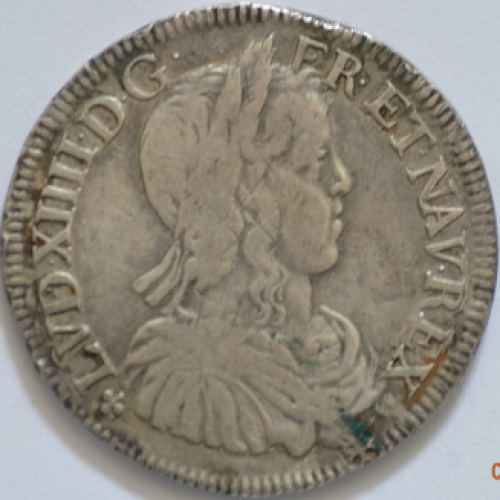 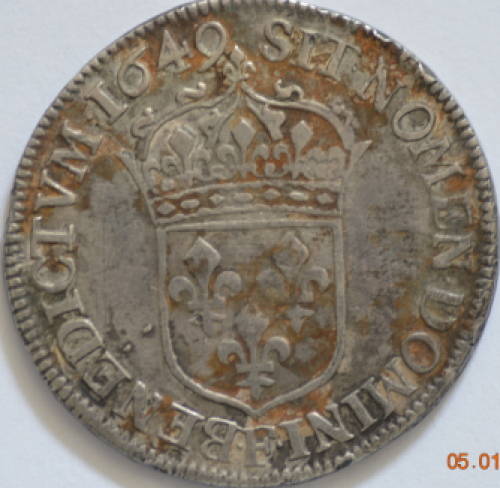 Green trace seen 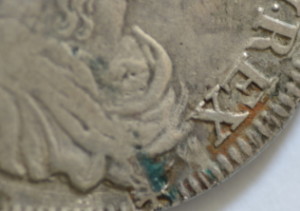 Silver remnant found 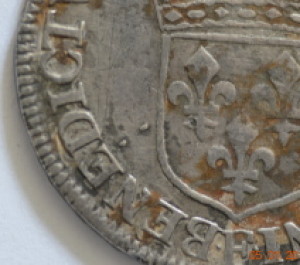 |
|
|
|
Pillar of the Community
 United States
1908 Posts |
Nice coin; it looks genuine. Copper in coin alloys typically corrodes to green so that is probably what it is. Try removing it with acetone. It's a small spot; you will not harm the coin if you don't rub hard or use rough cloth. There is also the chance it did not come from the coin at all, but from something the coin was touching. If by chance a drop of fruit juice (very acidic) got on the coin, that would turn green very quickly.
|
|
Pillar of the Community
United States
5362 Posts |
Looks real to me. The green is verdigris a waxy compound that develops from copper leaching out of a coin when in the ground. Acetone (pure should be used) use only cotton swabs to work the verdigris off. NO RUBBING AT ALL.
|
|
Pillar of the Community
United States
1761 Posts |
This is an odd coin. This may be a counterfeit. Give me a couple of days - will have an answer for you around Monday 1/7/2013. In the interim just confirm that this silver layer has peeled away and that this green and brown dirt is NOT on the coin but is an underlayer or is showing up since the silver has peeled away.
Most of the Ecu CC's I have studied are from the 18thC - you seldom see a potential cadidate from the 17thC. A weight is CRITICAL here ...
John Lorenzo
United States
|
|
Pillar of the Community
 Hong Kong
1270 Posts |
Thank you all, glad to arise your interest and have your experience shared about the cleaning of the coin. I usually clean the verdigris of my coins by Heinz vinegar soaking the coin with it for a certain time, the verdigris will fade out. I soak this coin in Heinz vinegar for 20 minutes with brief agitation this morning. No rubbing. The coin is shown to you again. (colonialjohn, I will tell you the weight of the coin when I back to office tomorrow) 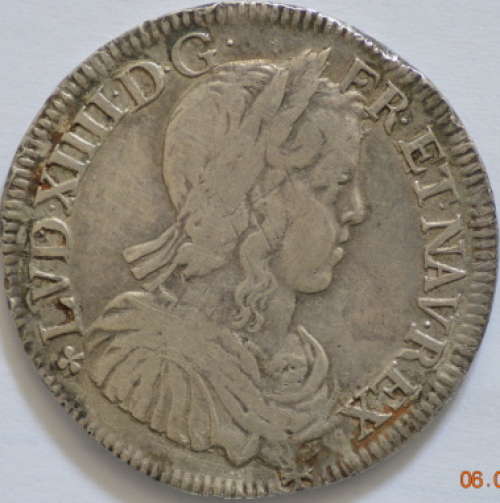 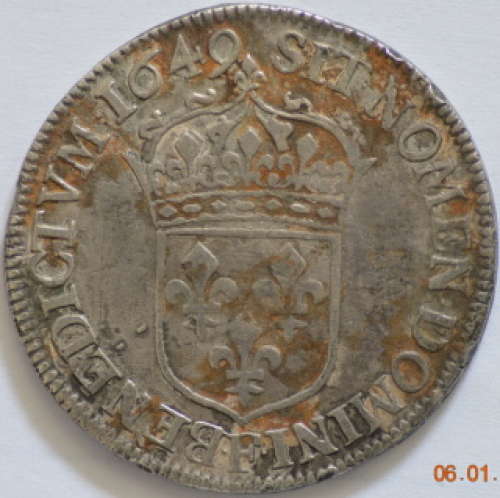 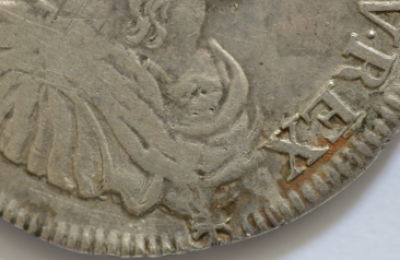 |
|
Pillar of the Community
Hong Kong
1270 Posts |
The weight of this coin : 13.26 grams. I think it's ok.
|
|
Pillar of the Community
United States
1761 Posts |
Colors which exist in debased silver coins with copper include these compounds: Red-brown color (Cuprite: Cu2O), yellow hematite(Fe2O), yellow-green atacamite (Cu2((OH3)Cl), dark brown (silver oxide) and the normally mentioned seen green color (Cu2(OH)2CO3) malachite. Silver/Copper alloys have ALL or SOME of these colors. I still see peeling and this reddish brown underlayer or copper oxide: Cu2O seems present. I am guessing this an early Sheffield type of product - I have a similar Ecu but in the mid-1700's in my collection - a silver plate but almost fully intact. Again this may be soil on the surface but it seems a good portion of the silvering is gone? Do you have an image of the EDGE which may show peeling of the silver? The metallic elements added to copper to form alloys significantly change its corrosion behavior. The more noble (Ag) accelerate the corrosion, while the most active (Pb,Zn,Sn) promote its cathodic protection. Most Sheffields are good to weight but some are light if not of the CC8R Birmingham Tower Mint types. Weight seems a little low ... I vote Sheffield Type counterfeit ... unless this brown color is surface debris and not an exposed underlayer. I just don't think ECU's copper leach this badly ... but I only been collecting CC ECU's for two years as part of my world contemporary counterfeit reference collection and primarily 18thC which comes in basic off-metals like copper, bronze and brass.
John Lorenzo
United States
|
|
Pillar of the Community
Hong Kong
1270 Posts |
|
|
Pillar of the Community
United States
1761 Posts |
Perhaps this severe form of cuprite leaching? has created this peeling effect since debased silver/copper alloys are usually 2-3 grams lighter than regal. Only an XRF analysis of the silver and reddish brown discoloration areas would tell us further about this coin. From the photos I see two distinct layers particularly on the reverse below VM & NO.
|
|
Pillar of the Community
Hong Kong
1270 Posts |
S.G. of this coin done : 10.182
Other data: "9999" silver coin S.G.=10.445
Pure copper (Cartwheel 2d)S.G.=8.885
So the corresponding %Ag of the coin by calculation = 83.17%
Who knows the specification of this coin?
|
|
Pillar of the Community
United States
3360 Posts |
Here's a Rennes Demi Ecu with similar wear from the same period. Not 1649 Angers but close enough to get an idea. http://www.cgb.fr/louis-xiv-le-gran...75860,a.html13.3 grams. .917 fineness. So your weight looks right for the degree of wear. I'd trust that over the fineness, not knowing the precision of your testing or the QC standards of the French mints of the period. "Two minutes ago I would have sold my chances for a tired dime." Fred Astaire
|
|
Pillar of the Community
Hong Kong
1270 Posts |
thq, thank you your information. Frankly, I don't think my coin is never real from the beginning.
|
| |
Replies: 11 / Views: 2,698 |
|








 Posted 01/05/2013 8:57 pm









