











 Posted 05/05/2013 8:59 pm


Hello and welcome. 
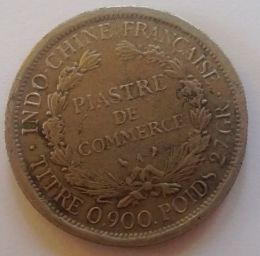
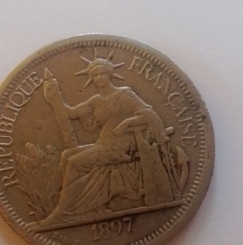
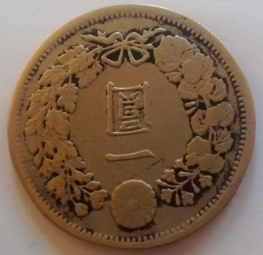
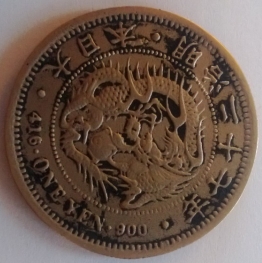
Unfortunately, I don;t think we've got good news for you. I believe both of your coins are replicas. Both of these coin types are very commonly counterfeited in China and Vietnam.
The top coin is a piastre from French Indochina. According to the NGC database page, this would be one of the scarcer dates, if genuine. But the wide rims and mushy details make me think this coin is not genuine. A quick way to test it: check the weight. "27GR" means it's supposed to weigh exactly 27 grams.
The second coin is a Japanese silver yen from Meiji Year 27 (AD 1894). NGC database entry. But, like the first coin, it has wide rims and mushy details typical of the cheaper replicas, and it also has the black, splotchy toning which is also typically painted onto such replicas to try to make them look old. Again; check the weight; it's supposed to weigh 27 grams.
Unfortunately, I don;t think we've got good news for you. I believe both of your coins are replicas. Both of these coin types are very commonly counterfeited in China and Vietnam.
The top coin is a piastre from French Indochina. According to the NGC database page, this would be one of the scarcer dates, if genuine. But the wide rims and mushy details make me think this coin is not genuine. A quick way to test it: check the weight. "27GR" means it's supposed to weigh exactly 27 grams.
The second coin is a Japanese silver yen from Meiji Year 27 (AD 1894). NGC database entry. But, like the first coin, it has wide rims and mushy details typical of the cheaper replicas, and it also has the black, splotchy toning which is also typically painted onto such replicas to try to make them look old. Again; check the weight; it's supposed to weigh 27 grams.
Don't say "infinitely" when you mean "very"; otherwise, you'll have no word left when you want to talk about something really infinite. - C. S. Lewis


