| Author |
 Replies: 19 / Views: 3,615 Replies: 19 / Views: 3,615 |
|
Pillar of the Community
Australia
1041 Posts |
well this is the results of the copper 10c I thought I had in another post and another no rim one I had in the draw can any one decipher this would be great I forgot to go to school that day this one is for the copper looking one 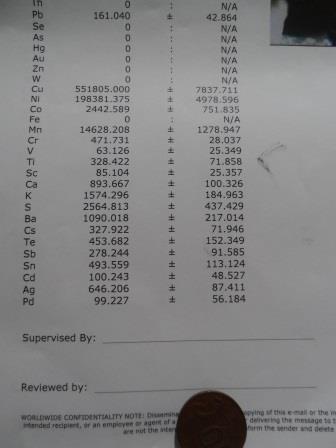 this one has no rim 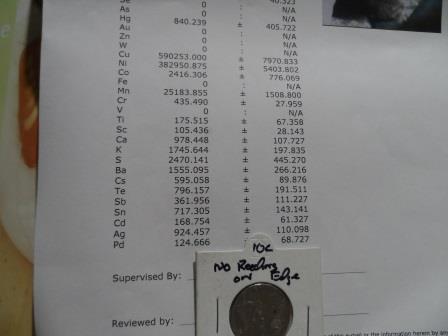 |
|
|
|
Pillar of the Community
Australia
4411 Posts |
The main metals seems to be copper and nickel aka cupronickel
|
|
Pillar of the Community
 Australia
1041 Posts |
10c coins are to be 75%copper 25%nickel one is 59% the other 55% copper and both have high mn levels what is mn and should it be there in that level I have no idea that why I am asking as I now the copper looking coin don't look like enviro damage
|
|
Moderator
 United States
14463 Posts |
Mn is Manganese. Speaking from US coin experience only: is that the metal content of the entire coin or only the surface. The overall percentages may be 75%Cu/25%Ni but the outer surface may be a bit different than the core.
|
|
Pillar of the Community
Australia
750 Posts |
Shane can you take a pic of the top of the page where the columns have headings? They might be PPM (parts per million) figures which would change things quite a bit.
|
|
Pillar of the Community
Australia
4411 Posts |
Are you sure they are percentages and not estimated mass?
If it is mass then:
The first one totals 776881. The copper content is 551805. That makes 71%.
The nickel content is 198381 which is 25.5%, Mn is manganese and is less than 2%
The second one totals 915790. The copper content is 590253. That makes 64%. The nickel content is 382950 which makes 42%. Manganese is almost 3%.
I would guess that its ppm though but the above calculations work out pretty close to what it should be if it was mass which is weird.
Anyway the surface is pretty corroded so might be completely different to the inner parts.
Edited by enworb
05/10/2013 04:25 am
|
|
Moderator
Australia
16982 Posts |
In any scientific test, it's always good to have a "control". If you've got two coins you wish to investigate, then submit a third coin for analysis, one that seems perfectly normal and has no issues or problems whatsoever. That way, you can tell the difference between things that are actually strange about the sample and things that have gone wrong with the testing.
I have two quick questions about the test.
First, what was the test, exactly? XRF? You still seem to have the coins with you, so it's safe to assume it wasn't an ICP test like we use in the lab where I work - for that test, you need to dissolve the entire coin in acid first. The nature of the test will also affect the interpretation; XRF is surface analysis only, and doesn't tell us whether the coin is solid coppery metal or whether it's simply picked up a coppery coating from someplace.
Second, as others have asked, what are the units? It's impossible to interpret results that are just a bunch of numbers, without knowing what the numbers represent.
Don't say "infinitely" when you mean "very"; otherwise, you'll have no word left when you want to talk about something really infinite. - C. S. Lewis
|
|
Pillar of the Community
Australia
1041 Posts |
I think its ppm 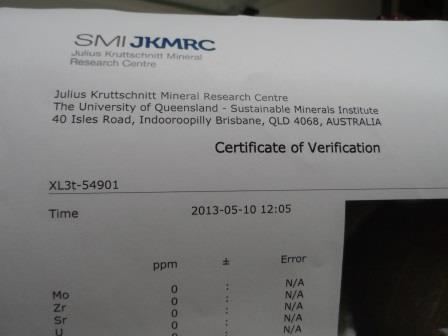 there just seem to be no environmental damage 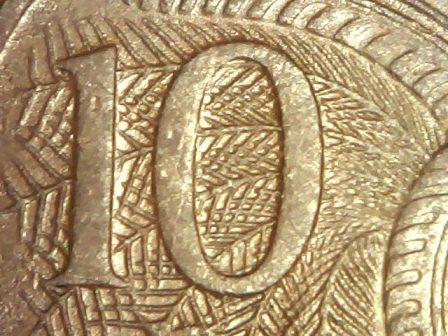 |
|
Pillar of the Community
Australia
1041 Posts |
the other ten cent piece with no reading on edge micro views of the rim with a another 10c beside it 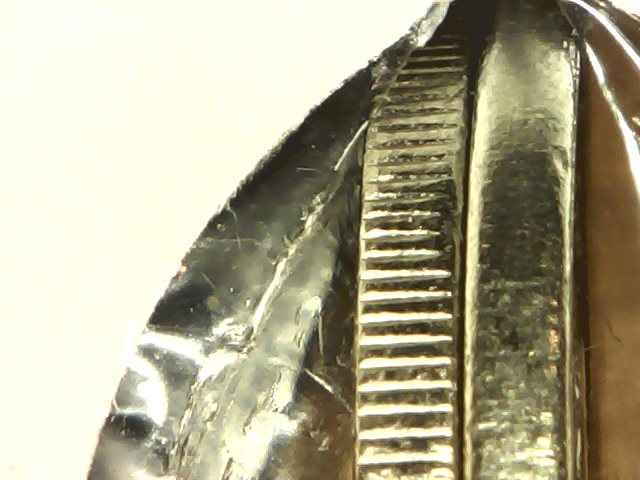 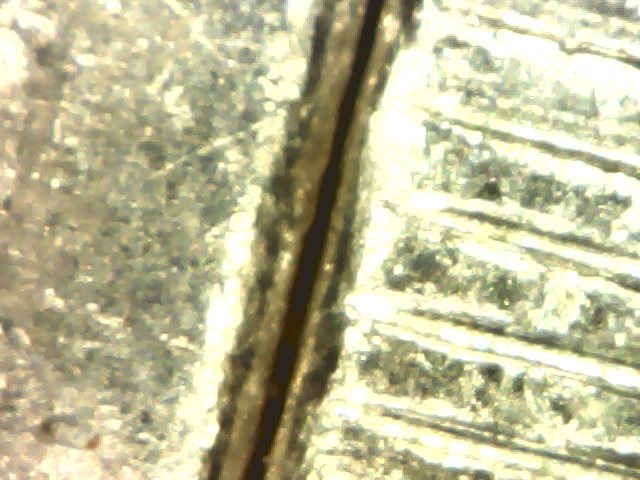 |
|
Pillar of the Community
Australia
750 Posts |
Shane, if you don't mind me asking, how much did the tests cost? Did you take them there, or post them? Thanks!
|
|
Pillar of the Community
Australia
1041 Posts |
cost nothing had 5 items done took about a hour sorry cost me a bottle of vodka will let you know the other items when I have done some more home work
|
|
Pillar of the Community
Australia
2180 Posts |
There's traces of silver in it? That doesn't seem right.
|
|
Pillar of the Community
Australia
4411 Posts |
|
|
Pillar of the Community
Australia
2180 Posts |
I suppose, but ~0.36g of silver per 10c piece adds up when they're made by the million. Probably depends how economical it is to separate it I guess, assuming there actually is silver.
|
|
Pillar of the Community
Australia
4411 Posts |
Its possible (pretty likely) the silver was picked up by the coin rather than having been there in the original planchet.
|
|
Pillar of the Community
Australia
2180 Posts |
Yeah you're probably right. Looking at that list it must have been in contact with all sorts of weird and wonderful things.
|
| |
Replies: 19 / Views: 3,615 |










 Posted 05/10/2013 04:11 am


