| Author |
 Replies: 12 / Views: 2,313 Replies: 12 / Views: 2,313 |
|
|
New Member
United States
1 Posts |
I found this forum in the course of a search to find out about the edge inscription on an imperial Russian Ruble I have. A thread here went a long way towards solving that for me. A moderator who goes by the handle "sap" gave a good explanation.
But although the thread was from 2008 (and is locked), I feel compelled to respond to one particular statement. That is that the Polish zloty is named after the Russian unit of weight (used for precious metal content in coins)the zolotnik.
I suspect it's very easy, when people encounter something similar in Polish and Russian, or in Poland and Russia, to quickly conclude, "Oh, Polish got that from Russian," or "Poland got that from Russia." Very often, it's not true; it might even be the other way round (Vodka, a Polish invention widely believed to be Russian, comes to mind).
But in this case, it is probably neither. Both words are related to a Slavic word for gold; in Polish, that is zloto (with the Polish L, with a slanted line through it). I'm sure that the name of the precious metal predates any terms for coinage or units of measurement.
|
|
|
|
Pillar of the Community
Russian Federation
5186 Posts |
I wouldn't even exactly say that the Russian unit of measurement came from the word for gold (and if it did, it was probably in a roundabout way). And I'll have to check, but I suspect that the Polish monetary unit might actually predate the Russian measurement one  (edit: Wikipedia says that the former is from 14th century and the latter likely from 10th or 11th century; they're still both really old, and both basically mean "a gold [coin]"). |
|
Rest in Peace
United States
4078 Posts |
Hrabstan  "Sap" who is a moderator here at CCF has the best knowledge of foreign coins plus much more information. He is one of best.  Hold on and I hope he tells more for your quandary. |
|
Valued Member
Japan
71 Posts |
those two are of course 'related' in a sense of belonging to the same language family and meaning basically the same, but still, russian "zolotnik" or "zlatnik" coins were first minted in the end of the 10th century (but in this case the term "russian" is somewhat misleading as well, and should be understood as "kiev rus(sia)"): 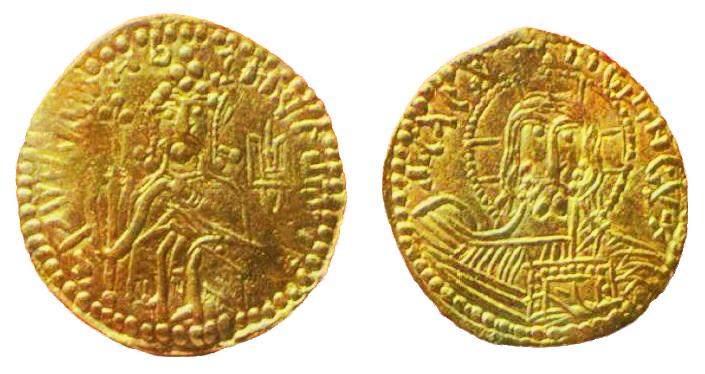 on the other hand, polish zloty was first introduced in 1496... |
|
Moderator
 Australia
16982 Posts |
I did indeed say it, not just once but twice; in this old thread and in the CCF Glossary entry for "zloty", which I wrote along with a whole bunch of other world coin related entries. I can't even recall where I obtained the information, so I can't rule out "logical deduction" as my source. I'm happy to concede to local knowledge that the two words are indirectly related at best. We've had another chap from Poland already point this out; his suggestion for a corrected entry to the glossary can be found here. I can't edit the glossary, so I'll ask Bobby if he'd mind editing it. "Logical deduction" can indeed lead one astray where proximate but different foreign languages have similar words. The Bulgarian lev and the Romanian and Moldovan leu are currency units which are named after an old Dutch Trade dollar, the leeuwendaalder. One might logically assume that the Albanian lek is also named after the leeuwendaalder ,but one would be wrong in making such an assumption; the lek is actually named after either Alexander the Great and/or the Albanian national hero, Skanderbeg. Don't say "infinitely" when you mean "very"; otherwise, you'll have no word left when you want to talk about something really infinite. - C. S. Lewis
|
|
New Member
 United States
1 Posts |
With particular respect to Bpoc1's contribution to this thread, I hope I did not come off as disrespecting Sap--whom I do not know, of course. It is a small--but to me, personally, and important--point, that I try to address whenever I encounter it. As I said, it's an easy inference to make, and the making of it shouldn't reflect badly on the individual who made it. I mean simply to put out the point, without judging someone else.
I'd come upon this community after going through a paper bag of coins from my Polish grandmother, born around 1897, I think. Prestige-wise, they run from that ruble (and a 50 kopeck) to a Seattle streetcar token. (They also include several Kings George, an Edward, a couple of Victoria, and a George III (!)--not to mention a place or two I'd never heard of, such as "Straits Settlements.")
I suspected the ruble was substantial from the heft of it, and from the edge lettering. But my limited knowledge of Polish (not Russian) suggested to me that that edge inscription referred to both silver and gold. I doubted if it was both metals, and it certainly didn't look like gold. Now I know that the word I took for gold in fact partly indicates the quantity of the silver.
|
|
Pillar of the Community
Australia
3841 Posts |
Reminds me of this coin that I have in my collection. 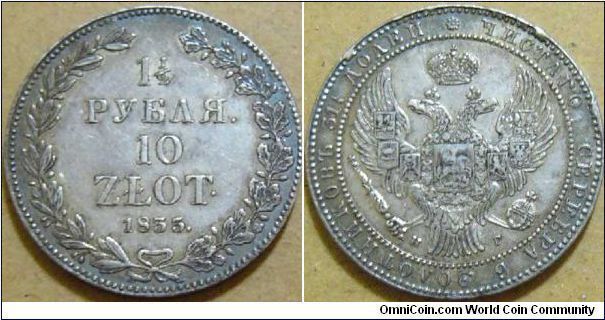 My partial coin collection http://www.omnicoin.com/collection/gxseriesMy numismatics articles and collection: http://www.gxseries.com/numis/numis_index.htmRegularly updated at least once a month. |
|
Valued Member
Japan
71 Posts |
|
|
Valued Member
Poland
392 Posts |
Sap, I have no idea where did you find that information that Polish zloty was named after Russian unit of weight...
The "zloty" is connected not with Russia but with completely another country - Hungary and hungarian gold ducats/florens (for example polish zloty was named in that time florenus polonicalis).
Since 1663 polish zloty wasn't a coin - it was only a unit of account.
|
|
Pillar of the Community
2087 Posts |
Quote:
I have no idea where did you find that information that Polish zloty was named after Russian unit of weight...
The "zloty" is connected not with Russia but with completely another country - Hungary and hungarian gold ducats/florens (for example polish zloty was named in that time florenus polonicalis). I dimly recall that the Ottomans issued a coin that was modeled on Polish coins. It was called a Zolota.....I dimly recall the Zolota( I am relying on my memory so I might be confusing the story with another ottoman coin the Yasluk) traced its origin back to the Jochimsthaler Guildengroschen from Bohemia. Jochimsthaler guildengroschen had three nicknames: Jochimer, Thaler, and Schlickainer. While the name Thaler moved west and became dollar, Jochimer moved east and became the origion of either the Zolota or the Yasluk. Unfortunately I am away from home and cant get to my references to confirm which coin is based on the Bohemian coin. |
|
Pillar of the Community
Hong Kong
1270 Posts |
Interestingly, I don't hear about the three nicknames of Jochimsthaler and one of them became the currency of the East. I am waiting for further information from you, austrokiwi. Henry
|
|
Pillar of the Community
2087 Posts |
Well I am back in Vienna.and suffering jet lag. I couldn't find the references related to the Joachimsthaler guildengroshen, and later polish and ottoman coins. But I did find in Freys "Dictionary of numismatic Terms" that the polish Zloty is derived from the word "Zloto" the word for gold Frey is a long out of print book but it seems reliable more often than not
|
|
Pillar of the Community
2087 Posts |
Additional note. Given that Zoloty is based on "gold" as first stated in this thread it will be Yasluk that traces its way back to Jochimsthal
|
| |
Replies: 12 / Views: 2,313 |
|









 Posted 06/21/2013 4:21 pm


