A bit of remarkable history from just over the hill from where I grew up, probably well known to the colonial numismatists among us (vermontensium?), but one I was ignorant of until yesterday.
To set the stage-- The city of Philadelphia was laid out in 1681 by William Penn, between the Delaware River on the east, and the Schuylkill River on the west. While others were raising the first beams of the new city, young Charles Pickering arrived from Cheshire in England, to seek his fortune. Where he chose to seek it, was upstream on the Schuylkill, into what can be only described as godforsaken wilderness, which had only just been nominally christened Chester County...
Quote:
Miner, counterfeiter, "attorney for ye King," Pickering was one of the most romantic figures of his day.
He had crossed the ocean with Penn and wandered up the Schuylkill River in search for treasure. After a long and tiresome journey through the forest, he lay down on the bank of the stream now called by his name, and dreamed his dream of silver. Dreamed, did I say? No, he saw and handled the shining particles washed from the neighboring hills, and, having assured himself of their value, hastened to Philadelphia; obtained the tract from Penn; returned; imparted the secret to Tinker, a miner; dug a cave; collected a mass of the supposed precious metal, and transported it to Europe for examination. Finis!
I spent a goodly portion of my childhood waist deep in what is now known as Pickering Creek. Unfortunately for Mr Pickering, the verdict returned from the Assayers' Office in London: "Sorry, old boy. No silver here." He now had no prospects, and a crew of miners from New England awaiting their pay. A solution apparently came from a fellow by the name of Robert Fenton, who helped to quickly set Pickering up in a new profession...
Quote:
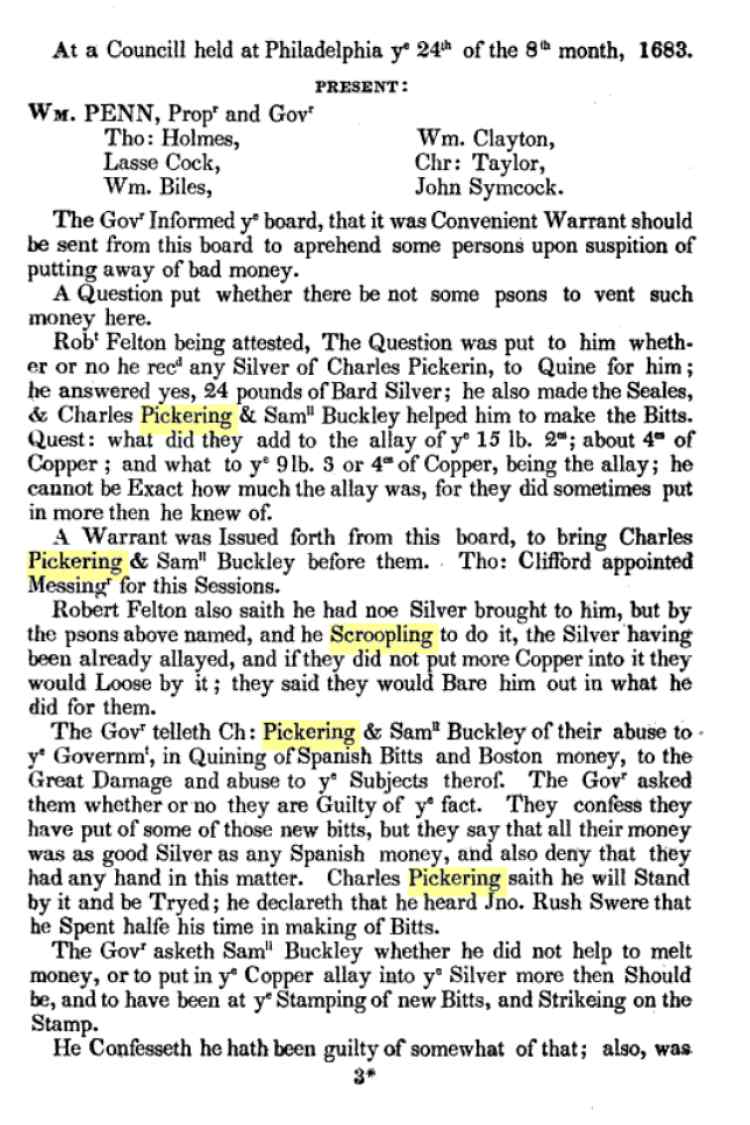
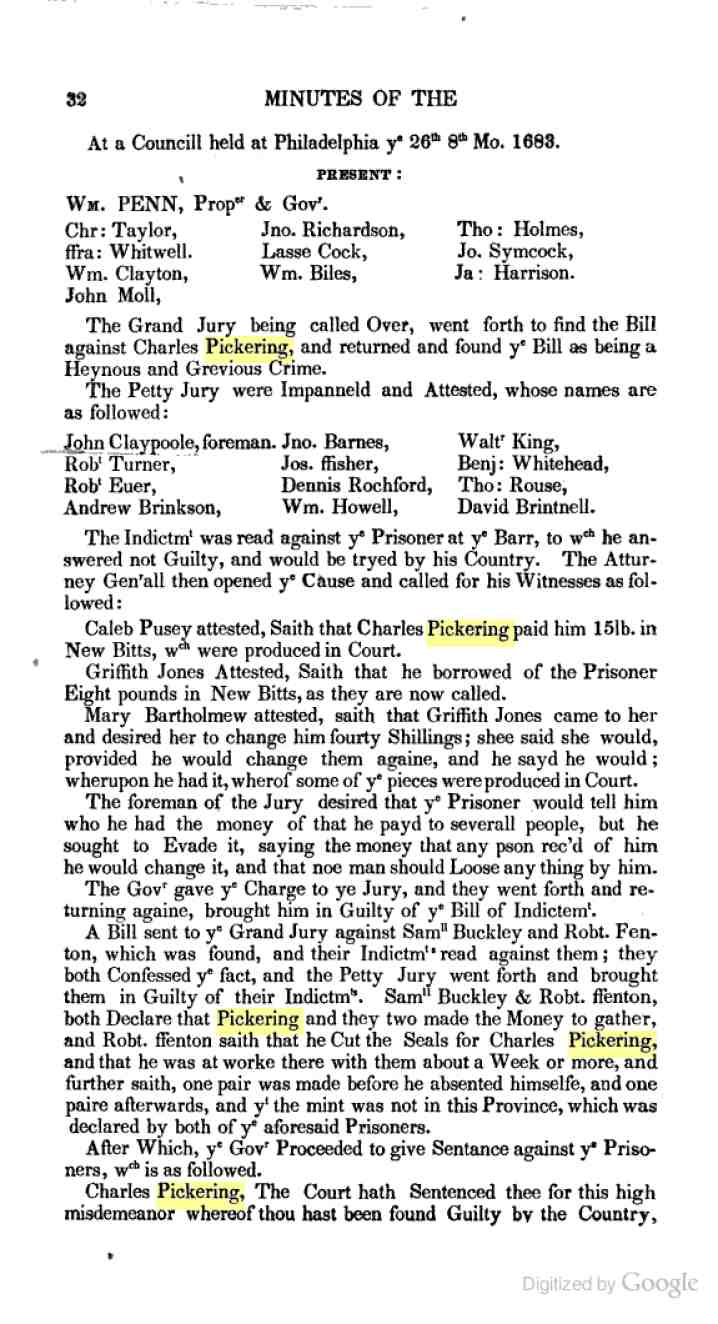
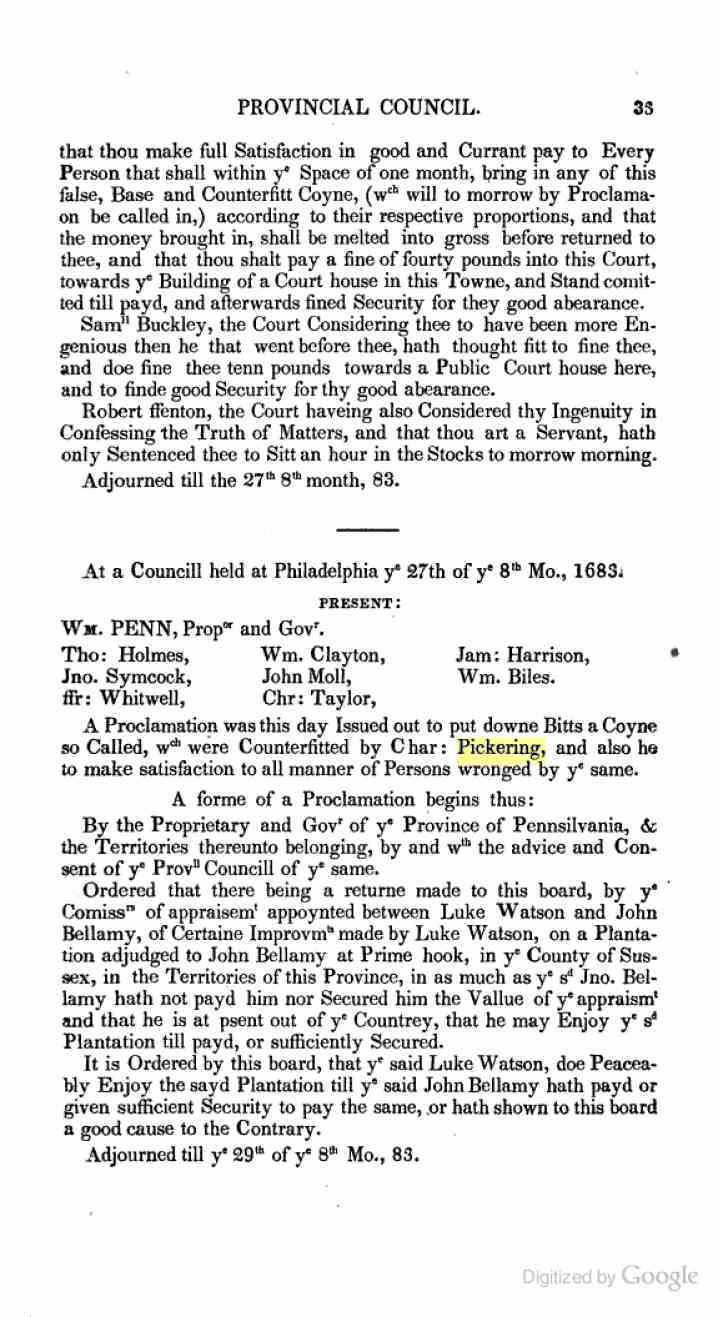
From mining, Pickering turned to coining, in which undertaking he was not altogether unsuccessful, until the Provincial Council interfered with his private minting of "Spanish Bitts and Boston money" by issuing a warrant for his arrest. The jury who tried the case against him and his assistant Buckley, convicted both. For this high misdemeanor the Governor sentenced them to make full satisfaction to every person who should within a month bring in any of the "Counterfitt Coyne," and also imposed a fine of forty pounds "toward ye building of a Courthouse."
Pennypacker suggests that Pickering's offence was probably "nothing more than an attempt to supply the colony with an irregular but an intrinsically valuable medium of exchange." It was followed by no social condemnation. In privilege and freedom, the Council declared in 1685, that Pickering stood in "Equal Capacity" with the other colonists.
Pickering's neighbor, Samuel Buckley, was fined £10, but Fenton, being only "a servant," and being the one to spill the beans to the authorities, got off with an hour spent in the stocks. The justices in Philadelphia probably never would know that fifteen years later, Fenton would be charged with counterfeiting coin again, this time in Connecticut. Inbetween, he also became what was likely the first American counterfeiter of paper money, as he was counterfeiting the first paper money in the Western Hemisphere, that of the Massachusetts Bay Colony. Pickering, in his next incarnation, that of lawyer on the King's Bench, ended up trying the first criminal case in the new court in Chester County in 1686.
Although Eric P. Newman (in an issue of The Colonial Newsletter that I don't feel like paying $65 to read) feels that Pickering and Co. were just coining "Spanish bitts," and not the "New England Shillings" or "Boston money" that he was charged with faking, what I wouldn't give to find a contemporary counterfeit Pine Tree shilling on the banks of the Pickering Creek!







 Posted 06/22/2013 10:01 am







 Love the info - thank so much for sharing! This kind of post is why CCF is such a fun and knowledgable community!


