| Author |
 Replies: 10 / Views: 2,160 Replies: 10 / Views: 2,160 |
|
|
Pillar of the Community
United States
950 Posts |
excuse me if this has been discussed before.. I tried searching and didn't find anything.
I just picked up a 1965 Winston Churchill Crown from ye olde local coin store for the princely sum of one dollar, and I noticed that it doesn't claim a denomination. That got me thinking.. do coins have to claim a denomination? A crown is legal tender.. right?
Along those same lines, can non-legal tender claim a denomination? like a copy or reproduction for instance.. Just curious..
Thanks for your time.
|
|
|
|
Moderator
 United States
14463 Posts |
A crown is/was legal tender in the UK. Most modern coins note the denomination, but some present and many past coins the denomination was determined by the coin size. Is this your coin? this was an pocket-piece experiment of mine. 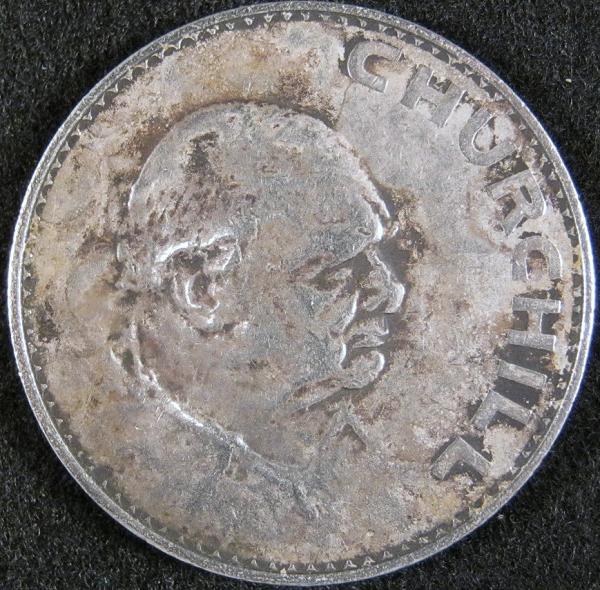 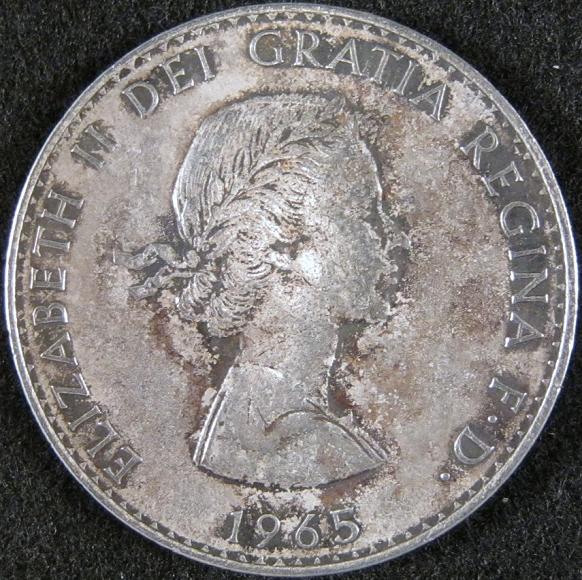 |
|
Valued Member
110 Posts |
 you took the words right out of my mouth. |
|
Pillar of the Community
 United States
950 Posts |
Yep, same one.
I saw your thread about this one (you thought it was in a fire if I remember correctly) and since then I have been looking for one.
Mine is still in pretty nice shape. I was surprised I could get it for such a small price in that condition.
See, it doesn't say "Crown" on it anywhere. how confusing.
|
|
Pillar of the Community
United States
807 Posts |
Many coins don't indicate denomination. Why should not having the word "crown" be confusing? "Crown" was a name given to coins of that size, which generally passed for five shillings English, but not always. (They could as easily pass for forty-five piastres in Cyprus currency!) Now, the double florin of four shillings was confusing, because it was almost as big as a crown, but it was rapidly discontinued.
Originally the value of a coin was determined by its metal content. A formal denomination only makes a material difference to token coinage.
|
|
Pillar of the Community
United States
950 Posts |
I'm not big on ancients of foreign coins, so all of the ones I am familliar with say how much they are (were) worth right on them.
I googled the value of a "crown" and it brought me to a page talking about Florins, half penny, schillings, pence, coins with little birdies on them, something is 1/12 of this other thing, and then you have these other coins, this and that, and all sorts of mumbo jumbo... it was all too much for my brain to handle on a friday. Maybe I will read it again after some R&R.
|
|
Bedrock of the Community
United States
17884 Posts |
Many countries have had coins that did not have denominations on them including the US. Half Dimes did not have the denomination on them until 1829, dimes got their denomination in 1809, the 1796 quarter has no denomination. The early quarter half and eagle gold coins did not have denominations on them. The British coins during that time period did not have denominations either. Since the people in the early US were used to using british coins, the idea of coins without denominations was not odd to them. They were used to identifying denominations by metal and size. |
|
Pillar of the Community
United Kingdom
856 Posts |
Quote:
I googled the value of a "crown" and it brought me to a page talking about Florins, half penny, schillings, pence, coins with little birdies on them, something is 1/12 of this other thing, and then you have these other coins, this and that, and all sorts of mumbo jumbo... it was all too much for my brain to handle on a friday. Maybe I will read it again after some R&R. Oh, it's easy baysinger! One pound is 20 shillings. Twelve pennies to a shilling. A farthing is 1/4 of a penny, a groat is fourpence. We used to have half-groats, but most people refer to them as twopence (pronounced 'tup-pence). A crown is five shillings (or a quarter of £1) and a half crown therefore two shillings and sixpence. Of course, nowadays that would be twelve and a half pence (P) I wonder if they called it L/S/D because it felt like your brain was on the stuff?  Now you know why we went decimal! But seriously, if you have any questions about old British coin denominations do please ask. I'll do my best to help! Edited by Tom Goodheart
07/13/2013 05:32 am
|
|
Pillar of the Community
Australia
4411 Posts |
British sovereigns and half sovereigns with the st george reverse dont have the denomination on them. The size and weight is what is used to differentiate them.
|
|
Moderator
Australia
16979 Posts |
Many older coins and coins such as the sovereign that have histories stretching back a century or more do not have face values (denominations) on them. It is not the face value stamped onto the coin which gives it legal tender status, it is the face value declared by the laws of the country that issued it which inputes its status as a coin.
Which leads us to another aspect of the subject. A coin which does not have a value stamped on it can easily be re-valued by the government, simply by changing the law. For example, when the British gold coin known as a "guinea" was first issued in 1663, it was valued at exactly one pound, or twenty shillings. But fluctuating gold prices forced them to declare several official re-valuations, raising the face value of all guinea coins up to thirty shillings, then eventually back down to 21 shillings in 1717, where it remained until the guinea was withdrawn in 1816.
On the other hand, if a government wished to re-value coins that had a value stamped on them, they have to recall them, counterstamp them with the new value, and re-issue them - a slow and laborious process. When Costa Rica wished to double the face value of its circulating silver coins in 1923, they had to withdraw and counterstamp them all.
The American government has the right to unilaterally change the face value of its coinage, as well, if it chooses. That's what that line in the Constitution means about Congress having the power "To coin Money, regulate the Value thereof, and of foreign Coin". That the American Congress has never actually done this is more an accident of history than anything else, though in this day and age where face value and intrinsic value have been decoupled, such drastic action seems unlikely.
Don't say "infinitely" when you mean "very"; otherwise, you'll have no word left when you want to talk about something really infinite. - C. S. Lewis
|
|
Pillar of the Community
United States
807 Posts |
Exception to the above statement by Sap : the Act of 28 June 1834, which changed the weight & fineness of the gold coinage from 270 grains 11/12 to 258 grains & very nearly 9/10 (changed again to exactly 900 by the Act of 18 January 1837), specified (s.3) that "all gold coins of the United States, minted anterior to the thirty-first day of July next, shall be receivable in all payments at the rate of ninety-four and eight tenths of a cent per pennyweight".
|
| |
Replies: 10 / Views: 2,160 |
|







 Posted 07/12/2013 7:12 pm





