| Author |
 Replies: 34 / Views: 12,810 Replies: 34 / Views: 12,810 |
|
Pillar of the Community
United States
1283 Posts |
I was wondering how long different types of toning take. Example, how long did rainbow toned Morgans have to touch the bags, and under what conditions?
We all know about artificial toning. But what would stop someone from deliberately toning a coin the "natural" way, or in the same manner that other attractive coins became toned?
|
|
|
|
Pillar of the Community
United States
7123 Posts |
Toning is largely an environment relic ,,so times can vary ,,I have some very pretty toned ASE's that toned in about 4 or 5 years stored in a GrandFathers chest. There are people who use methods of expediting the toning process ,such as placing a coin in an envelope with match heads and setting them on a window ledge,, some just claim that setting the coin on the window ledge expedite the process ,with the changes in Humidity and temperature, (I have never tried it ) but I can see how it would work. the question is would these be considered natural processes ? The morgan rainbows from the bags were stored from the time of minting and then released at various times well into the 1960's . and were back to varing times and conditions . Metalman |
|
Valued Member
United States
214 Posts |
It all depends on the metal a coin is struck in, even then each coin from the same metal will tone differently.
Just about any coin will tone if placed on a window ledge. You can achieve toning by placing the coin in an oven or frying pan.
Substances like albums with acetone, sulphur(matches, salt)and moisture all have different affects on coin. It all according to the correct mixture.
I don't buy that that it takes years to tone a coin indecent (rainbow). It's that Morgan sat in the vaults so long that it was assumed the toning took years.
It can be done in an hour with heat, or several months under the right circumstances.
I have a friend that sent a coin into PCGS and it came back cleaned, frustrated, he placed the coin in his sock drawer, and forgot about it.
A few months later he remembered the coin. He got it out to decide what to do with it and found that it had gained a slight patina. Not much, but noticeable.
So, he thought "What the heck" and sent it back to PCGS and they graded the coin Mint State.
This is a true story that I witnessed first hand.
|
|
Valued Member
United States
383 Posts |
In chemistry my son was studying oxidation and the effects of chemicals on different metals. I took an AU Peace dollar and placed it in a zip lock bag with some onions that I chopped up and water. The onions/water were in a cup. I placed this on top of the furnace, it was winter so I figured this would be a good low source of heat. Well after about a week the white coin turned a very nice blue. I gave it to his science teacher to use as an example. I don't think I saved pics. |
|
Pillar of the Community
United States
7123 Posts |
DD artificial toning and Natural toning are two entirely different things .
Artifical toning is a really frowned upon practice in the hobby of numismatics !!
true natural toning can take years and years ,,does it always ? IMO no it does not always take years and years ,but the process stays the same without anything added by a person to achieve or speed the process.
Metalman
|
|
Valued Member
United States
70 Posts |
Could take a year, could take 100 years. I've got 100+ year old blast white Morgan's, but the 2006 Jefferson's in my Dansco album are already toning.
|
|
Pillar of the Community
United States
1247 Posts |
|
|
Valued Member
United States
402 Posts |
I only have one coin that I know for sure how long it took to toned. It took about 43 years. 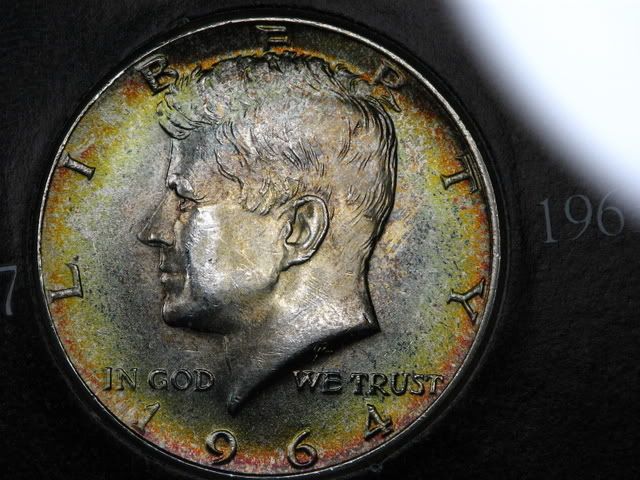 |
|
Pillar of the Community
United States
4589 Posts |
nice bullseye toning on that Kennedy 50cents
|
|
Pillar of the Community
United States
3357 Posts |
Something bad about silver and sulfur....that's why there's silver cream for cleaning silverware. It's amazing to me that any silver coin is blast white after 100 years. I've got a hammered sterling matchbox holder made during the early 1900's. Within a month or two of polishing it's black again, probably due to the matches it contains. Even worse, a single meal of lutefisk will tarnish the tines of a freshly polished sterling fork. Keeep that stuff away from your coins at all costs!
"Two minutes ago I would have sold my chances for a tired dime." Fred Astaire
|
|
Valued Member
United States
141 Posts |
Staying away from Lutefisk is just generally a good idea, methinks... just kidding  (btw, the lutefisk does that b/c it is so high in ammonia - ammonia + silver = bad). Toning just takes as long as it takes - unassisted, depending on conditions, anywhere from an hour to a millenia... |
|
Pillar of the Community
United States
3357 Posts |
I like lutefisk to a degree..  ..had a tasty batch last winter in Ham Lake MN. I'm not a fish chemist, but am suspicious that the silver-blackening powers of lutefisk have something to do with lye soaking of sulfur-containing proteins in the codfish. If lutefisk is done right, there isn't a lot of ammonia, but the silver gets black all the same. "Two minutes ago I would have sold my chances for a tired dime." Fred Astaire
|
|
Pillar of the Community
 United States
1283 Posts |
This is interesting stuff. It seems to me it's like a grey area. Much of the heavily saught after toning is caused by an outside influence. Using chemicals to tone would be "artificial", but isn't some of the beautiful toning just caused by prolonged contact with certain materials, like paper or cardboard? And if that's the case, anyone can just tone a coin in this manner.
|
|
Bedrock of the Community
United States
20753 Posts |
In reality not to much difference in AT or NT. Only noticed when forced toning is done. For a real education on toning try
www.tonedcoins.org That is a web site sort of dedicated to toning coins or toned coins. As for a short explanation, all metals react with some other elements. Regarless of what people usually say, even Gold and Plantinum react with some elements or compounds. As to Silver it reacts with numerous other items such as Flourine, Chlorine, Oxigen, Nitrates, Sulfates and on and on. Leaving a coin on a window sill depends on the area you live, the weather, your neighbors and many other things. I say neighbors since by me leaving a coin on a window sill makes it vanish, not tone. Now a Silver coin near a pool that is saturated with Chlorine will eventually react to form some AgF2 as a coating, Near factories that use HNO3 in any processes may leak some into the air and react with Silver coins to form AgNO3. The most common reaction is in Sulfur burning areas such as Northern Indiana where there USED to be many steel making companies and many used open hearth furnaces. These bellowed Sulfur Oxides into the air and when mixed with the moisture, (H OH) produced H2SO3 or 4. Best known when it rains as acid rain. In such areas Copper coinage as well as copper piping, grounding systems eroded into CuSO4. On coins appears as a greenish toning. Always a lot of fun in chem labs with Sulfuric Acid and a penny. In some areas the combination of Nitrates, Sulfates, Florides, etc in the air will eventually tone coinage if left in open air. Obviously putting coins in bags, envelopes, ovens, with onions, turnips, spit, dirt, etc is not always necessary. In many areas, such as desert regions, very little toning of coins happens due to lack of that famous substance, humidity (H OH)other wise none as water. This is the reason for the preservation of so many things in Egypt such as the mummies. No humidity. Same with coins.
|
|
Valued Member
United States
214 Posts |
Metal Man, you said "DD artificial toning and Natural toning are two entirely different things." Technically this is true, but a coin can be toned artificially and not be any different than a "naturally" toned coin.
If one knows how a coin becomes toned in the first place, the reactions of different metals with certain substances, and under different conditions then toning can be achieved with quality.
Let's see how we are defining "natural" toning. A silver coin will gain a black or brown tarnish natural over time. If it displays color then it was stored unnaturally and this cannot be called "natural" toning. Of course, there are always exceptions to any rule. But silver coins usually don't look nice after true silver tarnish or toning occurs.
Now, if a coin "doctor" can achieve the same quality of toning then who is to say this toning is not natural? This person used the same conditions and substances that toned the so-called natural toned coins. So, it can't be different, unless the coin was previously cleaned or altered, then it is called re-toning.
It appears the most active ingredient for toning Silver Dollars is sulphur. I have encountered several references to baking soda, match sticks, Morgans stored in old dynamite boxes, and bags treated with salt to retard rotting of said bags in a damp environment. So, how is the coins released in a toned condition, from this type of storage, called naturally toned?
I must disagree. Natural and unnatural toning are very difficult to discern.
Edited by DoubleDie
06/04/2007 8:18 pm
|
|
Pillar of the Community
United States
1283 Posts |
quote:
Now, if a coin "doctor" can achieve the same quality of toning then who is to say this toning is not natural? This person used the same conditions and substances that toned the so-called natural toned coins. So, it can't be different, unless the coin was previously cleaned or altered, then it is called re-toning.
This is exactly what I'm getting it, and why I wanted to learn about. I love beautifully toned coins, but I'm always reluctant to buy one. I want one that happened by chance (I don't know why, but this matters to me). Online I see certain dealers that have TONS of stunningly beautiful toned coins. Many of them are slabbed by PCGS, NGC, etc. I can't see how, logically, they would just HAPPEN to have that many beautifully toned coins. Edited by USArmyParatrooper
06/05/2007 10:47 am
|
| |
Replies: 34 / Views: 12,810 |










 Posted 06/02/2007 3:37 pm


 [/URL]


