| Author |
 Replies: 33 / Views: 6,581 Replies: 33 / Views: 6,581 |
|
Bedrock of the Community
United Kingdom
18511 Posts |
Inflation isn't pleasant, but it can make numismatics interesting! I thought it would be fun to post pictures showing how a particular coin denomination has changed over the years. This is my starter - South African 10 cents:  1961-64: 50% silver 1965-89: Nickel 1990 onwards: Brass-plated steel |
|
|
|
Moderator
 United States
194256 Posts |
Thank you for sharing. I find it interesting. Their ten cent coin now looks like a one cent coin, which reminds me that our ten cent coin should become our smallest denomination.  |
|
Moderator
United States
23522 Posts |
Quote:
Their ten cent coin now looks like a one cent coin, which reminds me that our ten cent coin should become our smallest denomination. Had to slip that in, didn't ya?  |
|
Moderator
United States
194256 Posts |
Yes. Yes I did. Another example of how the rest of the world seems to have figured out something that we have not.  |
|
Moderator
Australia
16957 Posts |
Well, don't forget that the South African 10 cent has seen more inflation than the American dime. It started out as more valuable (being pegged at 14 US cents) but, thanks to apartheid and the resultant political instability, has fallen to just under 1 US cent. South Africa has only just (in 2012) eliminated the 5 cent coin, making 10 cents their lowest denomination.
And South Africa is still far from a "first-world" economy. 10 South African cents will buy a poor person in South Africa a lot more than 1 US cent will buy a poor person in America.
Don't say "infinitely" when you mean "very"; otherwise, you'll have no word left when you want to talk about something really infinite. - C. S. Lewis
|
|
Pillar of the Community
United States
1109 Posts |
Quote:
I find it interesting. Their ten cent coin now looks like a one cent coin, which reminds me that our ten cent coin should become our smallest denomination. Be careful suggesting coin denomination variations...Fox will jump in and want us to accept a new .02 cent coin and stuff. |
|
Pillar of the Community
Canada
2785 Posts |
|
|
Moderator
Australia
16957 Posts |
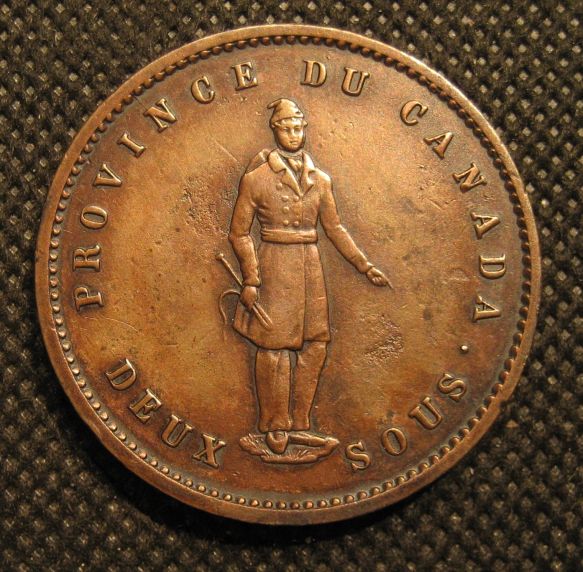
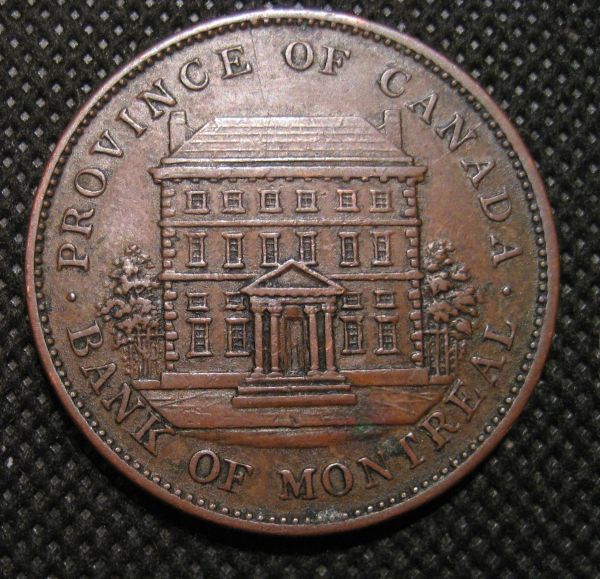
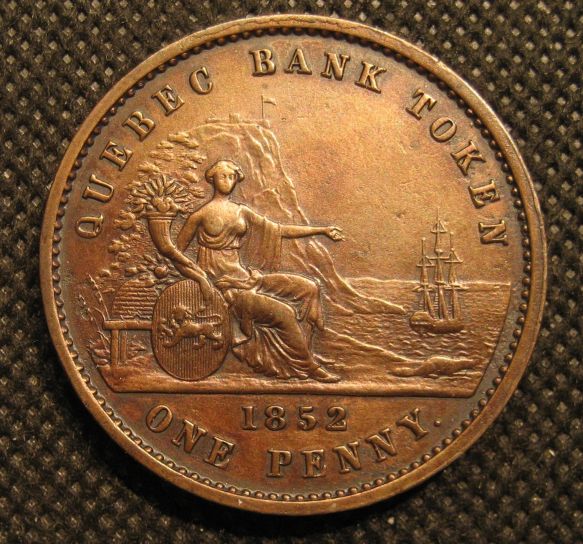
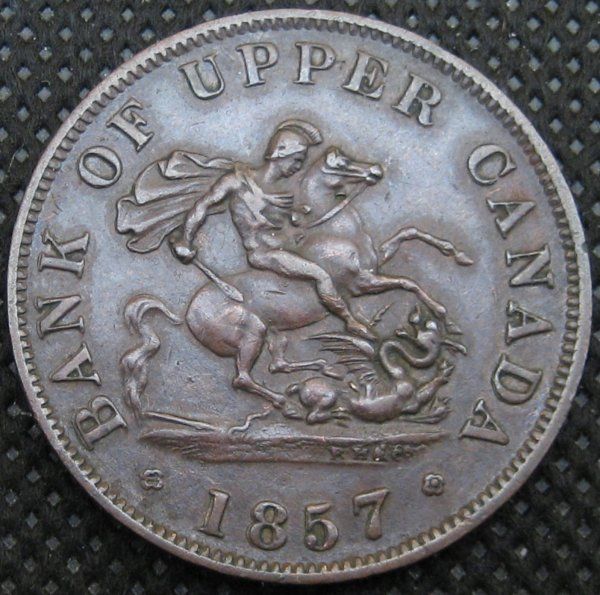
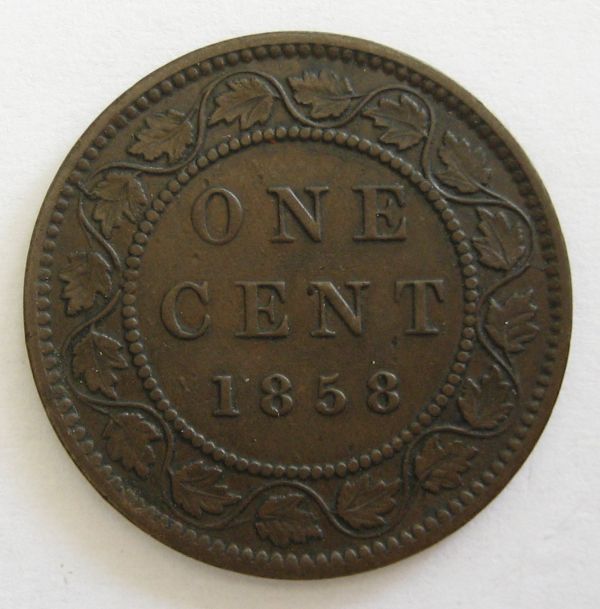
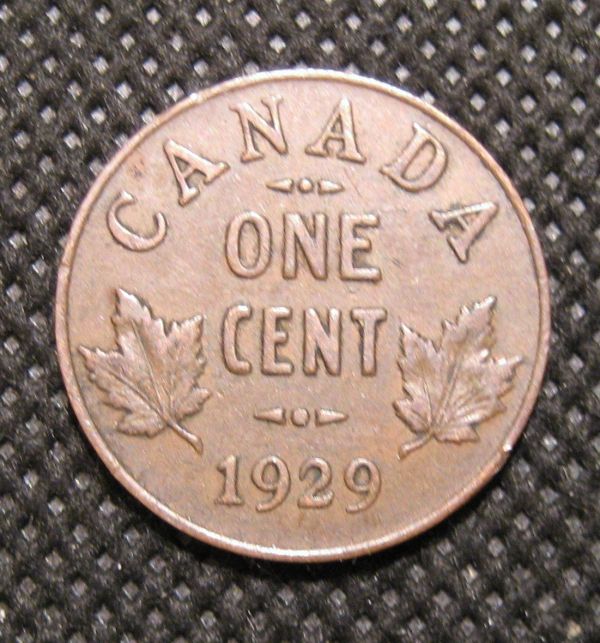
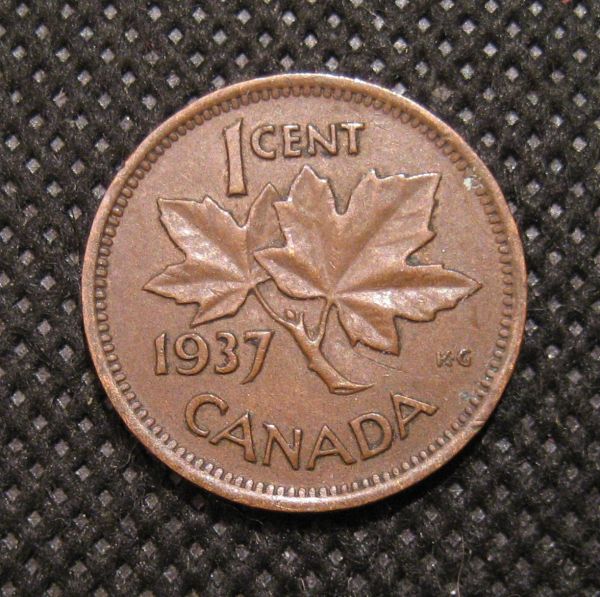
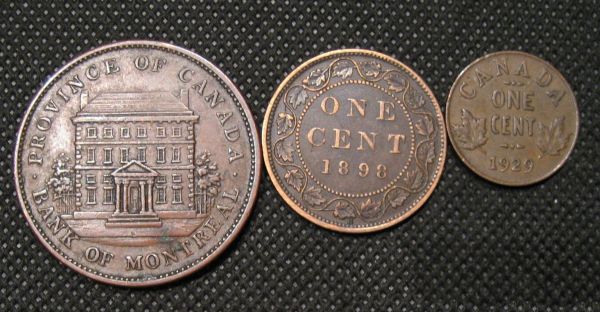
The Canadian pennies - the ones that actually say "penny" on them, not the ones that say "cent" - are not cents, so aren't really a continuum. With an exchange rate of £1 = $4.866666, one (predecimal) penny equalled 2.0277777 (2 and one-thirtysixth) cents.
Don't say "infinitely" when you mean "very"; otherwise, you'll have no word left when you want to talk about something really infinite. - C. S. Lewis
|
|
Pillar of the Community
United States
1109 Posts |
Here's a contribution to the thread. These are all Mexican 5 Centavos coins. The first one is from 1945. The second one is from 1955. The last one is from 1975. Interesting how drastically the coin was shrunk within a span of three decades. 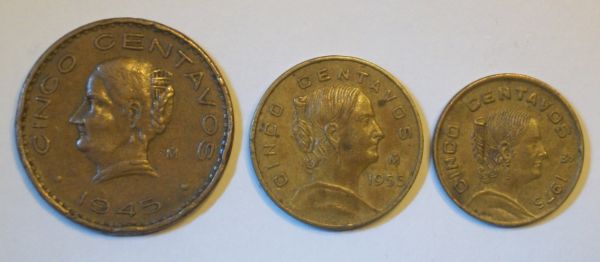 |
|
Pillar of the Community
United Kingdom
1324 Posts |
Here is the latest SA 10 Cents - now in copper plated steel...  |
|
Valued Member
United States
177 Posts |
This thread is pretty cool!
|
|
Valued Member
United States
477 Posts |
"Bank of Upper Canada"? Brrrrrrrr, makes a Florida boy shiver just thinking about it!
Rick
|
|
Pillar of the Community
Canada
2785 Posts |
Quote:
one (predecimal) penny equalled 2.0277777 (2 and one-thirtysixth) cents thats really very interesting, I've just shifted to an interest in Canadian tokens and hadn't followed the full "lineage" yet. I swear I've learned more about the country I live in since I started collecting coins than I ever did in years of school! |
|
Pillar of the Community
United Kingdom
4208 Posts |
Heres a picture of an 1810s 2 penny and a current 2 penny.  Id do a picture of 1 pennies, but its confusing stuff and the 1 penny has a long history (back to ancient roman denarius, and technically ancient greek drachm) |
|
Moderator
Australia
16957 Posts |
Again, the two tuppences aren't quite equivalent as the larger older one is predecimal; technically, it's face value now is only 5/6th of a decimal penny. Quote:
...the 1 penny has a long history (back to ancient roman denarius... Well, the English predecimal penny really derives its origin from the penny of Saxon king Offa, who borrowed the concept from the silver denier issued by Charlemagne. There isn't really any sort of continuity between Charlemagne's denier and the Roman denarius, except the name and (approximate) size and weight. There's a gap of 500 Dark Age years or more between their issue. The Latin-language records of Charlemagne's time call his new coin the "novus denarius" - a new coin, not a continuation or revival of an old one. Don't say "infinitely" when you mean "very"; otherwise, you'll have no word left when you want to talk about something really infinite. - C. S. Lewis
|
|
Pillar of the Community
Canada
2805 Posts |
The Canadian dollar used to be silver - then it was downsized into nickel - then we cut the dollar bill and released the loonie (nickel plated with brass) - and now the loonie is brass-plated steel. Quite a change - and now my Bounty Hunter won't be able to distinguish loonies and toonies from rusty nails. Aargh!
|
| |
Replies: 33 / Views: 6,581 |










 Posted 08/17/2013 11:09 pm