| Author |
 Replies: 14 / Views: 2,538 Replies: 14 / Views: 2,538 |
|
|
Valued Member
United States
136 Posts |
I know that: The first dollar approved by the congress was the Spanish dollar. Some body knows why in this Mexican coin said 10D with the "S" like was made in San Francisco. There's some doubling also. But my principal question is WHY 10D? Than a lot for your opinion. 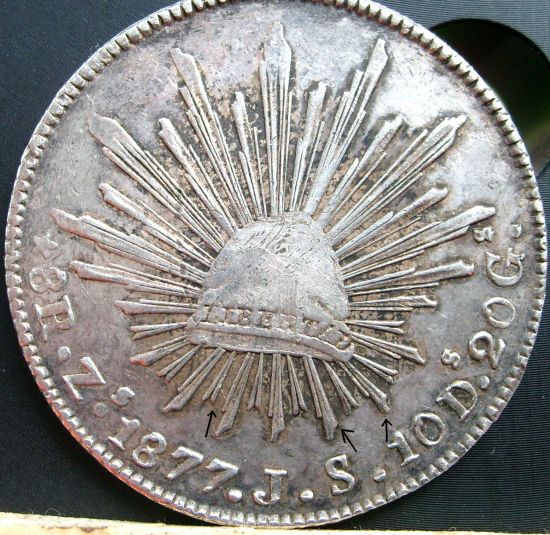 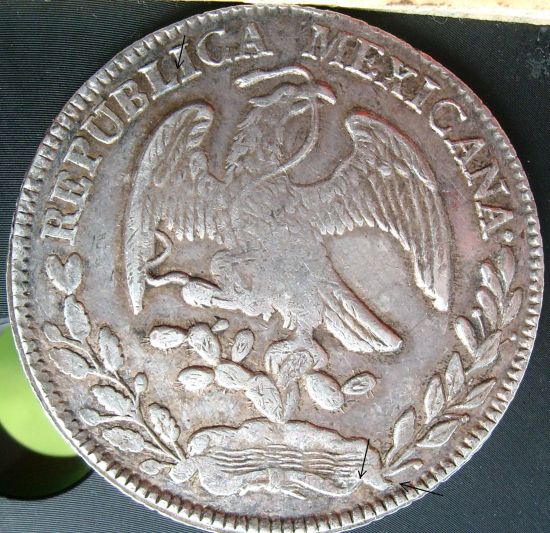 *** Moved by Staff to a more appropriate forum. *** *** Moved by Staff to a more appropriate forum. *** |
|
|
|
Bedrock of the Community
United States
12437 Posts |
The denomination of that coin is 8 Reales, not 10 Dollars. The 10D(dinero) 20G(grano) is an old unit of silver fineness with pure pure silver being 12 dineros. This coin was minted in Zacatecas Mexico, not San Francisco.
|
|
Valued Member
 United States
136 Posts |
Thank BIOKEMIST6 for that information.
|
|
Pillar of the Community
United States
3640 Posts |
Good info. Thanks Bio.
Was not the dinero used as the denomination before
the real ?
So then this coin is basically 20 grams of 83.3 % silver ?
Also, are those two so called S's actually dollar signs ?
Thanks.
|
|
Bedrock of the Community
United States
12437 Posts |
The Dinero as a denomination was a forerunner of the Real in Spain. The Spanish Real dates back to the 1300s and the denomination was continued after Mexican independence until 1897. Each dinero is 24 granos so the coin would have a fineness of .9028. As for the Ss, I really have no idea what they are but I will admit that I am venturing outside my area of expertise here  |
|
Valued Member
United States
136 Posts |
In the Spanish word, we use a lot the word "dinero" when we talk about money. It's new for me that was a monetary unit in the past. Thank again Bio for that lesson.
|
|
Pillar of the Community
Russian Federation
5186 Posts |
The little S letters appear to be plural markers (as in 10 D[inero]S). And that's pretty much the only thing related to this coin I can reliably say  |
|
Valued Member
United States
136 Posts |
january1may. noooooop. "s" it's no the plural. Because Zacateca--s is Zacatecas from the beginning. I have the feeling is something related with SAN FRANCISCO MINT. The coin itself can be seen Oberse and Reverse, by a front, turn-over; wish is typical in the American coinage. The coins from Europe and other countries normally use the OPEN BOOK system.
|
|
Pillar of the Community
Russian Federation
5186 Posts |
Okay, I reformulate: it's some Spanish/Mexican way to shorten words that end with "s". Any US-based mints have nothing to do with it. In fact, I suspect it's the same for any letter, so the Mexico mintmark is "Mo" for the exact same reason  |
|
Pillar of the Community
United States
1801 Posts |
Great questions, let me please clarify some answers.
The mint mark, as pointed out above is "Zs" for Zacatecas, one of the 14 mints in the Republic of Mexico (First Republic). The "s" is part of the mint mark and has nothing to do with San Francisco.
The two other small "s" marks are to point out the plural designation for "dineros" and "granos". The fineness of the coin is determined as follows. 12 dineros is pure silver. There are 24 granos in a dinero so the silver in this coin is 10 20/24 divided by 12. So 10.833 divided by 12 = 90.28 pure silver composition.
For the record, these coins contain .7859 of an oz of silver. This coin has nothing to do with the United States.
The "Milled Spanish Dollars" that were legal tender in the USA up until 1854 originally referred to what are known as "Pillar Dollars" and "Portrait Dollars" from the Spanish Colonial Mints, not this style "Cap and Ray" Mexican dollars which first appeared in 1823 after Spain lost it's hold on it's New World Colonies, although these were accepted as well due to the consistent quality of the silver.
|
|
Valued Member
United States
136 Posts |
january1may and jfransch. Thank for your opinion. Everithing make sense now. Mo=Mexico. Zs=Zacatecas. Ds=Dineros. and Gs=granos. Thank again.
|
|
Pillar of the Community
United States
2645 Posts |
Mexican coinage actually says 0.9027. I guess the Spanish dinero was derived from dinar, which came from denarius. 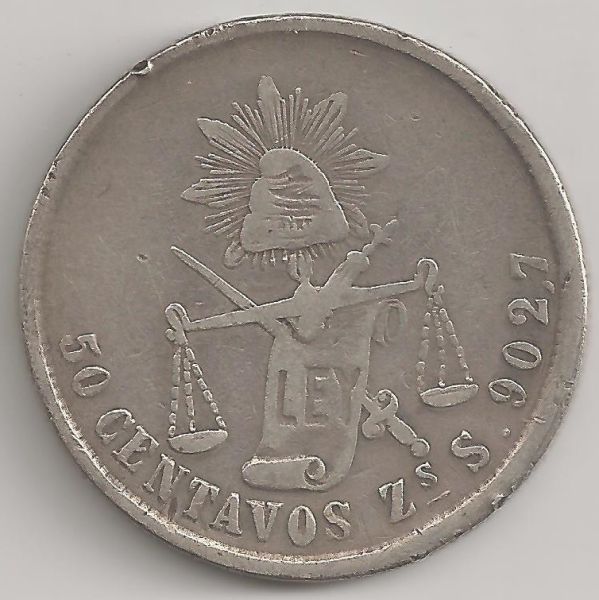 |
|
Pillar of the Community
United States
1801 Posts |
It is actually .902750, I rounded up to .9028, the mint just drops the last two digits without rounding. Many reference books round up even more to .903
One thing that made these coins so popular was the consistent fineness of the silver and the long standing "look" of the coin. When the Mexican mints changed the look in 1869 (some mints later) to the "balance peso" design (of which the coin above is a 50 centavo version) even though the silver content was the same, the fineness was expressed as 902.7, the denomination read "Un Peso" and the diameter was 2 millimeters smaller and the Chinese Market distrusted them and they were discounted up to 4% against the more familiar cap and ray 8 reales. The new design lasted only until 1973 when the 8 reales design was reinstated.
|
|
Valued Member
United States
136 Posts |
About the relation Oberse-Reverse. Last question for everybody. Then, Mexico use the United States way? FRONT TURN OVER. instead than the European way? OPEN BOOK?
|
|
Pillar of the Community
United States
1801 Posts |
The different mints in Mexico produced most of the First Republic Cap and Ray coins using what is know as "Coin Axis" where the coin when held between two fingers at 12:00 and 6:00 and rotated will show one side upside down from the other. But there are examples of using what is known as "Medal Axis" where both sides of the coin will appear right side up.
Portrait Spanish Colonial 8 Reales are almost always "Medal Axis"
|
| |
Replies: 14 / Views: 2,538 |
|







 Posted 09/05/2013 1:16 pm





