|
This page may contain links that result in small commissions to keep this free site up and running.

Welcome Guest! Registering and/or logging in will remove the anchor (bottom) ads and the security checks. It's Free!
To participate in the forum you must log in or register. | Author |
 Replies: 119 / Views: 15,049 Replies: 119 / Views: 15,049 |
|
|
|
Pillar of the Community
United States
3253 Posts |
Just to interject; to compare this contest to a "guess the price" or "college football pick 'em" is like finding a ruby in a sack of stale Cheetos. Thank you, RVFVS.
|
|
Pillar of the Community
Canada
579 Posts |
I didn't think I was going to be able to enter this smackdown but then I remembered one of my most recent purchases! The Prophet sent on of his close companions Abdullah Ibn Hudhafa as-Sahmi to the King of Persia, Khusro II, with a letter asking him to preach the religion of Islam. The letter was transmitted by Muslim historians to read: Quote:
In the name of Allah, the Beneficent, the Merciful. From Muhammad, the Messenger of Allah, to the great Kisra of Iran. Peace be upon him, who seeks truth and expresses belief in Allah and in His Prophet and testifies that there is no god but Allah and that He has no partner, and who believes that Muhammad is His servant and Prophet. Under the Command of Allah, I invite you to Him. He has sent me for the guidance of all people so that I may warn them all of His wrath and may present the unbelievers with an ultimatum. Embrace Islam so that you may remain safe. And if you refuse to accept Islam, you will be responsible for the sins of the Magi. Khusro II tore up the Prophet's letter and commanded one of his vassal rulers to dispatch two valiant men to seize Mohamet and bring the man to him. At this point Abdullah had told the Prophet how Khusro had torn his letter to pieces and Mohamet replied with 'May his kingdom tear apart'. My coin I believe comes much later than this exchange but I will enter it nonetheless. Khruso II (590-628 AD) Persia, The Sassanid Kingdom Obverse: King Khusro II wearing hat, three moons and stars in concentric rings. Reverse: Fire temple altar with 2 attendants. Concentrics rings, four moons and stars. ANoob identified this coin for me to be Year 35 (AD 626) from Nihavand in Media Mint  Awesome Smackdown FR I had never heard of this Fable before it was a truly amazing read! |
|
Pillar of the Community
 United States
3497 Posts |
The dates on Mahomet are given as AD570-632. At the age of 25 (AD 595) he married his first wife Cadijah (a wealthy widow) to whom he remained devoted for 24 years. As Gibbon puts it so much better ....
"The marriage contract, in the simple style of antiquity, recites the mutual love of Mahomet and Cadijah; describes him as the most accomplished of the tribe of Koreish; and stipulates a dowry of twelve ounces of gold and twenty camels, which was supplied by the liberality of his uncle. By this alliance, the son of Abdallah was restored to the station of his ancestors; and the judicious matron was content with his domestic virtues, till, in the fortieth year of his age, he assumed the title of a prophet, and proclaimed the religion of the Koran."
" During the twenty-four years of their marriage, her youthful husband abstained from the right of polygamy, and the pride or tenderness of the venerable matron was never insulted by the society of a rival. After her death, he placed her in the rank of the four perfect women, with the sister of Moses, the mother of Jesus, and Fatima, the best beloved of his daughters."
Mahomet "revealed" himself around AD 610 and most of the next ten years were in the slow growth of followers
"He persevered ten years in the exercise of his mission; and the religion which has overspread the East and the West advanced with a slow and painful progress within the walls of Mecca. Yet Mahomet enjoyed the satisfaction of beholding the increase of his infant congregation of Unitarians, who revered him as a prophet, and to whom he seasonably dispensed the spiritual nourishment of the Koran. The number of proselytes may be esteemed by the absence of eighty-three men and eighteen women, who retired to Aethiopia in the seventh year of his mission; and his party was fortified by the timely conversion of his uncle Hamza, and of the fierce and inflexible Omar, who signalized in the cause of Islam the same zeal, which he had exerted for its destruction. Nor was the charity of Mahomet confined to the tribe of Koreish, or the precincts of Mecca: on solemn festivals, in the days of pilgrimage, he frequented the Caaba, accosted the strangers of every tribe, and urged, both in private converse and public discourse, the belief and worship of a sole Deity. Conscious of his reason and of his weakness, he asserted the liberty of conscience, and disclaimed the use of religious violence: but he called the Arabs to repentance, and conjured them to remember the ancient idolaters of Ad and Thamud, whom the divine justice had swept away from the face of the earth."
It could possibly be AD 620 at the earliest which has him sending an emissary to the Persian King and probably several years later after the period in Medina.
Your coin is a BULLS EYE !
Edited by FVRIVS RVFVS
09/20/2013 9:38 pm
|
|
Pillar of the Community
United Kingdom
3626 Posts |
OK. Might be a bit of a stretch, but it is my only other possible coin for this contest. I am assuming that Theodocius I was still legal tender when Theo II was around. 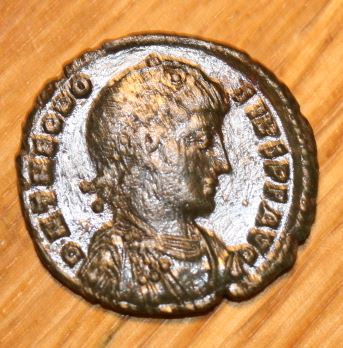 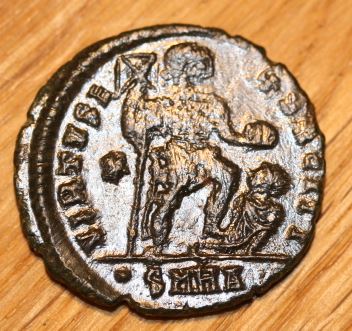 |
|
Pillar of the Community
United States
3497 Posts |
Not a stretch at all. 'Theo' II was born 6 years after the death of 'Theo the Great' and assumed office at the ripe old age of 1 ! No doubt his coins (Theo I) were preferable and still in some evidence during the 'reign' of the infant grandchild.
|
|
Pillar of the Community
United States
2480 Posts |
I tried and failed to read and understand the story due to the lack of paragraphs (it displays as one very wide run-on paragraph on my screen) and resorted to pasting it into a text editor. Glad I did! Great story, very though-provoking. Doubt I have anything to enter but I will follow along with interest. In case anyone else had the same difficulty, I screen captured that edit. 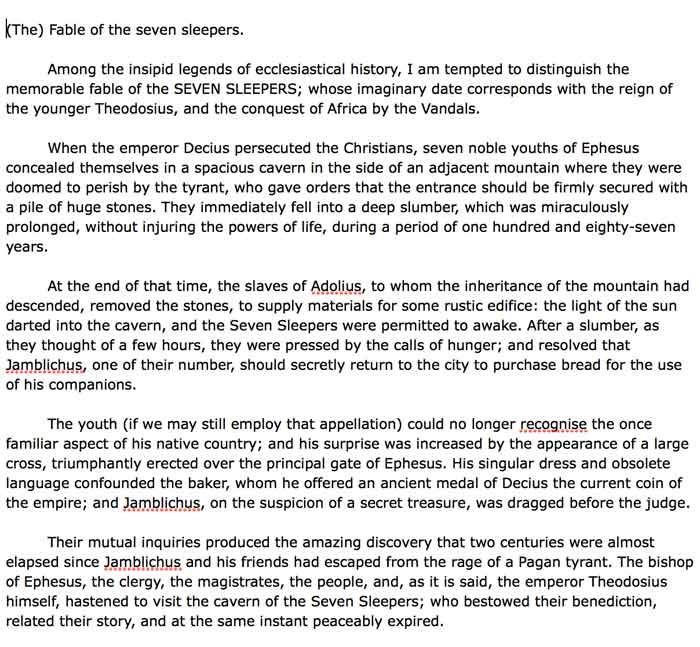 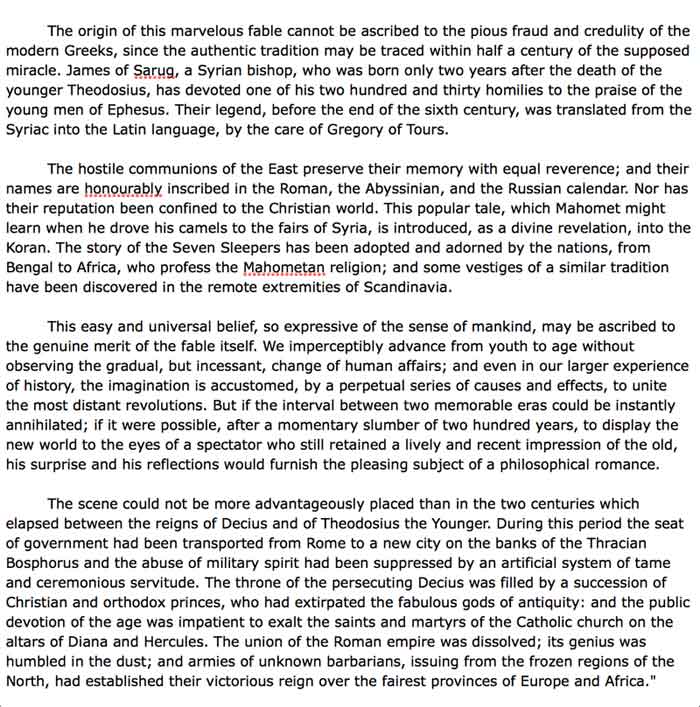 Edited by ThisIsFun
09/21/2013 08:13 am
|
|
Pillar of the Community
United States
3497 Posts |
I have read this passage more times than I can even count. Yours is far more readable than the text I used. Sir Edward was hands down the greatest writer of Roman History and a poet of the first order.
Not bad for a lad who got thrown out of Oxford University !
1776 (Volume I) was an amazing year for literature
|
|
Valued Member
Switzerland
54 Posts |
Here a Decius Antoninianus from my collection. 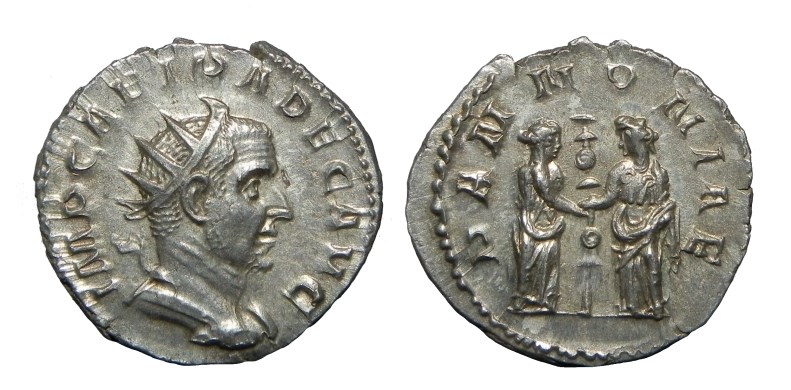 Antoninianus OV: Radiate and cuirassed bust right. Leg: IMP CAE TRA DEC AVG RV: The two Pannoniae standing right and left, clasping hands, a standard between them Leg: PANNONIAE Rome RIC 41 Regards, Victorioso |
|
Pillar of the Community
United States
3497 Posts |
Nice specimen and good candidate for a coin which might have been carried about
by any one of a group of young men circa AD 252. Like having a ten dollar bill
.... Enough to cover 'bus fare' and a quick lunch on the run. Interesting reverse too !
|
|
Pillar of the Community
United States
3497 Posts |
Many many years ago I had a Professor who 'forced' us to read hundreds of pages of 'Gibbon' for each class.
We hated it ....
Inspired by TIF reposting my quotation from The Decline and Fall
I can see that it is more favorably read as poetry.
And digested in more reasonable portions.
So during these lulls in the "competition" I will subject you to some single paragraphs of Sir Edward.
Reconfigured.
From Chapter X
"There is not, for instance, any difficulty in conceiving that the successive murders of so many emperors
had loosened all the ties of allegiance between the prince and people;
that all the generals of Philip were disposed to imitate the example of their master;
and that the caprice of armies, long since habituated to frequent and violent revolutions,
might any day raise to the throne the most obscure of their fellow-soldiers.
History can only add that the rebellion against the emperor Philip broke out in the summer
of the year two hundred and forty-nine, among the legions of Maesi;
and that a subaltern officer, named Marinus, was the object of their seditious choice.
Philip was alarmed.
He dreaded lest the treason of the Maesian army should prove the first spark of a general conflagration.
Distracted with the consciousness of his guilt and of his danger,
he communicated the intelligence to the senate.
A gloomy silence prevailed,
the effect of fear, and perhaps of disaffection:
till at length Decius, one of the assembly,
assuming a spirit worthy of his noble extraction,
ventured to discover more intrepidity than the emperor seemed to possess.
He treated the whole business with contempt, as a hasty and inconsiderate tumult,
and Philip's rival as a phantom of royalty,
who in a very few days would be destroyed by the same inconstancy that had created him.
The speedy completion of the prophecy inspired Philip with a just esteem for so able a counsellor:
and Decius appeared to him the only person capable of restoring peace and discipline to an army
whose tumultuous spirit did not immediately subside after the murder of Marinus.
Decius who long resisted his own nomination, seems to have insinuated the danger of presenting a leader
of merit to the angry and apprehensive minds of the soldiers;
and his prediction was again confirmed by the event.
The legion of Maesia forced their judge to become (A.D. 249) their accomplice.
They left him only the alternative of death or the purple.
His subsequent conduct, after that decisive measure, was unavoidable.
He conducted or followed his army to the confines of Italy, whither Philip,
collecting all his force to repel the formidable competitor whom he had raised up, advanced to meet him.
The Imperial troops were superior in number; but the rebels formed an army of veterans,
commanded by an able and experienced leader.
Philip was either killed in the battle or put to death a few days afterwards at Verona.
His son and associate in the empire was massacred at Rome by the Praetorian guards;
and the victorious Decius, with more favourable circumstances than the ambition of that age can usually plead,
was universally acknowledged by the senate and provinces.
It is reported that, immediately after his reluctant acceptance of the title of Augustus,
he had assured Philip, by a private message, of his innocence and loyalty,solemnly protesting that,
on his arrival in Italy, he would resign the imperial ornaments and return to the condition of an obedient subject.
His professions might be sincere.
But in the situation where fortune had placed him
it was scarcely possible that he could either forgive or be forgiven."
Edited by FVRIVS RVFVS
09/22/2013 1:11 pm
|
|
Pillar of the Community
United States
5155 Posts |
Coin# 1 Lifetime of Mohammed... We saw Xusro II Persian Shah during the lifetime of Mohammed so I will abstain from posting my example. In the spirit of the competition I can still post something...this guy took the prophet's letter to heart. Due to persecution from the current Arab leadership in Mecca, a number of Muslims emigrated to Axum. In response, the Arab leaders sent Amr ibn al-Aas to bring them back. Amr was a friend of Sahama, and at the same time also had good relations with Abu Sufyan, the then leader of Quraish.
Sahama did not act in a hurry but showed patience and demanded the holy scripture of Muslims to be read. At this, Ja`far ibn Abi Talib recited some verses from the Quran from the chapter of Maryam (Mary). According to Ibn Hisham, al-Najashi and the Ethiopian Orthodox priests in his court were greatly affected by the touching verses that they began to shed tears. And so, Sahama firmly denied Amr's request to be handed the Muslim refugees. The very next day, Amr tried to play a trick, in order to sow dissension between Sahama and the Muslim refugees. Amr was greatly distressed, and promised Ja`far and other Muslims that he's going to cause a great schism between them and King Sahama. Amr arrived the next day at the court of Sahama, and demanded in his presence that the Muslims make known their creed about Jesus. This was a difficult situation because Jesus is not considered as the son of God in the Qur'an, which was expected to greatly enrage a devout Christian like Emperor Sahama. To this, he explained that Jesus is considered in Islam to be a messenger of God, the word of God, and the miraculously born son of the Virgin Mary. In reply to this statement, King Sahama made a line on the sand with his mace and said, "By God, Jesus is not more than what you have described him. By God, I will never give you up to anyone." He then declared that Muslims could live in Axum for as long as they wished for. According to Muslim tradition, it is during this situation that King Sahama converted to Islam.
Some accounts state that Ashama read the Nikah at one of Muhammad's marriages.
The Sahabī Abu Huraira narrates that Muhammad announced the death of Sahama on the same day that he died, and even before any news became known about it for anyone in the city.
In a letter from Muhammad to Negus, king of Axum, Muhammad invites Negus and his men to follow his message and believe in Allah. When this letter was presented to Negus, he took the parchment and placed it on his eye, descended to the floor, confessed his faith in Islam. He then responded to Muhammad acknowledging him as the Messenger of Allâh and surrendering himself "through him to the Lord of the worlds."
Islamic scholar al-Nawawi wrote in his "Commentary on Sahih Muslim" that Imam Shafi`i and those who agree to his doctrine in fiqh see in this hadith a proof for praying in absence over a dead Muslim. There is in the hadith an evident miracle of the Prophet's due to his proclamation of the Negus's death on the same day that the latter died in Axum. There is also in the hadith the desirability of proclaiming the death of someone, but not in the pre-Islamic fashion which means to glorify and so forth.
Muhammad had asked the Negus to send Ja‘far and his companions, the emigrants to Axum, back home. They came back to see Muhammad in Khaibar. Negus later died in Rajab 9, A.H. shortly after the Ghazwa of Tabuk. Muhammad announced his death and observed prayer in absentia for him.Africa, Ethiopia Kingdom of Axum (600-631 AD) King Armah (Ashama Ibn Abjar) Gold Guilt AE Unit 20.8 mm x 2.45 grams Obverse: King Enthroned right with cross scepter. Ge'ez Legend- "King Armah" Reverse: Gilded Cross on short stem surrounded by two ears of grain. Ge'ez Legend- "Let there be joy to the people." ref: Munro - Hey 153, Hahn 72. Note: Best Known example, with clear bust of Armah. Superior to the BM example. Shortly after this coin was minted the coins of Axum disappear from the historical record. Armah was one of the last (or the last) Kings of Axum. 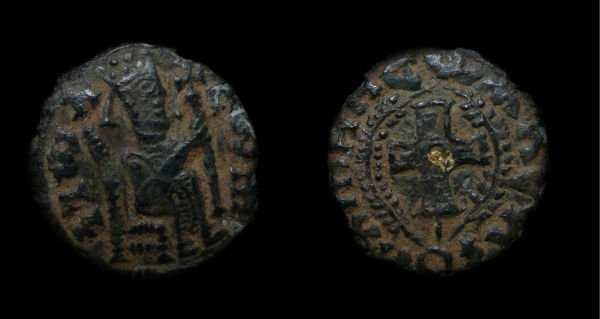 Edited by Ancientnoob
09/22/2013 09:51 am
|
|
Pillar of the Community
United States
2480 Posts |
|
|
Pillar of the Community
United States
5155 Posts |
Coin# 2 Lifetime of Mohammad. I believe this guy also got a Mohammad letter. In 629, the Islamic Prophet Muhammad had recently succeeded in unifying all of the nomadic tribes of the Arabian Peninsula. Those tribes had previously been too divided to pose a serious military threat to the Byzantines or the Persians. Now unified and animated by their new conversion to Islam, they comprised one of the most powerful states in the region. The first conflict between the Byzantines and Muslims was the Battle of Mu'tah in September 629. A small Muslim skirmishing force attacked the province of Arabia but were repulsed. Because the engagement was a Byzantine victory, there was no apparent reason to make changes to the military configuration of the region. Also, once the severity of the Muslim threat was realized, the Byzantines had little preceding battlefield experience with the Arabs, and even less with zealous soldiers united by a prophet.Even the Strategicon, a manual of war praised for the variety of enemies it covers, does not mention warfare against Arabs at any length.
The following year the Muslims launched raids into the Arabah south of Lake Tiberias, taking Al Karak. Other raids penetrated into the Negev reaching as far as Gaza.[45] Islamic sources record that Heraclius dreamt of the coming Arab invasion. Historian Al-Tabari wrote that Heraclius dreamt of a new kingdom of the "circumcised man" that would be victorious against all its enemies.[46] After telling his court his dream, his patricians, who did not know of the rise of Islam in Arabia, "advised him to send orders to behead every Jew in his dominion."
It was only when a Bedouin trader speaking of a man uniting the tribes of Arabia under a new religion was brought before the Emperor did Heraclius and his court realize that the kingdom of the "circumcised man" was not the Jews but the new Islamic Empire. When the Muslim Arabs attacked Syria and Palestine in 634, he was unable to oppose them personally in battle. Although he remained strategically in charge of operations, his generals failed him in battle. The Battle of Yarmouk in 636 resulted in a crushing defeat for the larger Byzantine army; within three years, the Levant had been lost again. By the time of Heraclius' death in Constantinople, on February 11, 641, most of Egypt had fallen as well.
Islamic view of the Emperor
In Islamic and Arab histories Heraclius is the only Roman Emperor who is discussed at any length. Owing to his role as the Roman Emperor at the time Islam emerged, he was remembered in Arabic literature, such as the Islamic hadith and sira. Outside of Islamic sources there is no evidence to suggest Heraclius ever heard of Islam,and it is possible that he and his advisors actually viewed the Muslims as some special sect of Jews.
In Surah 30, the Qur'an refers to the Perso-Roman wars as follows:
30:2 Certainly, the Romans will be defeated. 3 In the nearest land. After their defeat, they will rise again and win. 4 Within several years. Such is GOD's decision, both in the first prophecy, and the second. On that day, the believers shall rejoice 5 in GOD's victory. He grants victory to whomever He wills. He is the Almighty, Most Merciful.
The Swahili Utendi wa Tambuka, an epic poem composed in 1728 at Pate Island (off the shore of present-day Kenya) and depicting the wars between the Muslims and Byzantines from the former's point of view, is also known as Kyuo kya Hereḳali ("The book of Heraclius"). In that work, Heraclius is portrayed as declining the Prophet's command to renounce his false belief in Christianity; he is therefore defeated by the Muslim forces.
This reflects the considerable impression which this Emperor made on his Muslim foes, being still prominently remembered by Muslims more than a millennium after his death and at a considerable geographical and cultural distance.
In Muslim tradition he is seen as a just ruler of great piety, who had direct contact with the emerging Islamic forces. The 14th century scholar Ibn Kathir (d. 1373) went even further stating that "Heraclius was one of the wisest men and among the most resolute, shrewd, deep and opinionated of kings. He ruled the Romans with great leadership and splendor." Historians such as Nadia Maria El-Cheikh and Lawrence Conrad note that Islamic histories even go so far as claiming that Heraclius recognized Muhammad as the true prophet and proclaimed him the messenger of God. Later however, when he told his people to turn to Islam and they rioted, he claimed this was just to test their faith.
Islamic historians often cite a letter that they claim Heraclius wrote to Muhammad: "I have received your letter with your ambassador and I testify that you are the messenger of God found in our New Testament. Jesus, son of Mary, announced you." According to the Muslim sources reported by El-Cheikh, he tried to convert the ruling class of the Empire, but they resisted so strongly that he reversed his course and claimed that he was just testing their faith in Christianity. El-Cheikh notes that these accounts of Heraclius add "little to our historical knowledge" of the emperor; rather, they are an important part of "Islamic kerygma," attempting to legitimate Muhammad's status as a prophet.Byzantine Empire Constantinople Heraclius (610-641 AD) AR Hexagram 22.0 mm x 6.23 grams Obverse:Heraclius and Heraclius Constantine seated facing on double throne, both holding gl.cr., cross above.dd NN hERACLIYS ET hERA CONST Reverse: Cross potent set on globe set on three steps, K to right.-DEYS ADIYTA ROmANIS ref: Sear 795 Note: Made from confiscated church plate. All Byzantine Silver is rare, silver coinage was largely monopolized by Sassanid Persia. 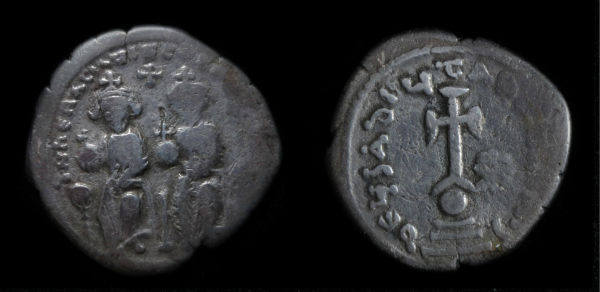 Edited by Ancientnoob
09/22/2013 12:51 pm
|
|
Pillar of the Community
United States
5155 Posts |
Hey FR- "The marriage contract, in the simple style of antiquity, recites the mutual love of Mahomet and Cadijah; describes him as the most accomplished of the tribe of Koreish; and stipulates a dowry of twelve ounces of gold and twenty camels."  I had to laugh when I read this, all I could think of was a stack of coins and a pack of smokes.... |
|
Pillar of the Community
United States
3497 Posts |
And my wife thinks I can suck all the air out of a room !  Excellent coins |
| |
Replies: 119 / Views: 15,049 |
To participate in the forum you must log in or register.
Disclaimer: While a tremendous amount of effort goes into ensuring the accuracy of the information contained in this site, Coin Community assumes no liability for errors. Copyright 2005 - 2026 Coin Community Family- all rights reserved worldwide. Use of any images or content on this website without prior written permission of Coin Community or the original lender is strictly prohibited.
Contact Us | Advertise Here | Privacy Policy / Terms of Use
|
| Coin Community Forum |
© 2005 - 2026 Coin Community Forums |
| It took 0.47 seconds to rattle this change. |
 |
|
| |
| |







 First Page


 Posted 09/20/2013 8:54 pm


