Rather than attempt an inadequate retelling I will let the Master himself tell it.
From The Decline and Fall of the Roman Empire Chapter XXXIII
Quote:
(The) Fable of the seven sleepers.
"Among the insipid legends of ecclesiastical history, I am tempted to distinguish the memorable fable of the SEVEN SLEEPERS; whose imaginary date corresponds with the reign of the younger Theodosius, and the conquest of Africa by the Vandals. When the emperor Decius persecuted the Christians, seven noble youths of Ephesus concealed themselves in a spacious cavern in the side of an adjacent mountain where they were doomed to perish by the tyrant, who gave orders that the entrance should be firmly secured with a pile of huge stones. They immediately fell into a deep slumber, which was miraculously prolonged, without injuring the powers of life, during a period of one hundred and eighty-seven years. At the end of that time, the slaves of Adolius, to whom the inheritance of the mountain had descended, removed the stones, to supply materials for some rustic edifice: the light of the sun darted into the cavern, and the Seven Sleepers were permitted to awake. After a slumber, as they thought of a few hours, they were pressed by the calls of hunger; and resolved that Jamblichus, one of their number, should secretly return to the city to purchase bread for the use of his companions. The youth (if we may still employ that appellation) could no longer recognise the once familiar aspect of his native country; and his surprise was increased by the appearance of a large cross, triumphantly erected over the principal gate of Ephesus. His singular dress and obsolete language confounded the baker, whom he offered an ancient medal of Decius the current coin of the empire; and Jamblichus, on the suspicion of a secret treasure, was dragged before the judge. Their mutual inquiries produced the amazing discovery that two centuries were almost elapsed since Jamblichus and his friends had escaped from the rage of a Pagan tyrant. The bishop of Ephesus, the clergy, the magistrates, the people, and, as it is said, the emperor Theodosius himself, hastened to visit the cavern of the Seven Sleepers; who bestowed their benediction, related their story, and at the same instant peaceably expired. The origin of this marvellous fable cannot be ascribed to the pious fraud and credulity of the modern Greeks, since the authentic tradition may be traced within half a century of the supposed miracle. James of Sarug, a Syrian bishop, who was born only two years after the death of the younger Theodosius, has devoted one of his two hundred and thirty homilies to the praise of the young men of Ephesus. Their legend, before the end of the sixth century, was translated from the Syriac into the Latin language, by the care of Gregory of Tours. The hostile communions of the East preserve their memory with equal reverence; and their names are honourably inscribed in the Roman, the Abyssinian, and the Russian calendar. Nor has their reputation been confined to the Christian world. This popular tale, which Mahomet might learn when he drove his camels to the fairs of Syria, is introduced, as a divine revelation, into the Koran. The story of the Seven Sleepers has been adopted and adorned by the nations, from Bengal to Africa, who profess the Mahometan religion; and some vestiges of a similar tradition have been discovered in the remote extremities of Scandinavia. This easy and universal belief, so expressive of the sense of mankind, may be ascribed to the genuine merit of the fable itself. We imperceptibly advance from youth to age without observing the gradual, but incessant, change of human affairs; and even in our larger experience of history, the imagination is accustomed, by a perpetual series of causes and effects, to unite the most distant revolutions. But if the interval between two memorable eras could be instantly annihilated; if it were possible, after a momentary slumber of two hundred years, to display the new world to the eyes of a spectator who still retained a lively and recent impression of the old, his surprise and his reflections would furnish the pleasing subject of a philosophical romance. The scene could not be more advantageously placed than in the two centuries which elapsed between the reigns of Decius and of Theodosius the Younger. During this period the seat of government had been transported from Rome to a new city on the banks of the Thracian Bosphorus and the abuse of military spirit had been suppressed by an artificial system of tame and ceremonious servitude. The throne of the persecuting Decius was filled by a succession of Christian and orthodox princes, who had extirpated the fabulous gods of antiquity: and the public devotion of the age was impatient to exalt the saints and martyrs of the Catholic church on the altars of Diana and Hercules. The union of the Roman empire was dissolved; its genius was humbled in the dust; and armies of unknown barbarians, issuing from the frozen regions of the North, had established their victorious reign over the fairest provinces of Europe and Africa."
History is full of the stories of Fable Myth and Legend. Generally these tales are firmly anchored to "A long long time ago" or the ever present "Once upon a time". But this tale as told (beginning in the 5th Century) is fixed to a definite time and place. Two possible explanations are that either the story is 'accurate' (a devout Moslem need believe this as the tale is incorporated in the Qur'an) or it is telling us something which was obvious to almost everyone in the 5th Century.
Times had changed !
The sleepers themselves noticed this immediately upon seeing the city of Ephesus. The people of Ephesus noted the unusual style of dress of the sleepers as well as their peculiar manner of speaking. After over 200 years of 'foriegn' immigration the common usage probably had incorporated many new terms while others were slowly altered with the passing of generations. Being set in Ephesus the language would of course be Greek.
The baker who sold Jamblichus the bread noticed immediately the coin with which he was paid. It was silver ..... real silver with the portrait of Decius.
We ourselves if handed a few silver dollars in exchange for bread would no doubt consider ourselves fortunate and the payer a fool. We might even offer a second loaf ..... half price ! In this case the vendor called the police.
The Imperial tax collectors had long demanded payment in 'real' money and would not accept the coin which circulated despite having been issued under the authority of the State. One would believe that any old coins would have been ordered recalled to be replaced with the new 'funny money' and the penalties for non compliance were probably severe in the least ! The author of the tale might also have used either Diocletian or Galerius (two famous persecutors of the early Church) as the originator of this series of events but they were not remembered for the silver they minted. Apparently Decius was (and one of the last too). The magistrate although unnamed by Gibbon may well have been named Adolphus (Adolf) rather than the customary Maximus of an earlier time ..... or even something that might sound like 'Diabetes' to our modern ear.
The world had changed ...... and everybody knew it.
That "Mahomet" would know the story well is not surprising either. Arabia had long been the place of exile for many who fled the various times of religious upheaval that were common at the time. Jews who fled from Titus and Hadrian and Christians who fled the religious upheavals which were common at the time (Arianism Donatism etc.) formed a large portion of the 'urban' population of both Mecca and Medina. The rather incomplete retelling in the Qur'an indicates to me that the 'faithful' were already familiar with many of the details.
Back to the subject at hand ......
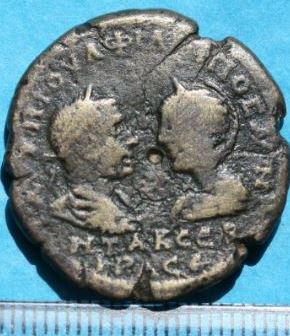
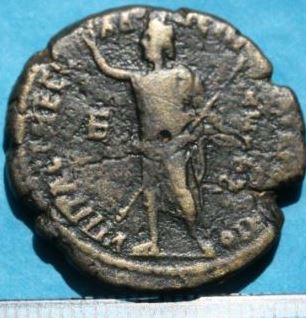
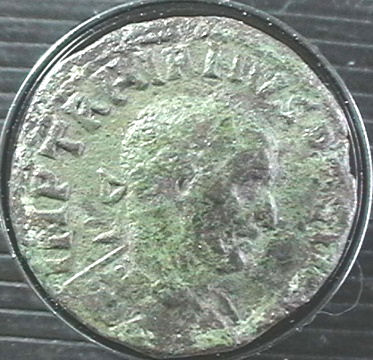
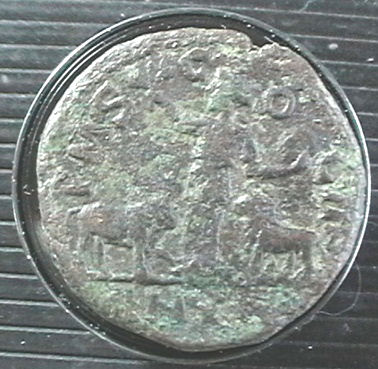
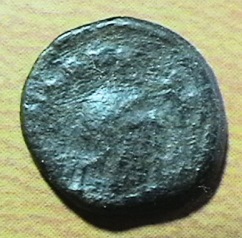
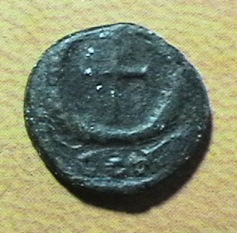
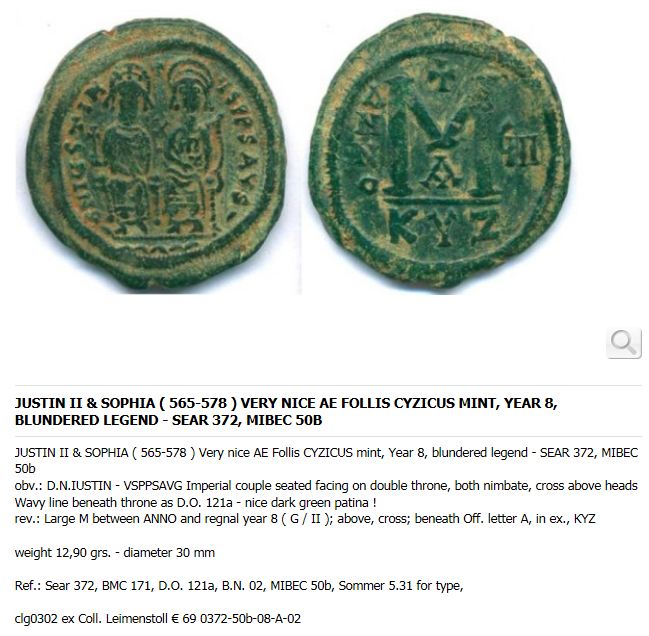
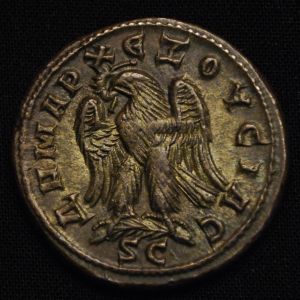
Enter two coins which would be likely to be current during the reign of Decius (and thus carried by the sleepers)or of the reign of Theodosius II (thus present in the shoppe of the baker) or the lifetime of the Prophet 'Mahomet' (AD 570-632) and thus familiar to the faithful who no doubt recognized the difference in their own coin from those of a long vanished past. To be generous an Islamic coin dating from the century after Mohamet which seeks to copy in style the ancients issues of the Greek East is very acceptable !
Silver Tetradrachm of Trajan Decius Antioch Mint
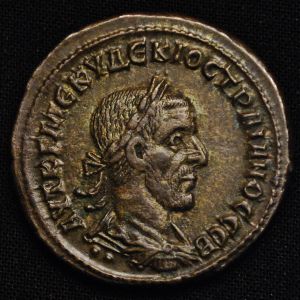
Rules are the same as last Smackdown IV and entries will end 6PM EST next Friday 9-27.
I will myself provide some small token of Victory to the top 3 winners (nothing as glorious as the Probus Ant. but I will do my best to make them interesting)
And before I forget !
The Dwellers of the Cave
From the Holy Qur'an in translation
[18:9] Why else do you think we are telling you about the people of the cave, and the numbers connected with them? They are among our wondrous signs.
[18:10] When the youths took refuge in the cave, they said, "Our Lord, shower us with Your mercy, and bless our affairs with Your guidance."
[18:11] We then sealed their ears in the cave for a predetermined number of years.
[18:12] Then we resurrected them to see which of the two parties could count the duration of their stay therein.
[18:13] We narrate to you their history, truthfully. They were youths who believed in their Lord, and we increased their guidance.
[18:14] We strengthened their hearts when they stood up and proclaimed: "Our only Lord is the Lord of the heavens and the earth. We will never worship any other god beside Him. Otherwise, we would be far astray.
[18:15] "Here are our people setting up gods beside Him. If only they could provide any proof to support their stand! Who is more evil than the one who fabricates lies and attributes them to GOD?
[18:16] "Since you wish to avoid them, and their worshiping of other than GOD,* let us take refuge in the cave. May your Lord shower you with His mercy and direct you to the right decision."
[18:17] You could see the sun when it rose coming from the right side of their cave, and when it set, it shone on them from the left, as they slept in the hollow thereof. This is one of GOD's portents.* Whomever GOD guides is the truly guided one, and whomever He sends astray, you will not find for him a guiding teacher.
[18:18] You would think that they were awake, when they were in fact asleep. We turned them to the right side and the left side, while their dog stretched his arms in their midst. Had you looked at them, you would have fled from them, stricken with terror.
[18:19] When we resurrected them, they asked each other, "How long have you been here?" "We have been here one day or part of the day," they answered. "Your Lord knows best how long we stayed here, so let us send one of us with this money to the city. Let him fetch the cleanest food, and buy some for us. Let him keep a low profile, and attract no attention.
[18:20] "If they discover you, they will stone you, or force you to revert to their religion, then you can never succeed."
[18:21] We caused them to be discovered, to let everyone know that GOD's promise is true, and to remove all doubt concerning the end of the world.* The people then disputed among themselves regarding them. Some said, "Let us build a building around them." Their Lord is the best knower about them. Those who prevailed said, "We will build a place of worship around them."
[18:22] Some would say, "They were three; their dog being the fourth," while others would say, "Five; the sixth being their dog," as they guessed. Others said, "Seven," and the eighth was their dog. Say, "My Lord is the best knower of their number." Only a few knew the correct number. Therefore, do not argue with them; just go along with them. You need not consult anyone about this.










 Posted 09/20/2013 11:26 am