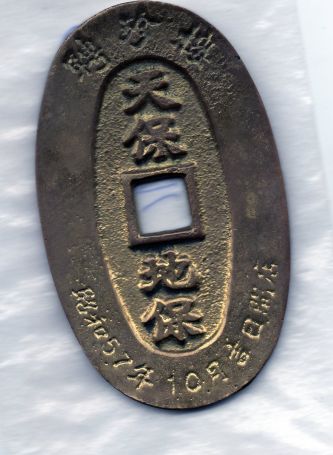
The inscription above and below the square hole on the obverse side (first image) is
tian bao di bao (天保地保) which translates as "protection from heaven and earth".
This is an inscription that appears on
this type of Chinese charm.
However, this Chinese charm is usually considered to be based on the oval-shaped
Japanese "Tempo Tsuho" coin which had a similar inscription (
tian bao tong bao 天保e€š宝) and which was minted in Japan beginning in 1835.
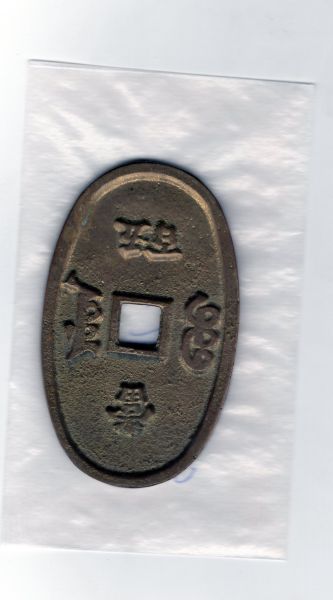
Also, this Chinese charm has a reverse side that is very different from that of the Japanese coin, as can be seen in the images.
The reverse side of the OP's piece states that the denomination is "Value 500" (å½"äº"百).
Additionally, the Manchu characters state that the coin was cast at the Board of Works mint. Manchu characters were used by the Manchus that ruled China during the Qing Dynasty (1644-1911). While I do not collect Japanese coins/charms, I have never seen Manchu characters used on any coin or charm from Japan.
The OP's "coin" therefore appears to be Chinese.
But, that is probably not correct because the incused inscription at the bottom of the obverse side gives a date of the 10th Month of Showa 57th Year. Showa refers to the reign (1926-1989) of the Showa Emperor of Japan who was also known as Hirohito. The 57th year would be 1982 and the date engraved on the coin is therefore October, 1982.
The year and the month are written in Arabic numerals. The day, however, appears to be written in Chinese (Kanji). It is difficult to make out from the image but the character appears to be
ji (吉) which means "lucky" or "auspicious".
This could make sense because the "auspicious day" in October, 1982 refers to the "grand opening" of a store or business. The last two Chinese characters in the incused inscription are
kai dian (e-‹店) which means "opening for business", "opening a store or new building", etc.
As to what business, the name of the store or company is written at the top of the obverse side.
Unfortunately, the image is not clear enough for me to read. The name is written left-to-right. The last character looks like
lou (楼) which means "building" although I am not certain. I cannot make out the first two characters.
So, this "coin" resembles an old Japanese coin and a Chinese charm but isn't either.
I would characterize it as a souvenir that was given out at the opening of a business or the dedication of a building in Japan. It was probably a novelty item produced in Japan (or imported from China) that had the name of the company and the date added. The owner of the business, for reasons we do not know, apparently felt that it was suitable as a give-away item at the dedication ceremony.
That's my best guess! Others may have a different opinion.
(Please note that the software on this forum does not print certain Chinese characters. Also, I have used Chinese pronunciation throughout. The pronunciation of Kanji characters will be different.)
Gary












 Posted 10/27/2013 11:40 pm


 I would've never figured that out


